Recommended resources
The freely available resources this lesson will direct you to.
Welcome back. In our previous lesson, we completed the year-end closing process by preparing the journal entries to close all temporary revenue and expense accounts. We saw how the Moroccan accounting system uses the Class 8 accounts in a "cascade" to calculate the net result and transfer it to the balance sheet's equity section.
This brings us to the final step of the entire accounting cycle. In this lesson, we will learn how to prepare the final trial balance after closing. This report is the definitive confirmation that the books for the period are closed and balanced, ready for the new year to begin.
Think of it as the final checkpoint. After a full year of recording transactions, making adjustments, and closing the books, this step ensures that the fundamental accounting equation remains in balance and provides the starting figures for the next accounting period.
1. Defining the Post-Closing Trial Balance
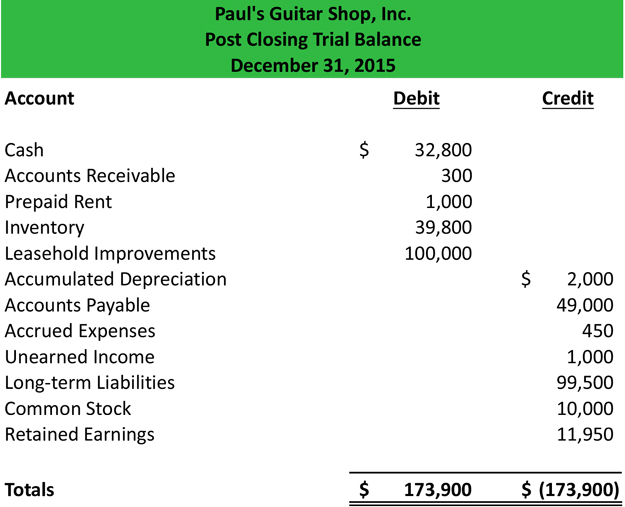
A Post-Closing Trial Balance (in French, Balance de clôture or Balance après inventaire) is a list of all permanent accounts and their balances at the end of an accounting period, after the closing journal entries have been recorded and posted.
Its primary purposes are:
- To verify that total debits equal total credits for all remaining accounts.
- To confirm that all temporary accounts (revenues, expenses - Classes 6 & 7) and intermediate result accounts (Class 8) have a zero balance.
Essentially, it lists only the balance sheet accounts—Assets, Liabilities, and Equity (Classes 1 through 5).
To start, let's get a concise overview of this concept.
How to Prepare Closing Entries and Prepare a Post Closing Trial Balance
The following video from Wiley provides a clear definition of the post-closing trial balance and distinguishes between temporary and permanent accounts, which is the foundation for this topic.
Please watch from the beginning until 1:40. Focus on understanding which accounts are included in a post-closing trial balance and why.
The key takeaway is that the post-closing trial balance contains only permanent accounts. Their balances are carried forward to become the opening balances for the next financial year.
2. From Adjusted Trial Balance to Post-Closing Trial Balance
Throughout the accounting cycle, we encounter different types of trial balances. It is crucial to understand their sequence and purpose:
- Unadjusted Trial Balance: Prepared before adjusting entries. It lists all accounts (permanent and temporary) to check debit/credit equality after initial transaction recording.
- Adjusted Trial Balance: Prepared after adjusting entries but before closing entries. This is the version we used in the previous lesson to calculate income tax and start the closing process. It contains all accounts with their updated balances.
- Post-Closing Trial Balance: Prepared after closing entries. It contains only permanent accounts.
The video below visually demonstrates the transformation from an adjusted trial balance to a post-closing trial balance.
CLOSING ENTRIES: Everything You Need To Know
This video from Accounting Stuff will help you visualize the difference. You'll see an adjusted trial balance full of accounts, and then see the clean post-closing trial balance after the closing process.
Please watch the segment from 4:14 to 5:48, and then from 11:15 to 11:38. Pay attention to how the temporary 'R-E-D' (Revenue, Expenses, Dividends) accounts present in the adjusted trial balance disappear in the post-closing trial balance.
3. The Preparation Steps
The process of preparing a post-closing trial balance is straightforward and methodical. It follows directly from the work we did in the last lesson.
What Is A Post-Closing Trial Balance?
The following article from BILL clearly outlines the steps involved and some common errors to avoid. It provides a good summary of the practical 'how-to'.
Read the sections titled 'How to prepare a post closing trial balance' and 'Common challenges and errors to watch out for'. This will give you a clear, step-by-step procedure and help you develop a professional's mindset for avoiding mistakes.
Let's apply these steps using the simplified example from our previous lesson. After all closing entries, our general ledger would look something like this for the key accounts:
Ventes de marchandises (7111): Balance = 0Achats de marchandises (6111): Balance = 0Rémunérations du personnel (6171): Balance = 0Résultat net de l'exercice (1191): Balance = 196,000 (Credit)- All other balance sheet accounts (e.g.,
Capital social,Banques,Clients,Fournisseurs) retain their balances.
To prepare the post-closing trial balance:
- Identify the permanent accounts: This includes all accounts in Classes 1, 2, 3, 4, and 5.
- List their final balances: We take the ending balance for each of these accounts from the general ledger. The equity section will now include the new balance for
1191 - Résultat net de l'exercice. - Format the report: Create a list with account numbers, names, and two columns for debit and credit balances.
- Verify equality: Sum both columns. The totals must match perfectly.
Here is a demonstration of how to construct the report using a new set of data.
How to Prepare Closing Entries and Prepare a Post Closing Trial Balance
This clip from the Wiley video walks through the creation of a post-closing trial balance from a given set of account balances after closing entries.
Watch the segment from 3:14 to 4:07. Observe how the narrator lists only the permanent accounts and their final balances to build the post-closing trial balance.
4. Moroccan Context: Closing and Reopening the Books
In Moroccan practice, the preparation of the Balance de clôture is the final step before officially closing the books. These final balances then become the opening balances for the new fiscal year. The OFPPT resource we used previously has a section dedicated to this final procedure.
This section of the professional training manual explains the final closing of accounts and their reopening for the next period, which is the ultimate purpose of the post-closing trial balance.
Please read sections IV- Clôture des comptes and V- REOUVERTURE DES COMPTES (pages 76-77 of the PDF). Focus on understanding the logic: the closing balances of one year become the opening balances of the next.
As the document explains, the journal entry to "close" the balance sheet accounts is a technical step where all debit-balance accounts are credited and all credit-balance accounts are debited. Then, on January 1st of the new year, a "reopening" entry is made that is the exact reverse, re-establishing the opening balances.
In modern accounting software, this closing/reopening process is often automated. However, understanding the manual logic is crucial for a confirmed accountant. The post-closing trial balance is the report that summarizes the data used for these final closing and reopening entries.
Test your understanding!
Below is a list of accounts and their final balances for "Services Pro SARL" on December 31, 2023, after all closing entries have been posted.
| Account No. | Account Name | Final Balance |
|---|---|---|
| 1111 | Capital social | 100,000 (Credit) |
| 1191 | Résultat net de l'exercice | 35,000 (Credit) |
| 2340 | Matériel de transport | 80,000 (Debit) |
| 2834 | Amort. matériel de transport | 20,000 (Credit) |
| 3421 | Clients et comptes rattachés | 40,000 (Debit) |
| 4411 | Fournisseurs et comptes rattachés | 15,000 (Credit) |
| 5141 | Banques, trésorerie générale | 50,000 (Debit) |
| 6111 | Achats de marchandises | 0 |
| 7111 | Ventes de marchandises | 0 |
From this list, prepare the Post-Closing Trial Balance for Services Pro SARL as of December 31, 2023.
Show answer
First, we identify the permanent accounts (Classes 1-5). The temporary accounts (6111 and 7111) with zero balances are excluded.
Services Pro SARL
Balance de Clôture au 31/12/2023
| N° Compte | Libellé | Débit | Crédit |
|---|---|---|---|
| 1111 | Capital social | 100,000 | |
| 1191 | Résultat net de l'exercice | 35,000 | |
| 2340 | Matériel de transport | 80,000 | |
| 2834 | Amort. matériel de transport | 20,000 | |
| 3421 | Clients et comptes rattachés | 40,000 | |
| 4411 | Fournisseurs et comptes rattachés | 15,000 | |
| 5141 | Banques, trésorerie générale | 50,000 | |
| TOTAL | 170,000 | 170,000 |
The total debits equal the total credits, confirming the books are balanced.
Conclusion
Congratulations, you have now covered every step of the fundamental accounting cycle, from recording the first transaction to preparing the final report of the year.
Key Takeaways:
- The post-closing trial balance is the final report in the accounting cycle.
- It lists only permanent accounts (Assets, Liabilities, Equity) and their final balances.
- Its primary purpose is to verify that debits equal credits after all temporary accounts have been closed to zero.
- In the Moroccan context, this
Balance de clôtureprovides the figures for the closing entry of one year and the reopening entry of the next.
Preview of the Next Module:
This lesson concludes our module on "End-of-Period Closing and Review Procedures." We are now perfectly positioned to start the next module, "Financial Statements and Analysis." Our very first lesson will be on preparing the Moroccan Income Statement (Compte de Produits et Charges - CPC). You will see how the temporary accounts we just learned to close are the building blocks of this critical financial statement.