Recommended resources
The freely available resources this lesson will direct you to.
Welcome to Module 11: Advanced Financial Reporting and IFRS Introduction.
In our previous module, we concluded the full accounting cycle by preparing the post-closing trial balance. This finalized the accounting records for the period, leaving us with a balanced and accurate balance sheet. Now, we shift our focus from recording and closing to analyzing and interpreting. A confirmed accountant doesn't just produce financial statements; they understand the story the numbers tell.
This lesson introduces three fundamental indicators used to analyze a company's financial health: Working Capital (Fonds de Roulement - FR), Working Capital Requirement (Besoin en Fonds de Roulement - BFR), and Net Cash Position (Trésorerie Nette - TN). By the end of this 60-minute lesson, you will be able to define and calculate these three key figures, which are essential for assessing the financial equilibrium of any business, particularly in the Moroccan SME context.
1. The Functional Balance Sheet: A Tool for Analysis
To understand a company's financial structure, we can't just look at the standard accounting balance sheet. We need to rearrange it into a Functional Balance sheet (Bilan Fonctionnel). This approach reorganizes assets and liabilities based on their function or purpose within the company's operating, investment, and financing cycles.
The core idea is to see how a company finances its different activities. A healthy company should finance its long-term investments with long-term resources. The functional balance sheet makes this analysis possible.
Analyse de la structure financière : Le bilan fonctionnel
To begin, let's understand the concept of the functional balance sheet and why it's the primary tool for this type of analysis. This document introduces its structure and objectives.
Read the first two parts of the document: 'Le concept du bilan fonctionnel' and 'L’analyse de la structure du bilan fonctionnel'. Focus on how it regroups assets and liabilities into four main categories (emplois stables, ressources stables, etc.) and how this structure is designed to calculate the FR, BFR, and TN.
The functional balance sheet provides the framework for calculating our three key indicators. The following diagram gives a clear visual representation of how they relate to each other.
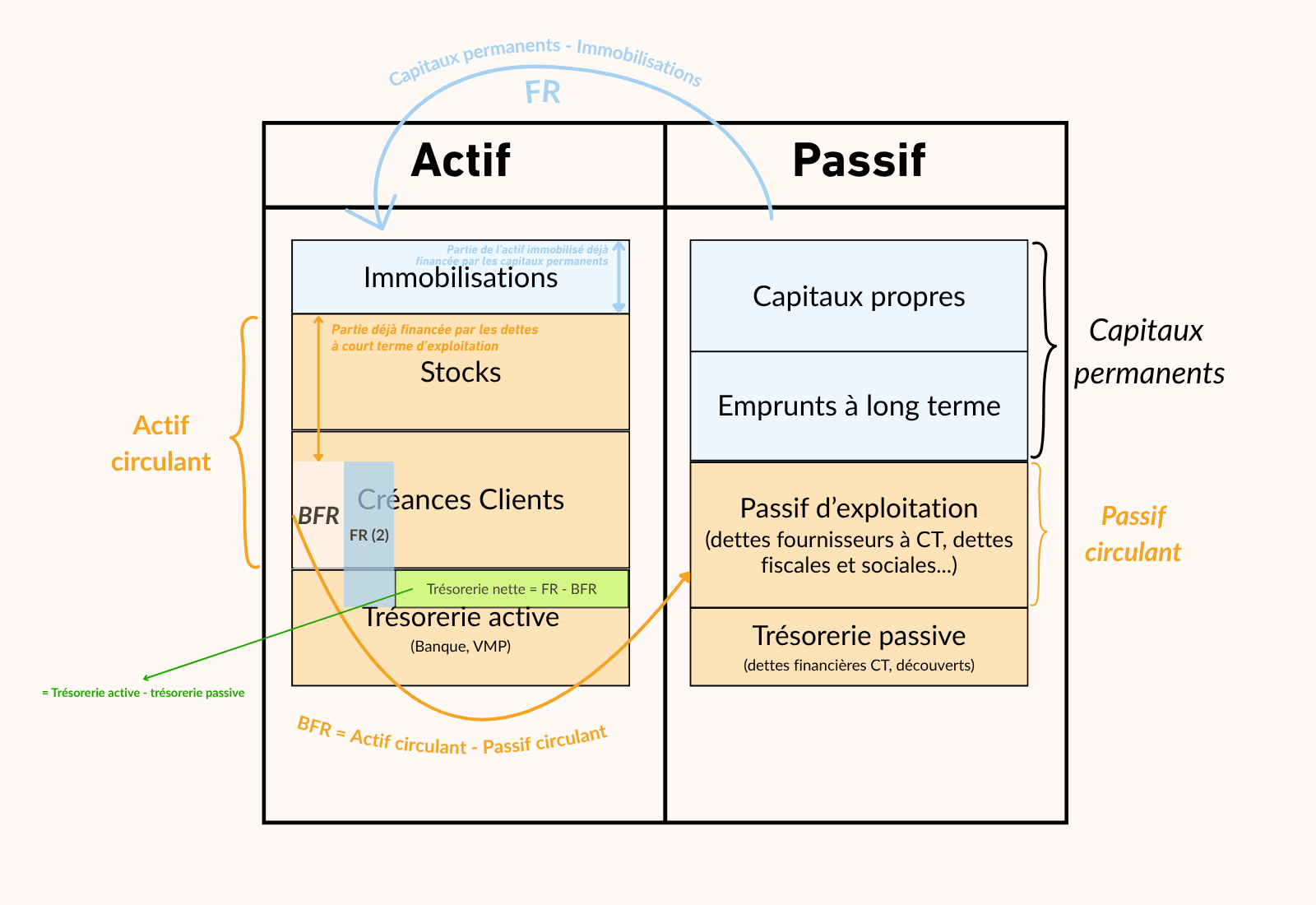
2. Defining and Calculating the Key Indicators
Now, let's break down each indicator. We will explore what it represents, how to calculate it, and what its value signifies.
Analyse de la structure financière : Le bilan fonctionnel
The following sections of the same document provide precise definitions and formulas for our three key indicators. We will study this section carefully as it forms the theoretical core of our lesson.
Read section 3. L’analyse des équilibres fonctionnels du bilan. Pay close attention to the sub-sections on 'Le fonds de roulement net global', 'Le besoin en fonds de roulement' (including the distinction between BFRE and BFRHE), and 'La trésorerie nette'. Note the two different ways to calculate the Trésorerie Nette.
Let's summarize these crucial concepts.
a) Fonds de Roulement Net Global (FRNG) - Working Capital
- Concept: The FRNG represents the portion of long-term resources (equity + long-term debt) that a company has left over after financing all its long-term assets (immobilisations). It acts as a financial safety cushion to help fund the day-to-day operating cycle.
- Formula (from the top of the balance sheet):
(Where
Ressources stables=Capitaux Propres+Amortissements et Provisions+Dettes de financement > 1 an) - Interpretation:
- FRNG > 0 (Positive): The company's long-term resources are sufficient to cover its long-term investments, with a surplus remaining. This is a sign of good financial health.
- FRNG < 0 (Negative): The company has to use short-term debt to finance a portion of its long-term assets. This is a precarious and risky situation.
b) Besoin en Fonds de Roulement (BFR) - Working Capital Requirement
- Concept: The BFR is the amount of cash a company needs to finance its operating cycle. This need arises from the time lag between paying suppliers for goods/services and receiving payment from customers.
- Formula:
The BFR is often split into two parts:
- BFR d'Exploitation (BFRE): Related to the main operating cycle (Stocks +
Créances clients-Dettes fournisseurs). This is the structural part of the BFR. - BFR Hors Exploitation (BFRHE): Related to non-operating activities (e.g.,
créances sur cessions d'immobilisations,dettes fiscales sur l'IS).
- BFR d'Exploitation (BFRE): Related to the main operating cycle (Stocks +
- Interpretation:
- BFR > 0 (Positive): The company needs external financing for its operating cycle. This is typical for most industrial and commercial businesses.
- BFR < 0 (Negative): The operating cycle generates cash. This happens when customers pay before the company has to pay its suppliers (e.g., supermarkets, where customers pay immediately but suppliers are paid after 30 or 60 days).
c) Trésorerie Nette (TN) - Net Cash Position
- Concept: The TN is the company's final cash position resulting from the interplay between its financing structure (FRNG) and its operating needs (BFR). It shows whether the company has a cash surplus or deficit.
- Formulas: There are two ways to calculate it, which must give the same result. This is an excellent way to check your calculations.
- From FRNG and BFR (top-down):
- From treasury accounts (bottom-up):
- Interpretation:
- TN > 0 (Positive): The company has a cash surplus after financing its investments and operations. The
Fonds de Roulementis greater than theBesoin en Fonds de Roulement. - TN < 0 (Negative): The company has a cash deficit and must rely on short-term bank loans (
crédits de trésorerie,découverts) to meet its obligations. TheFonds de Roulementis insufficient to cover theBesoin en Fonds de Roulement.
- TN > 0 (Positive): The company has a cash surplus after financing its investments and operations. The
This summary image provides a helpful quick reference.

3. Practical Application: A Moroccan SME Example
Let's apply these concepts to a simplified functional balance sheet for a Moroccan SME, "ALPHA SARL". The values are given in thousands of MAD.
| ACTIF FONCTIONNEL | Amount | PASSIF FONCTIONNEL | Amount |
|---|---|---|---|
| ACTIF IMMOBILISÉ (brut) | 1,500 | RESSOURCES STABLES | 1,800 |
| Capitaux Propres | 1,000 | ||
| Amort. & Provisions | 400 | ||
| Dettes financières (>1 an) | 400 | ||
| ACTIF CIRCULANT (H.T.) | 800 | PASSIF CIRCULANT (H.T.) | 550 |
| Stocks | 300 | Dettes fournisseurs | 450 |
| Créances clients | 500 | Dettes fiscales & sociales | 100 |
| TRÉSORERIE ACTIF | 50 | TRÉSORERIE PASSIF | 100 |
| TOTAL ACTIF | 2,350 | TOTAL PASSIF | 2,450 |
Note: For a functional balance sheet, assets are at gross value, and the accumulated depreciation (Amortissements et Provisions) is moved to the Ressources Stables. The totals will not match the accounting balance sheet. Our goal here is analysis, not accounting proof.
Let's calculate the three indicators for ALPHA SARL.
1. Calculate the Fonds de Roulement Net Global (FRNG):
Interpretation: ALPHA SARL has a positive FRNG of 300. Its long-term resources are sufficient to finance its fixed assets and leave a safety cushion of 300 to finance its operations.
2. Calculate the Besoin en Fonds de Roulement (BFR):
Interpretation: The company needs 250 to finance its operating cycle. This is a financing requirement.
3. Calculate the Trésorerie Nette (TN):
- Method 1: Top-down
- Method 2: Bottom-up
Wait, the results don't match! Let's re-check the example. Ah, this is a common pitfall. The functional balance sheet must balance. Let's adjust the example to be correct. Let's say Total Actif and Total Passif are both 2,450. Then Trésorerie Actif would be 150. Let's re-run with correct numbers.
Corrected Example for ALPHA SARL:
| ACTIF FONCTIONNEL | Amount | PASSIF FONCTIONNEL | Amount |
|---|---|---|---|
| ACTIF IMMOBILISÉ (brut) | 1,500 | RESSOURCES STABLES | 1,800 |
| ACTIF CIRCULANT (H.T.) | 800 | PASSIF CIRCULANT (H.T.) | 550 |
| TRÉSORERIE ACTIF | 150 | TRÉSORERIE PASSIF | 100 |
| TOTAL | 2,450 | TOTAL | 2,450 |
Re-calculating the Trésorerie Nette (TN):
- Method 1: Top-down
- Method 2: Bottom-up
The results now match perfectly.
Final Interpretation: ALPHA SARL's safety cushion (FRNG = 300) is more than enough to cover its operational financing needs (BFR = 250), leaving it with a positive net cash position of 50. The company is in a balanced and healthy financial situation.
Test your understanding!
Here is the simplified functional balance sheet for "BETA SARL" (in thousands of MAD). Calculate its FRNG, BFR, and TN (using both methods) and provide a brief interpretation of its financial situation.
| ACTIF FONCTIONNEL | Amount | PASSIF FONCTIONNEL | Amount |
|---|---|---|---|
| ACTIF IMMOBILISÉ (brut) | 2,000 | RESSOURCES STABLES | 2,100 |
| ACTIF CIRCULANT (H.T.) | 1,200 | PASSIF CIRCULANT (H.T.) | 900 |
| TRÉSORERIE ACTIF | 50 | TRÉSORERIE PASSIF | 250 |
| TOTAL | 3,250 | TOTAL | 3,250 |
Show answer
1. Fonds de Roulement Net Global (FRNG):
2. Besoin en Fonds de Roulement (BFR):
3. Trésorerie Nette (TN):
- Method 1:
TN = FRNG - BFR = 100 - 300 = \mathbf{-200} - Method 2:
TN = Trésorerie Actif - Trésorerie Passif = 50 - 250 = \mathbf{-200}
Interpretation:
BETA SARL has a positive Fonds de Roulement of 100, which is good. However, its operating cycle requires 300 of financing (Besoin en Fonds de Roulement). The FRNG is not large enough to cover this need. As a result, the company has a negative net cash position of 200, meaning it must rely on 200 of short-term bank financing (Trésorerie Passif) to fund its daily operations. The situation is imbalanced and needs attention.
Conclusion
In this lesson, we have moved beyond bookkeeping into the realm of financial analysis. You have learned to define and calculate the three pillars of financial equilibrium analysis from the functional balance sheet.
Key Takeaways:
- Fonds de Roulement (FRNG): The financial safety margin. Calculated as
Ressources Stables - Actif Immobilisé. A positive FRNG is essential for stability. - Besoin en Fonds de Roulement (BFR): The financing need of the operating cycle. Calculated as
Actif Circulant (H.T.) - Passif Circulant (H.T.). - Trésorerie Nette (TN): The resulting cash surplus or deficit. It must satisfy the equation
TN = FRNG - BFR, which also equalsTrésorerie Actif - Trésorerie Passif.
Understanding these indicators is a critical skill for any accountant who aims to provide valuable insights to management.
Preview of the Next Lesson:
Now that you can calculate these indicators from a given functional balance sheet, our next lesson will focus on how to analyze a company's financial equilibrium more deeply. We will learn the detailed steps to construct a complete functional balance sheet from a standard Moroccan accounting balance sheet, performing all the necessary reclassifications. This will enable you to conduct this powerful analysis on any company's financial statements.