Recommended resources
The freely available resources this lesson will direct you to.
Welcome back. In our previous lesson, we defined the three fundamental indicators of financial equilibrium: Fonds de Roulement Net Global (FRNG), Besoin en Fonds de Roulement (BFR), and Trésorerie Nette (TN). You learned how to calculate them from a pre-prepared functional balance sheet and understood the core relationship: TN = FRNG - BFR.
Today, we move from calculation to diagnosis. A confirmed accountant must not only compute these figures but also interpret them to assess a company's financial health. This lesson will equip you to do just that. We will cover two key steps:
- Constructing a functional balance sheet from a standard accounting balance sheet, performing the necessary reclassifications (
retraitements). - Analyzing the results to diagnose the company's financial equilibrium and identify potential structural weaknesses.
By the end of this lesson, you will be able to take a standard Moroccan balance sheet, transform it into a powerful analytical tool, and use it to form a professional judgment on the company's financial stability.
1. From Accounting Balance Sheet to Functional Balance Sheet
The standard balance sheet (Bilan Comptable) is a legal document. To analyze financial structure, we need the functional balance sheet (Bilan Fonctionnel). This involves reclassifying items based on their economic function within the company's cycles: investment, financing, and exploitation (operating).
The main goal is to adhere to a key principle of sound financial management: long-term assets should be financed by long-term resources.
To make this transition, several adjustments, known as retraitements, are necessary.
Analyse de la structure financière : Le bilan fonctionnel
To understand these adjustments, let's study the section of a technical document that details the process. This will provide the theoretical foundation for building a functional balance sheet.
Please read section II - Le concept du bilan fonctionnel, focusing on part 2- Les retraitements fonctionnels du bilan comptable. Pay close attention to the treatment of: Assets at their gross value (valeurs brutes). Amortissements et provisions (Depreciation and provisions). Crédit-bail (Leasing). Écarts de conversion (Foreign exchange differences).
Let's summarize the most critical reclassifications you will encounter:
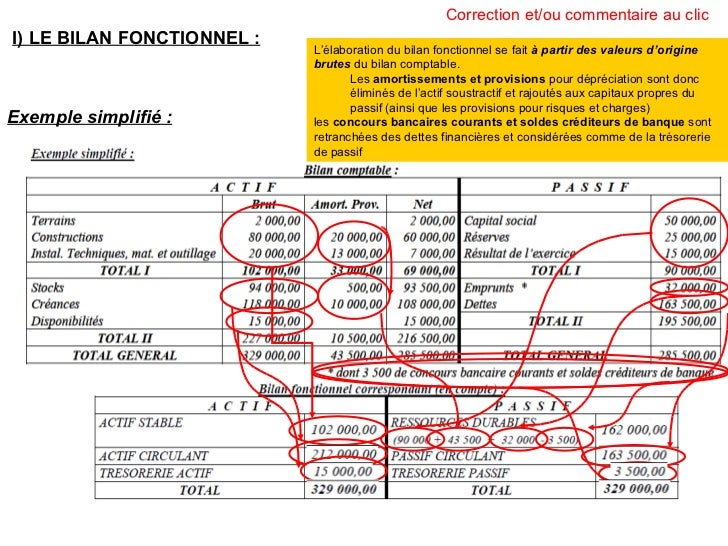
- Assets at Gross Value: In the functional balance sheet, all assets (
immobilisations, stocks, etc.) are stated at their original acquisition cost (valeur brute). This is because we want to see the total value of assets the company must finance, regardless of their accounting depreciation. - Depreciation and Provisions (
Amortissements et Provisions): Since assets are shown at gross value, their corresponding accumulated depreciation and provisions are removed from the asset side. They are then added to theRessources Stables(Stable Resources) on the passive side. Why? Because they represent resources generated internally by the company that have been retained—a form of self-financing (autofinancement). - Leasing (
Crédit-bail): A company might use assets it doesn't legally own (e.g., a leased building or vehicle fleet). While not on the accounting balance sheet, these are critical to the company's operations. For a true economic picture, we must:- Add the original value of the leased asset to the
Actif Immobilisé(Stable Assets). - Add the corresponding financial obligation to the
Dettes de financement(Financial Debt).
- Add the original value of the leased asset to the
- Distinguishing Operating vs. Non-Operating Items: It is crucial to separate current assets and liabilities into
d'exploitation(operating) andhors exploitation(non-operating).- Operating (
d'Exploitation): Items directly related to the core business cycle (e.g., inventory, trade receivables/créances clients, trade payables/dettes fournisseurs). - Non-Operating (
Hors Exploitation): Items not related to the core cycle (e.g., receivables from the sale of a fixed asset, corporate tax liabilities/dettes sur IS).
- Operating (
This diagram visually summarizes the transformation from the accounting view to the functional view.
2. Analyzing Financial Equilibrium
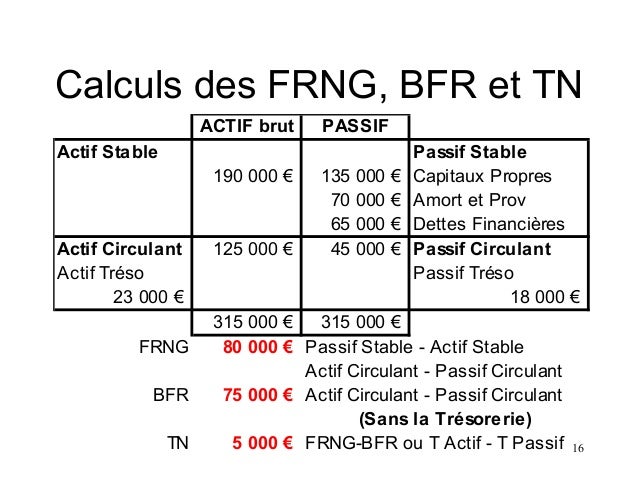
Once the functional balance sheet is prepared, we can calculate FRNG, BFR (now split into BFRE and BFRHE), and TN. The real analysis, however, lies in comparing these indicators.
The golden rule of financial equilibrium states that an enterprise's structural financing needs must be covered by its stable resources. In practical terms:
The
Fonds de Roulement Net Global(FRNG) should be sufficient to finance theBesoin en Fonds de Roulement d'Exploitation(BFRE).
The BFRE is a permanent, structural need for financing tied to the operating cycle. It is logical and safe to fund this permanent need with the surplus of permanent resources (the FRNG).
Analyse de la structure financière : Le bilan fonctionnel
Let's deepen our understanding of how to interpret these indicators. The following section of our reference document explains how to analyze the equilibrium and describes various possible financial situations.
In the document you've already opened, please read part 3. L’analyse des équilibres fonctionnels du bilan. Focus specifically on Encadré 1 : l’analyse des équilibres fonctionnels and Encadré 2 : Les situations reflétant l'équilibre fonctionnel. These boxes provide concise rules for interpretation.
Let's break down the main scenarios for a company with a positive BFR (which is the most common case):
-
Healthy Situation:
FRNG > BFR- This results in a positive Net Cash position (
TN > 0). - The company's long-term financial structure is solid. The safety cushion (FRNG) is large enough to cover the operational financing needs (BFR) and still generate a cash surplus.
- This is the ideal situation, indicating financial stability and autonomy.
- This results in a positive Net Cash position (
-
Risky Situation:
0 < FRNG < BFR- This results in a negative Net Cash position (
TN < 0). - The company has a positive FRNG, which is good, but it's insufficient to cover the BFR.
- The company is forced to finance a portion of its permanent operating needs with short-term bank loans (
concours bancaires,découverts). This creates financial risk and dependency on banks. This is a very common situation in SMEs that requires careful management.
- This results in a negative Net Cash position (
-
Very Dangerous Situation:
FRNG < 0- This will always result in a negative Net Cash position (
TN < 0). - This is a sign of major structural weakness. Not only are short-term resources financing the operating cycle, but they are also financing a part of the company's long-term assets (
immobilisations). The company is highly vulnerable.
- This will always result in a negative Net Cash position (
The diagram below shows the flow of calculations and the relationships that lead to the final Net Cash position.
3. Application: Identifying Reclassifications
Let's test your ability to apply these concepts. Below is the setup for the "CAS MALEC" from the document we have been studying. You don't need to do all the calculations. Your task is to identify the necessary retraitements based on the provided information.
Context: MALEC S.A. is an industrial company. You are given its balance sheets and the following "informations diverses":
- The corporate tax rate (IS) is 30%.
- A
crédit-bail(leasing) for industrial equipment worth 20,000 KDH was started in N-1 for 5 years. - The provisions for risks (
provisions pour risques) are not justified. - The
écarts de conversion actifare related to bank loans. - The
écarts de conversion passifare related to trade receivables (créances clients).
Test your understanding!
Based on the information above and what you've learned, describe the main retraitements (reclassifications) you would need to perform on MALEC's accounting balance sheet to build its functional balance sheet. For each point, briefly state what you would do and why.
Show answer
Here are the key reclassifications required for "CAS MALEC":
-
General Principle: First, all assets on the balance sheet would be re-stated at their gross value (
valeur brute). The accumulated depreciation and provisions (Amortissements & Provisions) would be moved from the asset side and added to theRessources Stablesin the passive section. This reflects the self-financing capacity of the firm. -
Crédit-Bail (Leasing):
- What: Add 20,000 KDH to
Actif Immobilisé(specifically under "ITMO" or similar) and add a corresponding debt of 20,000 KDH toDettes de financement. - Why: To reflect the economic reality that the company uses this asset for its operations, creating a long-term financing obligation, even if it's not legally owned.
- What: Add 20,000 KDH to
-
Provisions for Risks (
Provisions pour risques):- What: Since they are "not justified," they behave like hidden reserves. The amount (net of tax) should be reclassified from
Provisions durablestoCapitaux Propres(as part ofRessources Stables). The corresponding potential tax liability (30% of the provision amount) should be moved toDettes hors exploitation. - Why: Unjustified provisions are not true liabilities. They are a form of retained earnings, so they belong with equity. However, if they are reversed, they will be taxed, creating a future tax debt.
- What: Since they are "not justified," they behave like hidden reserves. The amount (net of tax) should be reclassified from
-
Écarts de Conversion (FX Differences):
- What: These accounts must be eliminated to show the original value of the debts and receivables. The
écart de conversion actif(a latent loss) on bank loans would be removed from assets and used to adjust the value of theDettes de financement. Theécart de conversion passif(a latent gain) oncréances clientswould be removed from liabilities and used to adjust the value of thecréances clients. - Why: The functional analysis aims to work with original, stable values, neutralizing temporary fluctuations from currency exchange rates at the closing date.
- What: These accounts must be eliminated to show the original value of the debts and receivables. The
By performing these steps, we transform the legal balance sheet into a functional one, ready for a meaningful analysis of its financial equilibrium.
Conclusion
In this lesson, you have made a significant leap from calculation to analysis. You now understand the methodology and reasoning behind the construction of the functional balance sheet and, more importantly, how to use it to diagnose a company's financial health.
Key Takeaways:
- The functional balance sheet is built by applying specific reclassifications (
retraitements) to the accounting balance sheet, most notably using gross asset values, re-integrating depreciation into resources, and accounting for off-balance sheet items like leasing. - A thorough financial analysis hinges on comparing the
Fonds de Roulement Net Global(FRNG) to theBesoin en Fonds de Roulement(BFR). - A healthy company ensures its
FRNGis large enough to cover its structural operating needs (BFRE), resulting in a positive or stableTrésorerie Nette. A shortfall (FRNG < BFRE) indicates a structural weakness financed by risky short-term debt.
Preview of the Next Lesson:
Having explored an advanced analysis technique under Moroccan GAAP, we will now broaden our perspective. The next lesson begins our progressive introduction to International Financial Reporting Standards (IFRS). We will discuss the purpose of IFRS, its global importance, and the key conceptual differences between the IFRS framework and the Moroccan accounting principles you have learned so far.