Recommended resources
The freely available resources this lesson will direct you to.
Welcome back. In our previous lesson, we completed a crucial year-end task by calculating and recording the Corporate Income Tax (IS) expense. This was the final adjusting entry, meaning all of our revenue and expense accounts for the fiscal year are now complete and reflect their final balances.
This brings us to the next logical step in the accounting cycle: closing the books. Today's lesson will focus on how to prepare the journal entries to close revenue and expense accounts and transfer the net result to equity.
The purpose of these "closing entries" is twofold:
- To reset all temporary accounts (revenues and expenses) to zero, preparing them for the next accounting period.
- To formally transfer the year's net profit or loss, which we have carefully calculated, from the income statement to the balance sheet's equity section.
By the end of this lesson, you will understand the principles behind closing entries and be able to perform them according to the Moroccan Plan Comptable Général.
1. The "Why": Temporary vs. Permanent Accounts
Before we can close any accounts, we must understand the fundamental difference between two types of accounts:
-
Permanent Accounts: These are the balance sheet accounts (Assets, Liabilities, and Equity - Classes 1 to 5). Their balances are not closed at year-end. Instead, they are carried forward to become the opening balances for the next accounting period. For example, the cash balance on December 31st is the same cash balance on January 1st.
-
Temporary Accounts: These are the income statement accounts (Expenses/
Charges- Class 6, and Revenues/Produits- Class 7). Their purpose is to measure financial performance over a specific period (e.g., one year). To measure the next year's performance accurately, we must start with a clean slate. Therefore, these accounts must be reset to zero at the end of each period.
To get a clear explanation of this concept and an overview of the closing process, please watch the first part of the following video.
CLOSING ENTRIES: Everything You Need To Know
This video from Accounting Stuff provides an excellent introduction to closing entries, explaining the difference between temporary and permanent accounts and the overall purpose of the process.
Please watch from the beginning until 2:46. Focus on understanding why revenue, expense, and dividend accounts are considered 'temporary' and need to be reset to zero.
2. The Closing Process: A Conceptual Framework
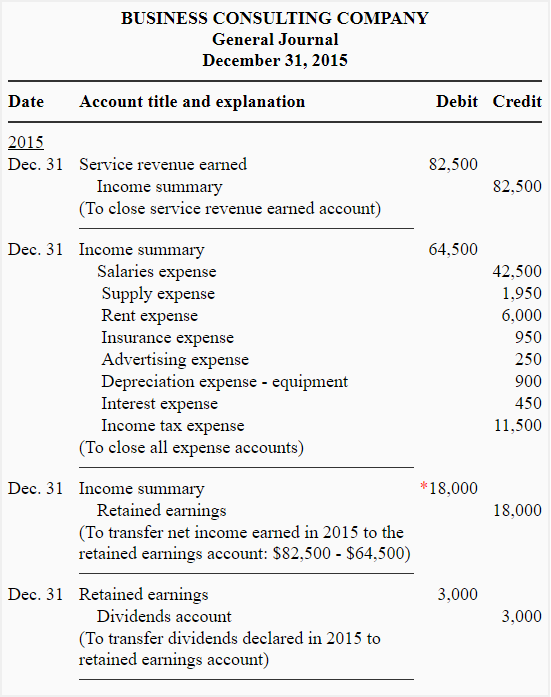
In international accounting standards (like US GAAP), the closing process is often simplified by using a temporary holding account called Income Summary. The process generally follows four steps:
- Close Revenue Accounts: Debit each revenue account for its balance and credit the total to
Income Summary. - Close Expense Accounts: Credit each expense account for its balance and debit the total to
Income Summary. - Close Income Summary: The balance in
Income Summarynow equals the net income (or loss). This balance is then closed toRetained Earnings(an equity account). - Close Dividends: The Dividends account (or Withdrawals) is closed directly to
Retained Earnings.
The image below shows a clear example of these four journal entries.
This four-step method provides a solid conceptual foundation. However, the Moroccan accounting system uses a more detailed and structured approach.
3. The Moroccan Method: Closing via Class 8 Accounts
The Plan Comptable Général Marocain (PCGM) does not use a single Income Summary account. Instead, it uses a series of "result accounts" from Class 8 to determine the net result in a cascading manner. This process mirrors the structure of the Moroccan income statement, the Compte de Produits et Charges (CPC).
This "cascade" method provides a clear audit trail of how the final net profit was calculated directly within the general ledger.
To understand this method, let's first look at an overview of the process.

The core idea is to close different categories of revenues and expenses into specific Class 8 accounts, which are then consolidated.
The key document below from OFPPT, a professional training institution in Morocco, details this procedure. We will follow its logic.
This document outlines the year-end closing procedures according to Moroccan standards. We will focus on the section explaining the determination of the net result.
Please review the section titled 'II- ECRITURES DE DETERMINATION DU RESUTAT' (on page 74 of the PDF). Do not worry about memorizing it; focus on grasping the 'cascade' logic: closing operating accounts to 8100, financial accounts to 8300, and so on.
A Practical Example
Let's apply this method to a simplified adjusted trial balance for "SME Services SARL" as of December 31, 2023.
| Account No. | Account Name | Debit | Credit |
|---|---|---|---|
| 7111 | Ventes de marchandises | 800,000 | |
| 7381 | Intérêts et produits assimilés | 10,000 | |
| 6111 | Achats de marchandises | 350,000 | |
| 6171 | Rémunérations du personnel | 200,000 | |
| 6311 | Intérêts des emprunts et dettes | 15,000 | |
| 6701 | Impôts sur les bénéfices | 49,000 |
We will now perform the closing entries step-by-step.
Step 1: Close Operating Accounts (Classe 6 & Classe 7) to 8100 - Résultat d'exploitation
First, we close the operating revenue account.
| Date | Account No. | Account Name | Debit | Credit |
|---|---|---|---|---|
| 31/12/23 | 7111 | Ventes de marchandises | 800,000 | |
| 8100 | Résultat d'exploitation | 800,000 | ||
| Clôture du compte de produits d'exploitation |
Next, we close all operating expense accounts.
| Date | Account No. | Account Name | Debit | Credit |
|---|---|---|---|---|
| 31/12/23 | 8100 | Résultat d'exploitation | 550,000 | |
| 6111 | Achats de marchandises | 350,000 | ||
| 6171 | Rémunérations du personnel | 200,000 | ||
| Clôture des comptes de charges d'exploitation |
At this point, the balance of account
8100is800,000 (Cr) - 550,000 (Dr) = 250,000 (Cr). This is the Operating Profit.
Step 2: Close Financial Accounts to 8300 - Résultat financier
| Date | Account No. | Account Name | Debit | Credit |
|---|---|---|---|---|
| 31/12/23 | 7381 | Intérêts et produits assimilés | 10,000 | |
| 8300 | Résultat financier | 10,000 | ||
| Clôture du compte de produits financiers |
| Date | Account No. | Account Name | Debit | Credit |
|---|---|---|---|---|
| 31/12/23 | 8300 | Résultat financier | 15,000 | |
| 6311 | Intérêts des emprunts et dettes | 15,000 | ||
| Clôture du compte de charges financières |
The balance of account
8300is10,000 (Cr) - 15,000 (Dr) = 5,000 (Dr). This is the Financial Loss.
Step 3: Consolidate Results into 8890 - Résultat net de l'exercice
Now, we transfer the intermediate results and the tax expense to a final summary account to find the net result.
| Date | Account No. | Account Name | Debit | Credit |
|---|---|---|---|---|
| 31/12/23 | 8100 | Résultat d'exploitation | 250,000 | |
| 8890 | Résultat net de l'exercice | 250,000 | ||
| Virement du résultat d'exploitation | ||||
| 31/12/23 | 8890 | Résultat net de l'exercice | 5,000 | |
| 8300 | Résultat financier | 5,000 | ||
| Virement du résultat financier | ||||
| 31/12/23 | 8890 | Résultat net de l'exercice | 49,000 | |
| 6701 | Impôts sur les bénéfices | 49,000 | ||
| Virement de l'impôt sur les bénéfices |
The balance of account
8890is250,000 (Cr) - 5,000 (Dr) - 49,000 (Dr) = 196,000 (Cr). This is the Net Profit for the year.
Step 4: Close the Final Result to Equity
The final step is to move this net profit into the balance sheet. Since it's a profit, we use account 1191.
| Date | Account No. | Account Name | Debit | Credit |
|---|---|---|---|---|
| 31/12/23 | 8890 | Résultat net de l'exercice | 196,000 | |
| 1191 | Résultat net de l'exercice (bénéfice) | 196,000 | ||
| Affectation du résultat net de l'exercice |
After these entries, all accounts in Class 6, 7, and 8 have a balance of zero. The net result of the year's operations is now correctly recorded in the company's equity.
Test your understanding!
Given the following accounts from an adjusted trial balance:
7121 - Ventes de biens produits au Maroc: 150,000 (Credit)6121 - Achats de matières premières: 40,000 (Debit)6131 - Entretien et réparations: 10,000 (Debit)
Prepare the journal entries required to close these operating accounts to the 8100 - Résultat d'exploitation account.
Show answer
Entry 1: Close the revenue account
| Date | Account No. | Account Name | Debit | Credit |
|---|---|---|---|---|
| 31/12/N | 7121 | Ventes de biens produits au Maroc | 150,000 | |
| 8100 | Résultat d'exploitation | 150,000 | ||
| Clôture du compte de produits |
Entry 2: Close the expense accounts
| Date | Account No. | Account Name | Debit | Credit |
|---|---|---|---|---|
| 31/12/N | 8100 | Résultat d'exploitation | 50,000 | |
| 6121 | Achats de matières premières | 40,000 | ||
| 6131 | Entretien et réparations | 10,000 | ||
| Clôture des comptes de charges |
After these entries, the operating profit of 100,000 DH (150,000 - 50,000) would sit as a credit balance in account 8100, ready for the next step of the cascade.
Conclusion
Today, you have learned one of the final and most important procedural steps in the accounting cycle. Mastering closing entries is essential for ensuring the integrity of financial data from one year to the next.
Key Takeaways:
- Closing entries are necessary to reset temporary accounts (revenues and expenses) to zero for the next accounting period.
- The net profit or loss for the period is transferred from the temporary accounts to a permanent equity account (
Retained EarningsorRésultat net de l'exercice). - The Moroccan
Plan Comptableuses a structured "cascade" of Class 8 accounts to close the books, which provides a clear calculation of the results in stages (d'exploitation,financier, etc.). - After these entries are posted, all Class 6, 7, and 8 accounts will have a zero balance.
Preview of the Next Lesson:
With all temporary accounts closed, the only accounts left with balances are the permanent, balance sheet accounts (Assets, Liabilities, and Equity). Our next and final step in this module will be to prepare the final trial balance after closing. This report confirms that debits still equal credits and serves as the official starting point for the new fiscal year.