Welcome back to our module on year-end closing procedures. In the previous lesson, we finalized the depreciation schedule, which allowed us to record the depreciation expense for the year. This was a crucial step in determining the company's operating profit.
Today, we will tackle the final major expense to be recorded before closing the books: Corporate Income Tax, known in Morocco as l'Impôt sur les Sociétés (IS). This lesson directly addresses the learning outcome: Prepare the year-end journal entries to record the Corporate Income Tax (IS) expense.
Calculating and recording income tax is a bridge between accounting and taxation. It requires us to use the accounting profit we've been carefully calculating and apply fiscal rules to determine the tax expense. This is one of the most critical responsibilities of an accountant during the closing period.
By the end of this lesson, you will understand the complete accounting cycle for Corporate Income Tax, from the advance payments made during the year to the final calculation and journal entry at year-end.
1. The Two-Step Process of Accounting for Corporate Tax
Accounting for Corporate Income Tax (IS) is not a single action at the end of the year. It's a process that unfolds in two main stages:
- During the Fiscal Year: The company makes four advance payments (
acomptes provisionnels) to the state based on the previous year's tax. This is a "pay-as-you-go" system. - At Year-End Closing: The company calculates the actual tax due for the current year (
impôt exigible). This amount is recorded as an expense, and the advance payments are then deducted to determine the final balance to be paid or the credit to be carried forward.
The diagram below illustrates this two-step logic. We will break down each part.

2. Stage 1: Recording Advance Payments (Acomptes)
Throughout the year, a company is required to make four quarterly prepayments of its estimated income tax. These are called acomptes provisionnels. Each acompte is recorded as a receivable from the state, because the company is essentially giving the government money in advance of the final tax bill.
The correct account to use for this prepayment is a current asset account: 3453 - Acomptes sur impôts sur les résultats.
Each time an acompte is paid, the journal entry is:
| Date | Account No. | Account Name | Debit | Credit |
|---|---|---|---|---|
| 31/03/N | 3453 | Acomptes sur impôts sur les résultats | Amount Paid | |
| 5141 | Banque | Amount Paid | ||
| Paiement 1er acompte IS exercice N |
This entry is repeated for each of the four payments (due by March 31, June 30, September 30, and December 31). By the end of the year, the balance in account 3453 will represent the total tax prepaid for the year.
3. Stage 2: Calculating and Recording the Final Tax (Impôt Exigible)
At the end of the fiscal year, after all other revenues and expenses have been recorded, you can determine the accounting profit before tax (résultat comptable avant impôt). However, tax is not calculated on this figure directly. It is calculated on the taxable profit (résultat fiscal).
As we covered in Module 7, the formula is:Résultat Fiscal = Résultat Comptable + Réintégrations - Déductions
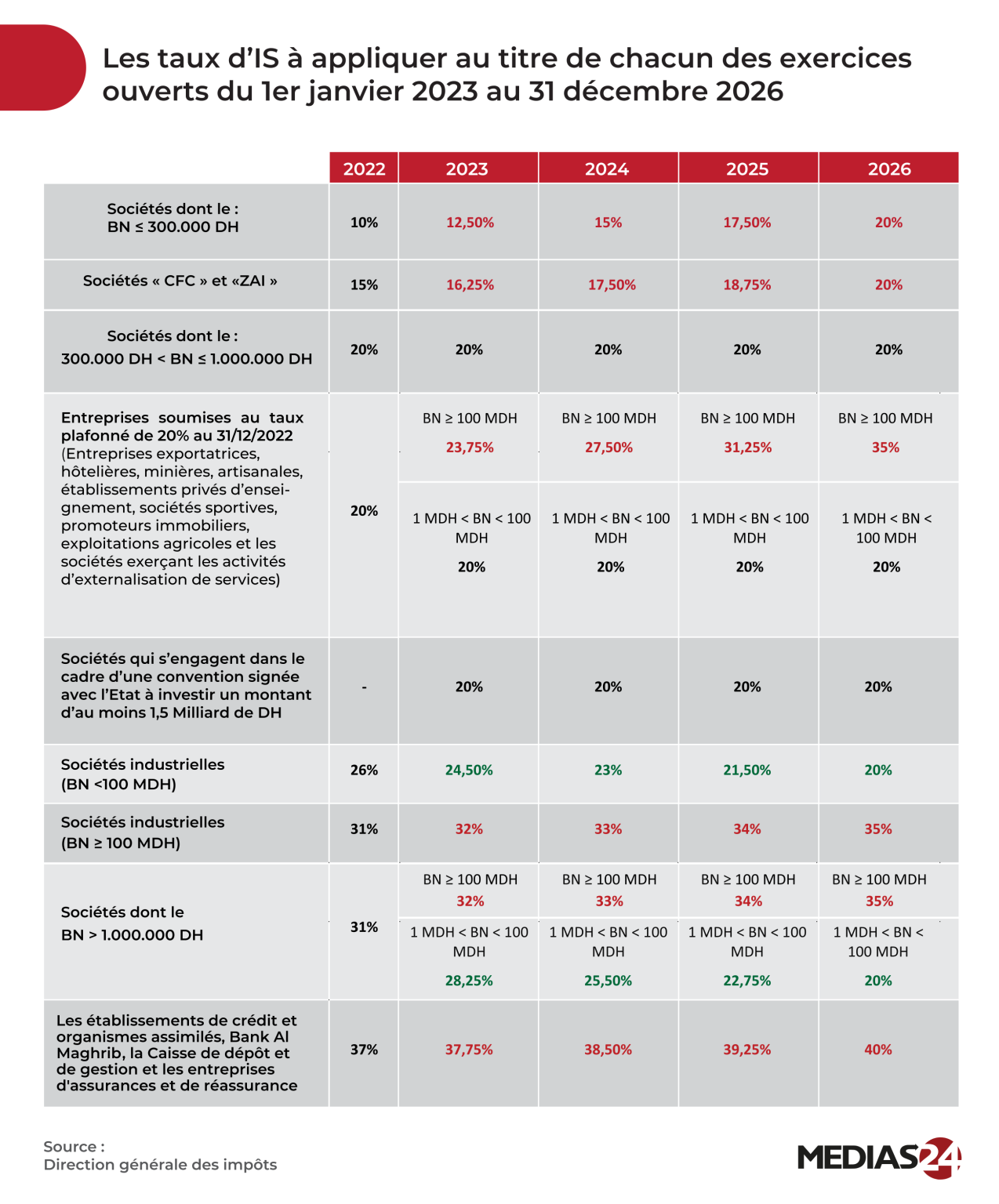
Once the résultat fiscal is determined, you apply the appropriate corporate income tax rate. These rates are progressive in Morocco.
The image below shows the official IS rates for 2023-2026. For our purposes, we will focus on the standard progressive scale for companies with a net profit of up to 100 million DH.
Example Calculation:
Let's assume "ALPHA Services SARL" has the following figures for the year 2023:
Résultat comptable avant impôt: 850,000 DH- Non-deductible expenses (
réintégrations): 50,000 DH (e.g., fines, non-deductible portion of car leasing) Déductions: 0 DH
-
Calculate
Résultat Fiscal:Résultat Fiscal= 850,000 + 50,000 - 0 = 900,000 DH -
Calculate
Impôt Exigible:
Looking at the table for 2023, the profit of 900,000 DH falls in the bracket of "300,001 to 1,000,000 DH," where the tax rate is 20%.Impôt Exigible (IS dû)= 900,000 DH * 20% = 180,000 DH(Note: The calculation is slightly more complex if the profit spans multiple brackets, but for simplicity, we assume it falls entirely within one).
The Year-End Journal Entry
Now we must record this calculated tax as an expense for the year 2023. This is a critical adjusting entry.
| Date | Account No. | Account Name | Debit | Credit |
|---|---|---|---|---|
| 31/12/23 | 6701 | Impôts sur les bénéfices | 180,000 | |
| 4453 | Etat, impôts sur les résultats | 180,000 | ||
| Constatation de l'IS dû pour l'exercice 2023 |
- Debit
6701 - Impôts sur les bénéfices: This is the tax expense account. It will appear at the bottom of the Income Statement (CPC) to calculate the net profit. - Credit
4453 - Etat, impôts sur les résultats: This is a liability account. It represents the total amount of tax that the company owes to the state for the year.
4. Final Settlement: Reconciling Payments and Dues
The final step is to determine the actual cash impact. Does the company still have to pay more tax, or did it overpay with its acomptes? This is done by comparing the total tax due with the total tax already paid.
Let's continue our example. Assume ALPHA Services SARL paid a total of 150,000 DH in acomptes during 2023. The balance of account 3453 is therefore 150,000 DH (Debit).
We have:
Impôt Exigible(Balance of4453): 180,000 DH (Credit)Acomptes Versés(Balance of3453): 150,000 DH (Debit)
The difference is 180,000 - 150,000 = 30,000 DH. This is the remaining amount to be paid, known as the reliquat.
To formalize this in the accounts, we make an entry to "use" the acomptes to pay down the tax liability:
| Date | Account No. | Account Name | Debit | Credit |
|---|---|---|---|---|
| 31/12/23 | 4453 | Etat, impôts sur les résultats | 150,000 | |
| 3453 | Acomptes sur impôts sur les résultats | 150,000 | ||
| Solder les acomptes versés |
Let's look at the T-account for the tax liability, 4453 - Etat, impôts sur les résultats:
4453 - Etat, impôts sur les résultats |
||
|---|---|---|
| Debit | Credit | |
| (Solder acomptes) 150,000 | 180,000 (IS dû) | |
| Ending Balance: 30,000 (Cr) |
The final credit balance of 30,000 DH in account 4453 represents the reliquat that the company must pay to the tax authorities by the filing deadline (typically March 31 of the following year).
Test your understanding!
A Moroccan SME, "BETA Distribution SARL," is closing its accounts for the year 2023. You are given the following information:
Résultat comptable avant impôtfor 2023: 280,000 DHRéintégrations fiscalesfor the year: 40,000 DH- Total
acomptespaid during 2023: 25,000 DH
Your Tasks:
- Calculate the
résultat fiscalfor 2023. - Using the tax rate table provided in the lesson, calculate the
impôt exigible(IS dû) for 2023. - Prepare the year-end journal entry to record the IS expense.
- Calculate the final balance (
reliquatorexcédent) for the year 2023.
Show answer
1. Calculate Résultat FiscalRésultat Fiscal = Résultat Comptable + RéintégrationsRésultat Fiscal = 280,000 + 40,000 = 320,000 DH
2. Calculate Impôt Exigible
The résultat fiscal of 320,000 DH falls into two brackets for 2023 rates:
- The first 300,000 DH is taxed at 12.5%.
- The remaining amount (320,000 - 300,000 = 20,000 DH) is taxed at 20%.
Impôt Exigible = (300,000 * 12.5%) + (20,000 * 20%)Impôt Exigible = 37,500 + 4,000 = 41,500 DH
3. Prepare the Year-End Journal Entry
| Date | Account No. | Account Name | Debit | Credit |
|---|---|---|---|---|
| 31/12/23 | 6701 | Impôts sur les bénéfices | 41,500 | |
| 4453 | Etat, impôts sur les résultats | 41,500 | ||
| Constatation de l'IS dû pour l'exercice 2023 |
4. Calculate Final BalanceSolde = Impôt Exigible - Acomptes VersésSolde = 41,500 - 25,000 = 16,500 DH
This is a reliquat (balance to be paid). The final balance in account 4453 will be a credit of 16,500 DH after the acomptes are offset against the total liability.
Conclusion
You have now mastered the accounting treatment of Corporate Income Tax, a process that blends procedural accuracy with fiscal knowledge. This is one of the final and most significant entries in the year-end closing cycle.
Key Takeaways:
- IS accounting is a two-stage process: recording advance payments (
acomptes) during the year and calculating the final tax (impôt exigible) at year-end. - Advance payments are recorded in an asset account (
3453 - Acomptes sur impôts sur les résultats). - The final tax expense is calculated on the
résultat fiscaland recorded by debiting an expense account (6701 - Impôts sur les bénéfices) and crediting a liability account (4453 - Etat, impôts sur les résultats). - The final settlement involves reconciling the total tax due with the prepayments to determine the balance to pay (
reliquat) or the credit to carry forward (excédent).
Preview of the Next Lesson:
With all expenses, including depreciation and taxes, now recorded, our Income Statement accounts (Classe 6 and Classe 7) are complete. The next logical step in the closing process is to zero out these temporary accounts and transfer the net result to the balance sheet. In our next lesson, we will prepare the journal entries to close revenue and expense accounts to the income summary.