Recommended resources
The freely available resources this lesson will direct you to.
Welcome back. In our last lesson, we focused on the year-end procedures for current assets, specifically how to reconcile and adjust inventory quantities and values. This was a critical step in ensuring the actif circulant (current assets) on the balance sheet is accurately stated.
Today, we shift our focus from current assets to non-current assets (immobilisations). This lesson directly addresses the learning outcome: Review and finalize the annual depreciation schedule for all fixed assets. We will explore how to systematically account for the wear and tear of a company's long-term assets, a fundamental task in the annual closing process.
As you can see in the flowchart of the year-end closing process, "Amortissements et dépréciations" (Depreciation and impairments) is one of the very first and most important accounting adjustments performed.

By the end of this lesson, you will understand the principles of depreciation, know how to construct a depreciation schedule (plan d'amortissement), and be able to prepare the necessary journal entries for a portfolio of fixed assets, just as you would in a Moroccan SME.
1. The "What" and "Why" of Depreciation (Amortissement)
Before we dive into calculations, let's establish a clear conceptual foundation. Not all assets are created equal. Some are used up quickly (like inventory), while others provide value over many years (like machinery, buildings, or software). Depreciation is the accounting process of allocating the cost of these long-term assets over their useful life. It is a direct application of the matching principle (principe de rattachement des charges aux produits), which dictates that expenses should be recognized in the same period as the revenues they help to generate.
First, let's clarify which assets are subject to depreciation.
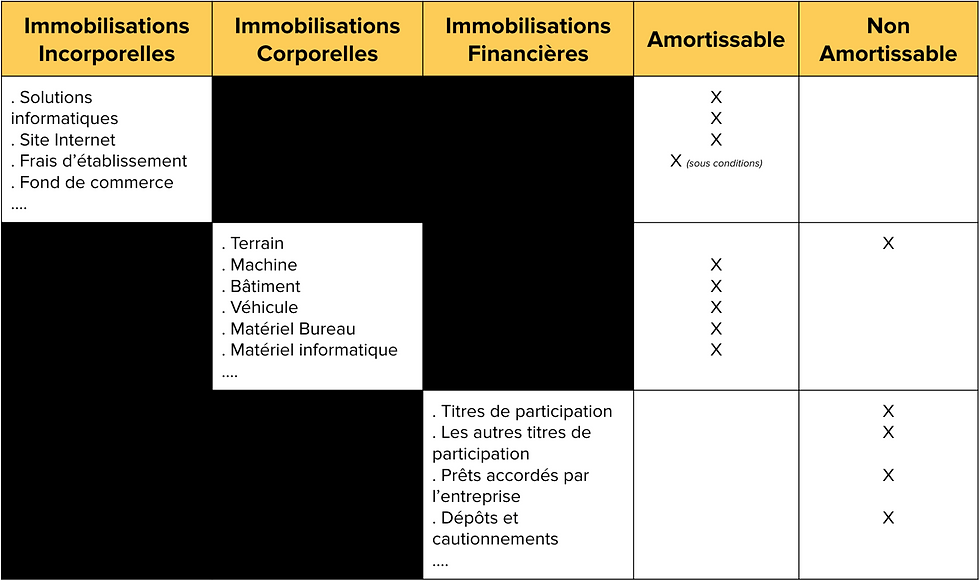
To solidify your understanding of the core concepts and to continue building your professional English vocabulary, the following video provides an excellent explanation of depreciation, capitalization, and the role of the accumulated depreciation account.
DEPRECIATION BASICS! With Journal Entries
Watch this video from Accounting Stuff to get a clear, conceptual overview of depreciation. It explains why we don't expense a major purchase immediately and how depreciation aligns with the accrual basis of accounting.
Watch the sections 'What is depreciation?' (00:22 - 02:37) and 'How to record a depreciation expense' (06:29 - 08:59). Pay close attention to the introduction of the 'Accumulated Depreciation' account as a contra-asset, as this is a universally applied concept.
As the video explained, instead of crediting the asset account directly, we credit a separate Accumulated Depreciation account (Amortissements de...). This is crucial because it allows the balance sheet to report both the original cost of the asset and the total depreciation charged to date, providing a more complete picture.
2. The Depreciation Schedule (Plan d'Amortissement) in Morocco
Now, let's apply these concepts within the Moroccan context. The key tool for managing an asset's depreciation over its life is the depreciation schedule (plan d'amortissement or tableau d'amortissement). This table methodically lays out the depreciation calculation for each year.
To build this schedule, you first need to understand the key terminology.
Cours Comptabilité Générale II
This document, a course excerpt from Prof. F. EL ARIF, provides the official French terminology used in Moroccan accounting for depreciation. Understanding these terms is essential for professional practice.
Read the section titled 'III- Terminologie'. This will define key terms like 'Valeur d'origine (V.O)', 'Annuité d'amortissement', 'Amortissements cumulés', and 'Valeur nette d'amortissement (VNA)'.
The most common method for depreciation is the straight-line method (amortissement constant or linéaire), which allocates an equal amount of depreciation expense to each full year the asset is in service.
The formula is:
Annual Depreciation (Annuité) = Original Value (V.O) / Useful Life (in years)
orAnnuité = V.O x Depreciation Rate
where Depreciation Rate = 100 / Useful Life
A critical rule in practice is the prorata temporis (time-apportionment) rule. If an asset is acquired or put into service during the year, you only depreciate it for the portion of the year you owned it. In Morocco, this is typically calculated by the number of months.
The following resource shows you exactly how to construct a straight-line depreciation schedule, including the prorata temporis calculation.
Cours Comptabilité Générale II
We will return to the same course document to see how these terms are assembled into a complete depreciation schedule.
First, review the section '1. L’amortissement constant (linéaire)'. Then, carefully study the table under 'IV- Plan d’amortissement', specifically the 'Exemple : Tableau d’amortissement constant'. Notice how the first and last years have partial depreciation amounts calculated based on the number of months the asset was used (4 months in 1998 and 8 months in 2003).
3. Recording Depreciation and Finalizing the Annual Schedule
In a real company, you manage a portfolio of dozens or even hundreds of fixed assets. This is done using a fixed asset register (fichier des immobilisations), which is essentially a master file containing a depreciation schedule for every asset.
The year-end task of "finalizing the schedule" involves:
- Adding any new assets acquired during the year to the register.
- Calculating the 202X
annuitéfor every single asset in the register. - Summing up all the individual
annuitésto get the total depreciation expense for the year. - Recording this total amount in a single, consolidated journal entry.
The journal entry to record the annual depreciation expense (dotation aux amortissements) is:
| Date | Account No. | Account Name | Debit | Credit |
|---|---|---|---|---|
| 31/12/N | 619x | Dotations d'exploitation aux amortissements... | Total Annuité |
|
| 28xx | Amortissements des immobilisations... | Total Annuité |
||
| Dotation aux amortissements de l'exercice N |
- The debit (619x) is an expense account that will appear on the Income Statement (
CPC). The third digit 'x' depends on the asset type (e.g.,6192for intangible,6193for tangible). - The credit (28xx) is the accumulated depreciation (contra-asset) account. The third and fourth digits 'xx' correspond to the asset itself (e.g.,
2834forMatériel de transport, account2340).
To see how this applies to common asset types in a Moroccan SME, let's look at some examples.
Amortissements des immobilisations
The resource from plancomptable.ma provides practical examples for depreciating different types of assets according to the Moroccan chart of accounts. This will help you understand how to handle a variety of assets in your register.
Read the sections for 'Amortissements des constructions' (account 2832) and 'Amortissements des installations techniques, matériel et outillage' (account 2833). Focus on the examples provided: see how they determine the useful life, calculate the annual depreciation, and prepare the journal entry with the correct account numbers.
Test your understanding!
A small Moroccan SME, "ALPHA Services SARL," closes its accounts on December 31st. Its fixed asset register contains the following two assets:
- Vehicle: A delivery van acquired on July 1, 2022, for 240,000 DH (HT). Useful life is 5 years.
- Computer Equipment: A new server acquired on October 1, 2023, for 30,000 DH (HT). Useful life is 4 years.
Your Tasks for the year ending December 31, 2023:
- Calculate the annual depreciation (
annuité) for 2023 for each asset. - Prepare the consolidated journal entry to record the total depreciation expense for 2023.
- Calculate the Net Book Value (
VNA) for each asset as of December 31, 2023.
Show answer
1. Calculation of Annual Depreciation for 2023
-
Vehicle (Matériel de transport - 2340):
- Depreciation Rate = 100 / 5 = 20%
- The asset was used for the full 12 months in 2023.
Annuité 2023= 240,000 DH * 20% = 48,000 DH
-
Computer Equipment (Matériel informatique - 2355):
- Depreciation Rate = 100 / 4 = 25%
- The asset was acquired on Oct 1, 2023, so it was used for 3 months (Oct, Nov, Dec). We must apply
prorata temporis. Annuité 2023= 30,000 DH * 25% * (3 / 12) = 1,875 DH
2. Consolidated Journal Entry at December 31, 2023
- Total Depreciation Expense = 48,000 (Vehicle) + 1,875 (Computer) = 49,875 DH
| Date | Account No. | Account Name | Debit | Credit |
|---|---|---|---|---|
| 31/12/23 | 6193 | Dotations d'expl. aux amort. des immob. corp. | 49,875 | |
| 2834 | Amortissement du matériel de transport | 48,000 | ||
| 28355 | Amortissement du matériel informatique | 1,875 | ||
| Dotation aux amortissements de l'exercice 2023 |
(Note: In practice, some accountants might post two separate credit lines as shown, while others might credit a single summary account if the system allows. Detailing is better for clarity.)
3. Calculation of Net Book Value (VNA) at Dec 31, 2023
-
Vehicle:
- Accumulated Depreciation =
Annuité 2022+Annuité 2023 Annuité 2022(6 months) = 240,000 * 20% * (6/12) = 24,000 DH- Total Accumulated Depreciation = 24,000 + 48,000 = 72,000 DH
- VNA = 240,000 - 72,000 = 168,000 DH
- Accumulated Depreciation =
-
Computer Equipment:
- Total Accumulated Depreciation =
Annuité 2023= 1,875 DH - VNA = 30,000 - 1,875 = 28,125 DH
- Total Accumulated Depreciation =
Conclusion
You have now worked through the entire process of managing depreciation for a period-end close. This is a recurring and highly structured task that is essential for correctly stating a company's asset values and annual profit.
Key Takeaways:
- Depreciation is the systematic allocation of a fixed asset's cost over its useful life, guided by the matching principle.
- The depreciation schedule (
plan d'amortissement) is the fundamental tool for tracking an asset'sV.O,annuité, accumulated depreciation, andVNAyear after year. - The
prorata temporisrule is essential for accurately calculating depreciation for assets acquired or disposed of mid-year. - In practice, you finalize a fixed asset register for all assets, and the total annual depreciation is recorded in a single consolidated journal entry, debiting an expense (
619x) and crediting accumulated depreciation (28xx).
Preview of the Next Lesson:
We have now covered period-end adjustments for major assets (inventory and fixed assets). Our next step in the closing process is to address potential losses on financial assets, specifically accounts receivable. In the next lesson, we will learn how to prepare an adjusting entry for estimated bad debts (créances douteuses) using the allowance method. This continues our theme of applying the principle of prudence to the balance sheet.