Recommended resources
The freely available resources this lesson will direct you to.
Welcome back. In our previous lesson, we established a solid framework for finalizing period-end adjustments, covering accruals, prepayments, and an introduction to provisions. These steps are crucial for ensuring all transactions are recorded in the correct period.
Today, we will apply and extend these concepts to one of the most significant assets on a company's balance sheet: inventory. This lesson is dedicated to mastering year-end inventory procedures. You will learn how to perform a physical inventory count, reconcile it with your accounting records, and record the necessary adjustments for both quantity and value.
This process is a cornerstone of the annual closing cycle. It directly impacts the accuracy of key figures like Cost of Goods Sold on the Income Statement and the value of Current Assets on the Balance Sheet, ensuring the financial statements present a true and fair view (image fidèle) of the company's position.
1. The Foundation: The Physical Inventory Count (Inventaire Physique)
The starting point for all year-end inventory procedures is the physical count. Moroccan law (specifically the Code de Commerce) mandates that every business conduct a physical inventory count at least once a year.
Purpose: The goal is to physically count every item in stock to determine the exact quantities on hand at the closing date (e.g., December 31st). This physical count is then compared against the company's accounting records (the inventaire permanent or perpetual inventory system).
The process of comparing the physical count to the accounting records is called inventory reconciliation. Discrepancies are common and can arise from various issues like unrecorded sales, supplier errors, damage, or theft.
To understand the standard professional approach to this task, please review the following guide.
A Step-by-Step Guide to Inventory Reconciliation
This article, 'A Step-by-Step Guide to Inventory Reconciliation' from GEP, outlines the professional process for reconciling inventory. While it uses general business terminology, the steps are universally applicable.
Read the sections 'What is Inventory Reconciliation?', 'How Businesses Approach Inventory Reconciliation', and 'Steps Involved in Inventory Reconciliation'. Focus on understanding the six key steps, from the physical count to documenting the process. This provides a strong procedural framework.
As you've read, the reconciliation process aims to identify and investigate discrepancies. Once the investigation is complete, the accountant must make adjusting entries to ensure the accounting records reflect the physical reality. These adjustments fall into two categories: adjustments for quantity and adjustments for value.
2. Adjusting for Quantity: La Régularisation des Stocks
In the Moroccan accounting system, the value of inventory shown on the balance sheet at the beginning of the year (Stock Initial) must be replaced by the value of inventory at the end of the year (Stock Final). This is done through a two-step journal entry process that uses a special "variation" account.
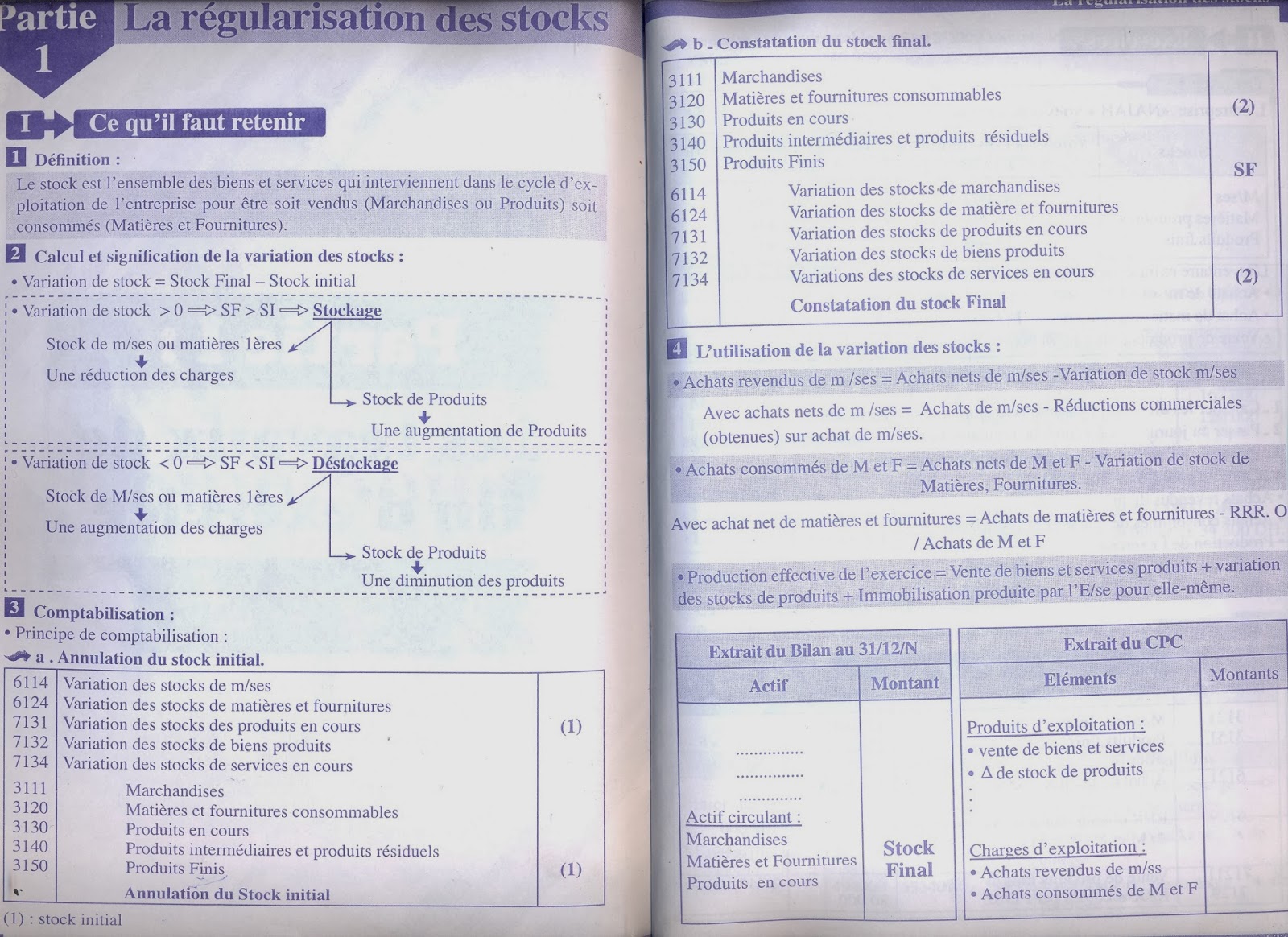
Based on the logic in the document above, the process is as follows:
Step 1: Annulment of the Initial Stock (Annulation du Stock Initial)
You start by removing the initial stock value from the balance sheet and moving it to a variation account. For merchandise, the entry is:
| Date | Account No. | Account Name | Debit | Credit |
|---|---|---|---|---|
| 31/12/N | 6114 | Variation des stocks de marchandises | Amount of SI | |
| 3111 | Marchandises (Stock) | Amount of SI | ||
| Annulation du stock initial |
Step 2: Recording the Final Stock (Constatation du Stock Final)
Next, you record the new, physically counted stock value onto the balance sheet. This value comes from your year-end physical count.
| Date | Account No. | Account Name | Debit | Credit |
|---|---|---|---|---|
| 31/12/N | 3111 | Marchandises (Stock) | Amount of SF | |
| 6114 | Variation des stocks de marchandises | Amount of SF | ||
| Constatation du stock final |
Note: The account numbers change depending on the type of stock (e.g., 312 for raw materials and 6124 for their variation; 315 for finished goods and 713 for their variation).
Interpreting the Stock Variation Account
After these two entries, the Variation des stocks account (e.g., 6114) will have a balance. This balance is crucial for calculating the Cost of Goods Sold.
- Debit Balance:
Stock Initial > Stock Final. This indicatesdéstockage(destocking). The company sold more than it purchased this period. The debit balance is added to purchases to calculate the total cost of goods sold. - Credit Balance:
Stock Final > Stock Initial. This indicatesstockage(stocking). The company purchased more than it sold. The credit balance is subtracted from purchases, reducing the cost of goods sold.
To see this logic applied in practice, the following video walks through a corrected exercise.
Exercice corrigé de comptabilité générale - Régularisation des stocks à l'inventaire - TD1 - EX3
This video, 'Exercice corrigé de comptabilité générale - Régularisation des stocks' from Révizaide, demonstrates exactly how to calculate and record stock variations. It is an excellent practical application of the theory.
Watch from the beginning until 03:03. Pay close attention to how the two-step journal entry process is explained using T-accounts. This will solidify your understanding of the mechanics of annulling the initial stock and recording the final stock.
Test your understanding!
Here is a common year-end inventory scenario for a Moroccan company.

Based on the information for "Matières premières" (Raw Materials):
- The initial stock (
stock initial) from the trial balance is 140,000 DH. - The final stock (
stock final) from the physical count is 190,000 DH.
Task: Prepare the two year-end journal entries to adjust the raw materials stock. What is the final balance of the Variation des stocks de matières premières (Acct. 6124) account, and what does it signify?
Show answer
1. Annulment of Initial Stock:
| Date | Account No. | Account Name | Debit | Credit |
|---|---|---|---|---|
| 31/12/09 | 6124 | Variation des stocks de M.P. | 140,000 | |
| 3121 | Matières premières | 140,000 |
2. Recording of Final Stock:
| Date | Account No. | Account Name | Debit | Credit |
|---|---|---|---|---|
| 31/12/09 | 3121 | Matières premières | 190,000 | |
| 6124 | Variation des stocks de M.P. | 190,000 |
Balance and Significance:
The Variation des stocks account (6124) has a debit of 140,000 and a credit of 190,000.
The final balance is 50,000 DH Credit.
This credit balance signifies stockage. The company increased its stock of raw materials by 50,000 DH during the year. This amount will be deducted from the purchases of raw materials to calculate the total cost of materials consumed.
3. Adjusting for Value: La Provision pour Dépréciation des Stocks
After adjusting for quantity, you must address value. The principle of prudence (principe de prudence) requires that assets not be overstated. If the market value of your inventory has fallen below its original cost, you must recognize this probable loss. This is done by creating a provision for depreciation.
You were introduced to provisions in the last lesson. Here, we apply the concept specifically to inventory.
When is a provision needed?
A provision is recorded when the inventory's current market value (valeur actuelle or probable selling price) is lower than its recorded cost (valeur d'origine or acquisition/production cost). This can happen due to:
- Obsolescence (e.g., outdated electronics).
- Damage or deterioration.
- A significant drop in market prices.
The accounting treatment in Morocco is very specific.
3911. Provisions pour dépréciation des marchandises
The article 'Provisions pour dépréciation des marchandises' from plancomptable.ma clearly explains the rules and accounting entries for inventory provisions under Moroccan GAAP.
Read the entire article, from the introduction to the end of the scenarios. Focus on the example of 'TechStore SARL'. It perfectly illustrates how to calculate the provision, record the initial entry (dotation), and adjust it in the following year (reprise).
As the resource demonstrates, the process involves:
- Comparison: At year-end, compare the cost of inventory items with their current market value.
- Calculation:
Provision = Cost - Market Value(only if Cost > Market Value). - Recording the Adjustment:
- If a new provision is needed or an existing one must increase (
Dotation):- Debit
6196 - Dotations d'exploitation aux provisions pour dépréciation de l'actif circulant. (This is an expense). - Credit
3911 - Provisions pour dépréciation des marchandises(or other39XXaccounts). (This is a contra-asset account that reduces the inventory's book value).
- Debit
- If a provision is no longer needed or must be decreased (
Reprise):- Debit
3911 - Provisions pour dépréciation des marchandises. - Credit
7196 - Reprises sur provisions pour dépréciation de l'actif circulant. (This is an income item).
- Debit
- If a new provision is needed or an existing one must increase (
This adjustment ensures that inventory is reported on the balance sheet at the lower of cost or market value, providing a more prudent and realistic view of the company's assets.
Year-End Inventory Checklist
To structure your work during a closing period, here is a professional checklist summarizing the key procedures:
- Plan the physical count: Schedule the date, assign count teams, and prepare count sheets.
- Ensure proper cut-off: Freeze all inventory movements during the count. Ensure goods received before year-end are included and goods shipped are excluded.
- Conduct the physical count: Count and document all inventory items.
- Reconcile physical vs. book: Compare count sheets to the perpetual inventory records. Investigate significant discrepancies.
- Record Quantity Adjustments (
Régularisation):- Pass the journal entry to annul the initial stock.
- Pass the journal entry to record the final stock based on the physical count.
- Perform Value Assessment:
- For each material inventory item, compare its cost to its current net realizable value.
- Identify all items where value is less than cost.
- Record Value Adjustments (
Provision):- Calculate the required provision amount for the current year.
- Compare it to any existing provision from the prior year.
- Record the necessary
dotation(increase) orreprise(decrease) to the provision account.
- Final Review: Confirm that the final inventory value on the trial balance reflects the physically counted stock, valued at the lower of cost or market.
Conclusion
You have now learned the complete, professional process for handling inventory at year-end. This involves more than just counting; it requires a disciplined reconciliation and two distinct types of accounting adjustments: the régularisation to correct quantities and the provision to reflect true economic value. Mastering these procedures is non-negotiable for producing reliable financial statements.
Key Takeaways:
- Year-end inventory procedures begin with a physical inventory count (
inventaire physique). - Inventory reconciliation is the process of comparing the physical count to accounting records and investigating differences.
- Quantity adjustments in Morocco are done via a two-step process: annulling the initial stock and recording the final stock, using a
Variation des stocksaccount. - Value adjustments are made through provisions for depreciation when an inventory's market value falls below its cost, in adherence to the principle of prudence.
- The final inventory value on the balance sheet should be the lower of cost or market value.
Preview of the Next Lesson:
We will continue our work on adjusting asset values by turning our attention from current assets to non-current assets. In the next lesson, we will focus on how to review and finalize the annual depreciation (amortissement) schedule for all fixed assets (immobilisations).