Recommended resources
The freely available resources this lesson will direct you to.
Hello! Welcome to the next lesson in our course on Popperian realism, tradition, and rationalism.
In our last session, we used David Deutsch's framework to diagnose Logical Positivism as a 'bad explanation' of science. We saw how its core tenet, the verification principle, was 'easy to vary' and ultimately collapsed under its own logic. This wasn't just an isolated failure; it represented the collapse of a major branch of justificationism—the long-held philosophical quest to find certain foundations for our knowledge.
Today, we will explore the profound consequences of this collapse. When the promise of certainty evaporates, where does that leave us? Our goal is to trace the philosophical pathway from the failure of justificationism to the intellectual 'despair' of relativism. We'll examine what relativism is, why it's a tempting conclusion, and why it's ultimately an untenable dead end.
Time to complete: Approximately 45 minutes.
1. The Justificationist's Dilemma
Let's begin by clearly stating the problem. The entire philosophical project of justificationism rested on a core assumption:
Knowledge is justified true belief.
For centuries, philosophers sought the source of that justification. Was it sensory experience (empiricism)? Was it pure reason (rationalism)? As we saw with Positivism, these attempts to build a fortress of certainty failed. No belief—not even a scientific one—can be conclusively proven or justified.
This failure creates a fork in the road.
- The Path of Despair (Relativism): If no belief can be justified, perhaps all beliefs are equally arbitrary. Maybe 'truth' is just a matter of perspective, culture, or personal opinion.
- The Path of Optimism (Critical Rationalism): We accept that justification is impossible, but we don't discard the idea of objective truth. Instead, we redefine knowledge not as what is proven, but as what has so far survived our best attempts to disprove it.
Today, we are walking down the first path to understand it, before we fully embrace the second in our next lesson.
2. What is Relativism?
Relativism is the idea that truths, particularly moral and epistemic (related to knowledge) ones, are not absolute but are relative to a particular framework or context, such as a society or culture.
To get a clear and intuitive grasp of this, please watch the first part of the following video.
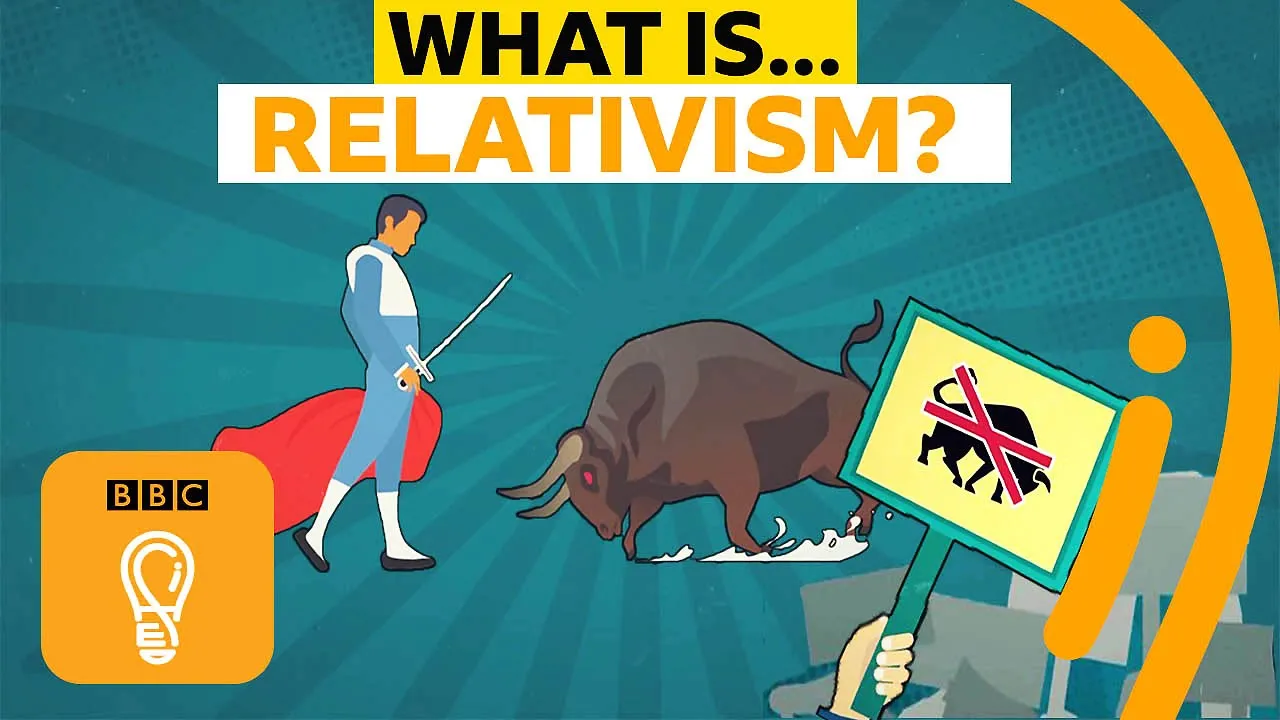
Watch from the beginning to 02:14. This segment will introduce you to:
- The core idea of moral relativism, using examples like bullfighting and ancient Roman practices.
- The anthropologist's non-judgmental stance, which seems attractive at first.
- The deeply problematic conclusion that relativism leads to when faced with morally repugnant systems, like that of Nazi Germany.
This video powerfully illustrates the 'despair' of relativism. If a strict relativist is to be consistent, they must concede that Nazi morality was 'right for Nazi Germany'. This forces a choice between intellectual consistency and what most of us recognize as a fundamental moral reality. This paralysis of judgment is the essence of the problem.
3. The Incoherence of 'Vulgar Relativism'
The impulse toward relativism often comes from a well-meaning place—a desire for tolerance. The thinking goes: "Since no one has the ultimate truth, we should not impose our values on others."
The philosopher Bernard Williams gave this common-sense position a pejorative name: 'vulgar relativism'. He argued that it is not just problematic, but fundamentally incoherent.
The following video from Jeffrey Kaplan provides an excellent breakdown of Williams's argument. It is philosophically precise and will appeal to your appreciation for logical rigor.
Please watch the following segments carefully:
-
Defining the Terms (03:41 - 09:20): This part distinguishes relativism from anti-realism and defines 'vulgar relativism' as the combination of two distinct claims:
- Relativism: What is morally right is relative to a society's accepted code, and that code is correct for that society.
- Toleration: It is wrong for people in one society to interfere with or condemn another society.
-
The Central Contradiction (10:02 - 12:50): This is the core of Williams's critique. Kaplan explains why the two claims above are mutually incompatible.
- The principle of Toleration ("it is wrong to interfere...") is presented as a universal, non-relative moral rule. It's supposed to apply to everyone, everywhere.
- This directly contradicts the core thesis of Relativism, which states that there are no universal, non-relative moral rules.
- You cannot hold both beliefs at the same time without contradiction. If toleration is a universal rule, relativism is false. If relativism is true, toleration cannot be a universal rule.
-
The Inescapable Conclusion (25:46 - 30:36): This final segment drives the point home with a simple, powerful thought experiment.
- Assume relativism is true.
- Now, consider an intolerant society—one whose moral code says it is right to interfere with others.
- According to the principle of relativism, that intolerant society's moral code is correct for them.
- Therefore, it is right (for them) to be intolerant.
- This conclusion, derived directly from relativism, is the exact opposite of the principle of toleration.
The argument is decisive. The popular, seemingly tolerant version of relativism is built on a logical fallacy. It tries to derive a universal principle (toleration) from a worldview that explicitly denies the existence of universal principles. As Williams put it, you are trying to "conjure" a non-relative principle out of thin air.
Conclusion
Today, we have mapped the intellectual journey that leads from the collapse of justificationist philosophy to the 'despair' of relativism.
Key Takeaways:
- The Pathway to Relativism: The failure to find certain justification for knowledge (the collapse of Positivism being a key example) led some thinkers to conclude that no belief system is better than any other.
- The Moral 'Despair': Relativism, when taken seriously, leads to morally repugnant conclusions, forcing an acceptance of abhorrent practices as 'right' for the cultures that practice them. It robs us of the grounds for moral judgment.
- The Logical Incoherence: The most common form of relativism, which combines a belief in relative truths with a call for universal tolerance ('vulgar relativism'), is logically self-contradictory. As Bernard Williams showed, it asserts a universal principle (toleration) while being based on a premise that denies universal principles can exist.
Relativism is not a sophisticated, worldly wisdom; it is a philosophical error born from a false dilemma. It stems from the mistaken belief that if we cannot have absolute proof, we cannot have objective knowledge.
Next Steps
Having explored this path of despair and found it to be a dead end, we are now ready to turn back to the other fork in the road. In our next lesson, we will fully formulate the Popperian/Deutschian alternative to relativism. We will see how it's possible to give up the failed quest for justification while still embracing objective knowledge, truth, and progress through a dynamic process of conjecture, good explanations, and error correction.