Recommended resources
The freely available resources this lesson will direct you to.
Hello! Welcome to your next lesson in our course on Popperian realism, tradition, and rationalism.
In our last lesson, we charted the path from the failure of justificationism to the intellectual cul-de-sac of relativism. We saw that relativism, particularly the common 'vulgar' form that pairs it with a call for universal tolerance, is not only morally paralyzing but also logically incoherent. It's a philosophical dead end born from a false dichotomy: if we cannot have absolute certainty, then all beliefs must be equally valid.
Today, we will explore the powerful and optimistic alternative. Having rejected both the quest for certainty (justificationism) and the despair of relativism, we will now formulate the Popperian/Deutschian view of knowledge. This lesson is central to our course, as it provides the epistemological engine for everything that follows.
Our learning outcome: To formulate the Popperian/Deutschian alternative to relativism: Knowledge as a web of problem-solving, explanatory conjectures that have survived severe criticism.
Time to complete: Approximately 50 minutes.
1. The Third Way: Fallibilism over Relativism and Dogmatism
The collapse of justificationism left a void. Dogmatism—the belief in certain, infallible knowledge—was no longer tenable. In its place, many adopted relativism—the belief that truth is merely a matter of perspective. Karl Popper and David Deutsch offer a third way: Fallibilism.
Fallibilism is the simple, yet profound, recognition that we are not infallible and that all our knowledge is conjectural. However, crucially, it does not conclude that all conjectures are equal. Some are objectively better than others.
To understand this crucial distinction, please watch this segment from a conversation with David Deutsch.
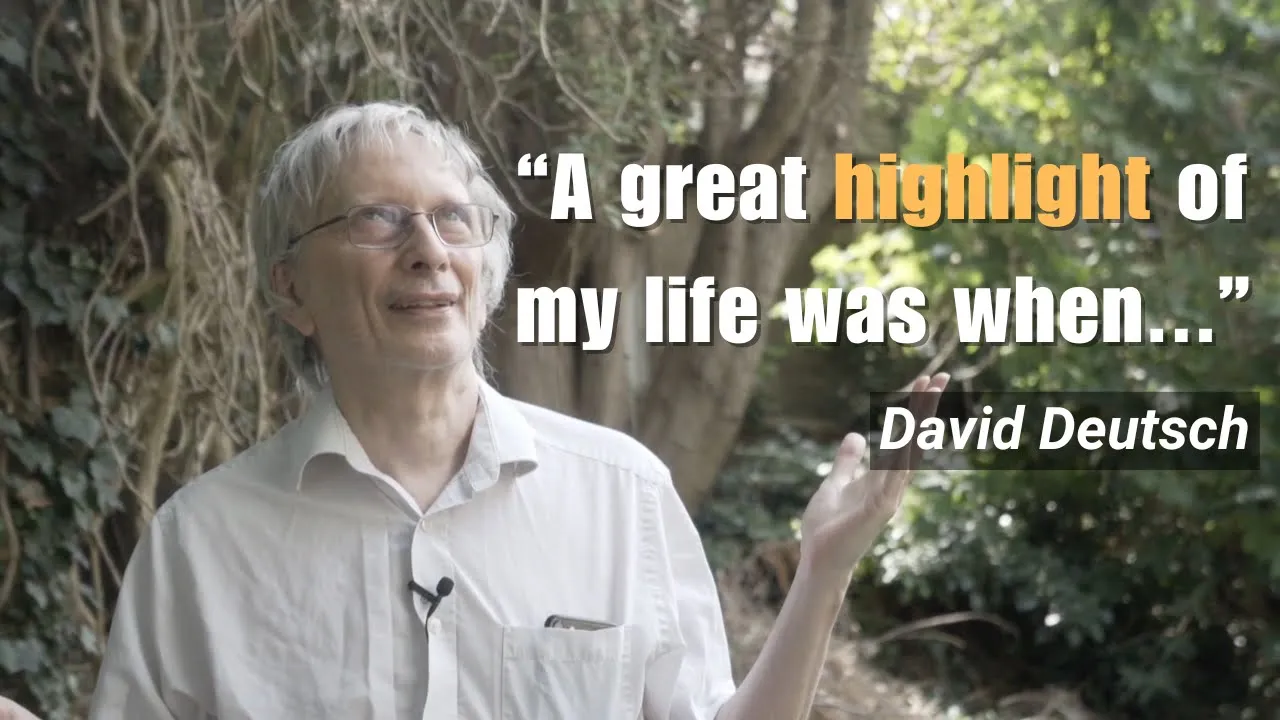
Watch the segment Fallibilism vs. Relativism and Dogmatism (13:14 - 21:29). Pay close attention to Deutsch's core argument:
- He contrasts fallibilism with both dogmatism (the certainty of religion or "science with a capital S") and relativism.
- He makes the critical point that although we can never have certainty, we can know when we have no further criticisms of an idea.
- Therefore, being rational doesn't mean you are guaranteed to be right. It means engaging in the process of error correction to improve your knowledge.
This is the escape route from the relativist's despair. We give up on proof, but we retain progress. Our knowledge isn't "justified," but it is rationally preferable to the alternatives because it has survived criticism.
2. The Starting Point: Knowledge Begins with Problems
So, if knowledge doesn't come from being "poured into our minds" (the "bucket theory") or induced from observation, where does it come from? The Popperian answer is that knowledge creation always begins with a problem.
What is a problem? In this context, a problem is a conflict between ideas. It's the moment you realize something doesn't add up—a prediction fails, a theory contradicts another, an explanation feels inadequate.
This next clip, with David Deutsch and Eli Tyre, lays out this foundational concept.

Please watch the segment Thinking Begins with Problems and Conflicts of Ideas (01:20 - 04:26). Deutsch explains that all thinking, and thus all knowledge creation, originates from a problem. Even in the simplest biological case, the 'problem' of survival exists in the conflict between the existing genome and a potential mutation.
This shifts the entire focus of epistemology. The goal is not to justify pre-existing beliefs, but to solve problems by creating new ideas.
3. The Engine of Progress: Conjecture and Criticism
Once a problem is identified, the creative process begins. We generate conjectures—tentative theories, or guesses—that might solve the problem. This is the "TT" (Tentative Theory) in Popper's P1 -> TT -> EE -> P2 schema.
Crucially, these conjectures don't come from anywhere "foundational." They are creative acts. As you know from your background in mathematics and logic, even the most rigorous systems ultimately rest on axioms that cannot themselves be proven. Deutsch drives this point home by referencing Gödel.
Now, watch another segment from the same video. It explains why all knowledge, even in mathematics, is fundamentally conjectural and not derived from a secure base.
Focus on the segment The Conjectural Nature of All Ideas and the Failure of Justificationism (13:41 - 20:54).
- Notice the discussion of how calculus arose from mathematicians like Newton and Leibniz guessing solutions to a problem (the meaning of instantaneous velocity).
- The reference to Gödel's incompleteness theorems is key: it proves that even within mathematics, you cannot create a system that proves its own consistency. There is "no bottom" from which to derive all truth.
This demolishes the justificationist project and establishes the conjectural nature of all our knowledge.
But a guess is not enough. The second, and equally critical, part of the engine is criticism, or Error Elimination ("EE"). This is where objectivity enters the picture. We subject our conjectures to the most severe tests and criticisms we can devise.
This is not a simple, one-off event. The process of criticism is itself creative and conjectural. You propose a theory (conjecture 1). I propose a reason why it might be wrong (conjecture 2, a criticism). You then might find a flaw in my criticism (conjecture 3, a critique of the critique) or modify your original theory to account for it.
This iterative, recursive process is what builds our knowledge. Please watch this final, crucial segment from the video.
Watch The Iterative Process of Conjecture, Criticism, and Pruning (01:09:20 - 01:18:47). This part brilliantly describes the dynamic reality of knowledge growth:
- It's an exponential process of conjectures and counter-conjectures.
- We need "pruning algorithms" (heuristics, which are themselves conjectural theories) to navigate this vast search space.
- This is how expertise is built—not by memorizing facts, but by developing better and better theories about what kinds of conjectures and criticisms are fruitful. This is what a chess grandmaster's "intuition" consists of.
This process creates what the learning outcome calls a "web of problem-solving, explanatory conjectures that have survived severe criticism." An idea isn't valuable because it is 'proven' (an impossible standard) but because it is deeply enmeshed in this web, connected by arguments and evidence, and has withstood numerous attempts to refute it.
4. Defeating Relativism with Objective Progress
Now we can see why this framework provides a robust alternative to relativism. The relativist claims there is no objective standard to judge between two competing conceptual schemes (e.g., modern medicine vs. traditional shamanism). The Popperian/Deutschian response is that there is a decisive standard: which scheme has a better, built-in process for detecting and correcting errors?
A tradition of knowledge based on conjecture and criticism is objectively better than a static tradition that seeks to suppress change, because the former is capable of making progress and the latter is not.
Deutsch makes this exact point when discussing the controversy over "indigenous ways of knowing" in science education.
Watch the segment Critique of Cultural Relativism and the Importance of Progress (21:29 - 26:20).
- Deutsch argues that the very idea of 'improvement' is incompatible with relativism.
- He contends that "Western ways of knowing" (a geographical tag for the tradition of criticism that began with the Enlightenment) are objectively better because they have the capacity for progress. All knowledge systems started as "indigenous," but some developed this error-correction mechanism and others didn't.
This is the knockout blow to relativism. We don't need access to absolute truth to make objective judgments. We only need to ask: Which system is better at finding and fixing its mistakes?
Conclusion
Today we have assembled the Popperian/Deutschian alternative to both justificationism and relativism. Instead of a hopeless search for certainty or a resigned acceptance that all ideas are equal, we have a dynamic and optimistic picture of knowledge creation.
Key Takeaways:
- Fallibilism is the alternative: We accept that all our knowledge is conjectural and we can be wrong, but this doesn't prevent us from making objective progress.
- Knowledge starts with problems: All progress begins with a conflict between our existing ideas.
- The engine is conjecture and criticism: We create knowledge by guessing solutions to problems and then subjecting those guesses to intense criticism.
- Knowledge is a web of survivors: What we call "knowledge" is a vast, interconnected network of theories, arguments, and explanations that have so far survived this rigorous process of error elimination.
- Objectivity through error-correction: This framework defeats relativism by providing an objective standard: a system of thought that embraces criticism and allows for progress is superior to one that doesn't.
Next Steps
We have established that the growth of knowledge is a real, objective process of problem-solving. This process is not only possible but is the most powerful force in the universe. In our next lesson, we will explore the ultimate implication of this idea: David Deutsch's "Principle of Optimism," which posits that since all evils are merely problems caused by a lack of knowledge, there are no inherent limits to the improvements we can make.