Hello! Welcome to your sixth lesson on the foundations of electricity.
In our last lesson, we mastered Ohm's Law (), the fundamental relationship connecting voltage, current, and resistance. We saw how this simple equation allows us to analyze and design basic circuits, like the voltage divider.
Today, we'll answer a crucial question: where does the energy in a circuit go? You may have noticed that electronic components, especially resistors, can get warm or even hot. This is not a side effect; it's a direct consequence of energy being converted. Our learning outcome is to derive and apply power equations (P=VI, P=I²R) to calculate energy consumption in resistive circuits. We will explore the physics behind this energy conversion, derive the formulas that quantify it, and see how this relates to practical concepts like component power ratings and your electricity bill.
1. The Physics of Electrical Power: Why Resistors Get Hot
When we discussed current, we described it as charge carriers (electrons) moving through a conductor. When we discussed voltage, we described it as the electrical potential energy difference that "pushes" these charges.
A charge moving from a point of high potential to a point of low potential loses electrical potential energy. Where does this energy go? In free space, it would convert to kinetic energy, and the charge would speed up. However, inside a resistor, the situation is different. The charge carriers constantly collide with the atoms of the resistive material.
To understand this process intuitively and visually, let's watch a segment from Khan Academy.
Electric power | Circuits | Physics | Khan Academy
The video 'Electric power' provides an excellent conceptual explanation for how the potential energy lost by charges is converted into thermal energy within a resistor.
Watch the first 5 minutes of the video (00:00 - 05:03). Pay close attention to the explanation of why charges don't accelerate through a resistor and how their collisions with the atomic lattice transfer energy, causing the resistor to heat up.
As the video explains, the electrons transfer their energy to the resistor's atomic lattice, causing the atoms to vibrate more intensely. This increased atomic vibration is what we perceive as heat. This phenomenon is known as Joule heating or ohmic heating. It is the fundamental mechanism by which electrical energy is converted into thermal energy in any resistive component.
For a deeper look into this process, the "Microscopic description" section of the Wikipedia article on "Joule heating" (LINK) provides a concise summary that aligns with the physics of charge carriers we've discussed.
2. Deriving the Power Equations
Now that we understand the physical process, let's quantify it. Power () is defined in physics as the rate at which energy () is transferred or converted.
For a constant rate of transfer over a time interval , this simplifies to .
In our circuit, the energy being converted is the electrical potential energy () lost by the charge () as it moves through a potential difference (). From our lesson on voltage, we know the relationship is , which we can rearrange to .
Let's derive the main formula for electric power.
Electric power | Circuits | Physics | Khan Academy
The same Khan Academy video continues from where we left off to provide a clear, step-by-step derivation of the primary power equation.
Now, watch from 05:03 to 08:56. Follow the derivation that starts with the definition of power and uses the definitions of voltage and current to arrive at the equation P = VI.
This derivation gives us the most fundamental equation for electrical power:
This equation states that the power dissipated in a component is the product of the voltage across it and the current flowing through it. The unit of power is the Watt (W), which is equivalent to one Joule per second (J/s).
Alternative Forms of the Power Equation
While is fundamental, it's not always the most convenient formula to use. By combining it with Ohm's Law (), which we mastered in the last lesson, we can derive two other extremely useful forms.
-
In terms of Current and Resistance:
Substitute into :
This form is perfect for calculating the power dissipated in a resistor when you know the current flowing through it. It's especially useful for analyzing power loss in transmission lines, where the resistance of the wire and the current it carries are the key parameters. -
In terms of Voltage and Resistance:
Substitute into :
This form is ideal when you know the voltage across a component, like a light bulb designed for a specific voltage, and its resistance.
These three equations, , , and , are all equivalent for ohmic devices. You choose which one to use based on the quantities you know.
3. Applying the Power Equations
Let's solidify our understanding with an example. Consider this simple circuit containing a battery and a lamp, which acts as a resistor.
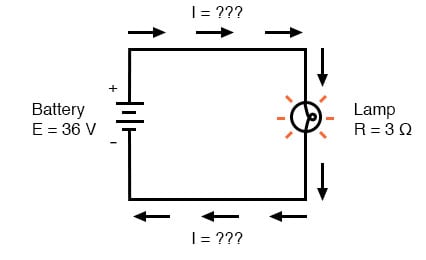
Problem:
- What is the current () flowing through the lamp?
- How much power () does the lamp dissipate?
- How much energy () does it consume in 2 minutes?
Solution:
-
Calculate the current: Using Ohm's Law from our previous lesson.
-
Calculate the power: We can use all three power formulas to verify they give the same result.
- Using :
- Using :
- Using :
The lamp converts electrical energy into light and heat at a rate of 432 Joules per second.
- Using :
-
Calculate the energy: Power is energy per unit time, so energy is power multiplied by time (). Remember to convert time to SI units (seconds).
Test your understanding!
Your Arduino kit contains many small resistors. A common power rating for these is 1/4 Watt (0.25 W). If you exceed this power rating, the resistor will overheat and likely be destroyed.
Your kit includes several 220 resistors. What is the maximum voltage you can safely apply across a single 220 resistor without exceeding its 0.25 W power rating? Which power formula is most direct for solving this?
Show answer
The most direct formula is because we know the power () and resistance (), and we want to find the voltage ().
First, we rearrange the formula to solve for :
Now, we plug in the values:
Therefore, you should not apply more than approximately 7.42 Volts across a single 220 , 1/4 W resistor. This is a crucial practical consideration when building circuits.
4. Electrical Energy and the Kilowatt-Hour
While the Joule is the SI unit of energy, it's very small for everyday purposes. When you get your electricity bill, the company doesn't charge you for Joules. Instead, they use a much larger unit of energy: the kilowatt-hour (kWh).
This unit is exactly what it sounds like: it's the total energy transferred by a device with a power of one kilowatt (1000 W) running for one hour.
Energy Transfer in Electric Circuits
To understand this practical unit of energy, we'll read a short section from the Phys LibreTexts online textbook.
Please read the section titled 'The Kilowatt-Hour'. Focus on the definition, the conversion to Joules, and the worked example showing how to calculate the cost of running an appliance.
As the text explains, the conversion is:
Understanding the difference between power (a rate, in W or kW) and energy (a total amount, in J or kWh) is key to understanding how electricity is measured and sold.
Conclusion
Today, we've connected the concepts of voltage and current to the flow of energy in a circuit. We've seen that the energy lost by charges moving through a resistor is converted into heat, a process called Joule heating.
Key Takeaways:
- Electrical Power () is the rate at which electrical energy is converted into other forms (like heat or light), measured in Watts (W).
- The conversion happens through collisions between charge carriers and the atoms of the conductor.
- The three fundamental and equivalent power equations are:
- Electrical Energy () is power multiplied by time (). It's the total amount of work done or heat generated, measured in Joules (J) or, more practically, in kilowatt-hours (kWh).
In our next lesson, we will expand our toolkit for circuit analysis. We've focused on simple, single-loop circuits so far. To analyze more complex circuits with multiple branches and loops, we need two new principles: Kirchhoff's Current Law (KCL) and Kirchhoff's Voltage Law (KVL). These laws govern the conservation of charge and energy in any electrical network.