Hello! Welcome to your seventh lesson on the foundations of electricity.
In our previous lessons, we analyzed circuits using Ohm's Law and calculated power dissipation. These tools work perfectly for simple circuits with a single power source and a straightforward arrangement of resistors. But what happens when circuits become more complex, featuring multiple power sources or several interconnected branches? For these, Ohm's Law alone is not sufficient.
Today, we will learn a powerful, universal method for analyzing any circuit, no matter how complex. This lesson covers Kirchhoff's Circuit Laws, which are fundamental principles rooted in the conservation of charge and energy. Your background in physics will be a great asset here, as you'll see these familiar conservation laws applied in a new context.
Our learning outcome is to apply Kirchhoff's Current Law (KCL) and Voltage Law (KVL) to analyze single-loop and multi-loop circuits.
1. Kirchhoff's First Law: The Junction Rule (KCL)
Imagine a junction in a circuit—a point where three or more wires meet. The current flowing in is made of electric charge, and charge cannot be created or destroyed. Therefore, all the charge that flows into the junction per second must also flow out per second. This is the core idea behind Kirchhoff's Current Law (KCL).
For a formal definition and a simple analogy, let's read the first part of the 'Kirchhoff's Rules' article from Phys LibreTexts.
Please read the text up to and including the subsection 'Kirchhoff’s First Rule'. Pay attention to the water pipe analogy, which provides an intuitive model for charge conservation.
As the text explains, KCL states:
The sum of all currents entering a junction must equal the sum of all currents leaving the junction.
A common way to write this is to say that the algebraic sum of all currents at a junction is zero, using the convention that currents entering are positive and currents leaving are negative.

For the junction on the left of the image, KCL would be written as:
.
What if we don't know the direction of the current?
In complex circuits, it's often not obvious which way the current flows in every branch. The good news is, it doesn't matter! You can make an educated guess and assign a direction to each unknown current. If your calculation yields a negative value for a current (e.g., ), it simply means the actual flow of conventional current is in the opposite direction to the one you assumed. The magnitude is still correct.
Test your understanding!
Consider a junction where three wires meet. A current of 5 A flows in through the first wire, and a current of 2 A flows out through the second wire. What is the magnitude and direction of the current in the third wire?Show answer
Let's call the currents , , and . We are given:
- (entering)
- (leaving)
According to KCL, .
Solving for the outgoing current in the third wire gives . So, a current of 3 A flows out of the junction through the third wire.
2. Kirchhoff's Second Law: The Loop Rule (KVL)
Kirchhoff's second law is a statement of the conservation of energy. Imagine carrying a charge around any closed loop in a circuit. As you move across batteries, the charge gains energy (potential increases). As you move across resistors, the charge loses energy (potential decreases). When you arrive back at your starting point, the net change in energy must be zero. After all, a point cannot have two different potential values at the same time.
Kirchhoff's Voltage Law (KVL) states:
The algebraic sum of the changes in electric potential around any closed circuit path (loop) must be zero.
To truly grasp this, it's helpful to think about it conceptually first.
Kirchhoff's voltage law (conceptual) | Electricity | Physics | Khan Academy
This Khan Academy video provides an excellent conceptual explanation of KVL, using the analogy of walking a charge through a circuit and tracking its potential energy.
Please watch from the beginning until 08:41. Focus on the analogy of gaining and losing potential energy (voltage) as you 'walk' across batteries and resistors. This will build the intuition behind the law.
Sign Conventions for KVL
The trickiest part of applying KVL is getting the signs right for voltage gains ("lifts") and voltage drops. A systematic approach is essential. Let's establish clear rules.
Kirchhoff's Law, Junction & Loop Rule, Ohm's Law - KCl & KVl Circuit Analysis - Physics
The video 'Kirchhoff's Law, Junction & Loop Rule' from The Organic Chemistry Tutor provides a very clear and methodical explanation of the sign conventions. This will be our guide for setting up the equations correctly.
Watch the segment from 02:45 to 06:30. Pay close attention to how the sign (+ or -) is determined for both batteries and resistors based on the direction of your 'travel' around the loop relative to the component's polarity and the assumed current direction.
Here is a summary of the sign conventions for a chosen loop direction:
-
Voltage Source (Battery):
- Moving from the negative to the positive terminal: Voltage Gain (+V). You are moving "uphill" in potential.
- Moving from the positive to the negative terminal: Voltage Drop (-V). You are moving "downhill".
-
Resistor:
- Remember: Conventional current always flows from a higher potential to a lower potential across a resistor.
- Moving in the same direction as the assumed current: Voltage Drop (-IR).
- Moving opposite to the direction of the assumed current: Voltage Gain (+IR).
Mastering these four rules is the key to successfully applying KVL.
3. Applying the Rules: Solving a Multi-Loop Circuit
Now let's put it all together. Analyzing a complex circuit with Kirchhoff's laws is a systematic process that transforms a circuit diagram into a set of linear equations. Given your interest in maths, you'll recognize this as a classic application of solving simultaneous equations.
The general strategy is as follows:
- Label: Identify and label all junctions and loops.
- Assign Currents: Assign a current variable (e.g., ) and a direction for each branch of the circuit. Don't worry if you get the direction wrong; the math will correct it.
- Apply KCL: Write a KCL equation () for each independent junction. You'll need one fewer equation than the total number of junctions.
- Apply KVL: Write a KVL equation () for enough independent loops to include every component at least once.
- Solve: You will now have a system of linear equations with the same number of equations as unknown currents. Solve this system to find the value of each current.
Let's watch a complete worked example that follows this process.
Kirchhoff's Law, Junction & Loop Rule, Ohm's Law - KCl & KVl Circuit Analysis - Physics
The same video from The Organic Chemistry Tutor will now walk us through solving a circuit with two loops. This demonstrates the full process from setup to solution.
Watch the first complete example, from the beginning to 12:57. Follow along as he sets up the KCL equation, the two KVL loop equations, and then solves the system of three equations for the three unknown currents.
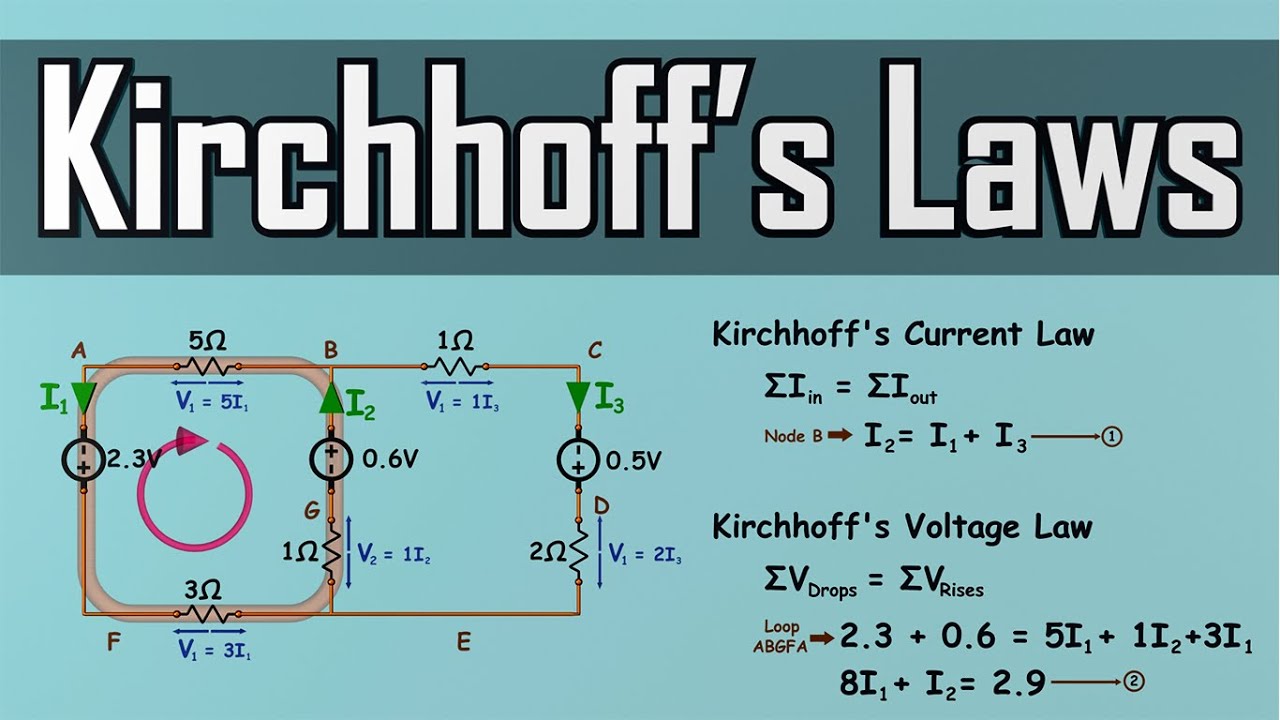
By following this methodical approach—label, assign currents, write KCL equations, write KVL equations, and solve—you can determine the current in every part of any DC circuit.
Conclusion
Today we've added two powerful laws to our analytical toolkit, moving beyond simple circuits to tackle any DC network. These aren't just arbitrary rules; they are the circuit-level expression of two of the most fundamental principles in physics: conservation of charge and conservation of energy.
Key Takeaways:
- Kirchhoff's Current Law (KCL): At any junction, the total current flowing in equals the total current flowing out (). This is due to the conservation of charge.
- Kirchhoff's Voltage Law (KVL): For any closed loop, the sum of all voltage gains and drops is zero (). This is due to the conservation of energy.
- Problem-Solving Process: A systematic approach of assigning currents, applying the laws to create a system of equations, and solving for the unknowns is the key to analyzing complex circuits.
In our next lesson, we will use KCL and KVL to derive the famous formulas for calculating the equivalent resistance of series and parallel resistor networks. This will give us a valuable shortcut for simplifying many circuits before needing to apply a full Kirchhoff's analysis.