Hello! Welcome back to your Spanish lessons.
In our last few lessons, we've built a solid foundation. You can introduce yourself, describe people and things with ser and estar, and, most recently, ask key questions to start a conversation. To make those conversations more expressive and interesting, you need a broader vocabulary of action words.
Today, we'll unlock a huge set of common Spanish verbs by mastering a predictable pattern. The learning outcome for this lesson is to apply common stem-changing verb patterns (e→ie, o→ue, e→i) in the present tense.
You'll find this topic quite systematic. While these verbs aren't perfectly regular, they follow a clear, predictable rule. Once you learn this rule, you'll be able to correctly conjugate hundreds of new verbs, dramatically expanding your ability to form sentences.
1. What are Stem-Changing Verbs?
First, let's define our terms. A verb's infinitive form (e.g., hablar, comer, vivir) consists of two parts:
- The stem (or
raíz), which carries the core meaning (e.g.,habl-,com-,viv-). - The ending (
terminación), which is-ar,-er, or-ir.
For regular verbs, the stem never changes. For stem-changing verbs, the last vowel in the stem changes in a predictable way for most, but not all, conjugations.
The "Boot Verb" Rule
The easiest way to remember which forms change is the "boot" concept. If you arrange the conjugations in a standard two-column chart, the forms that change can be circled to form the shape of a boot.
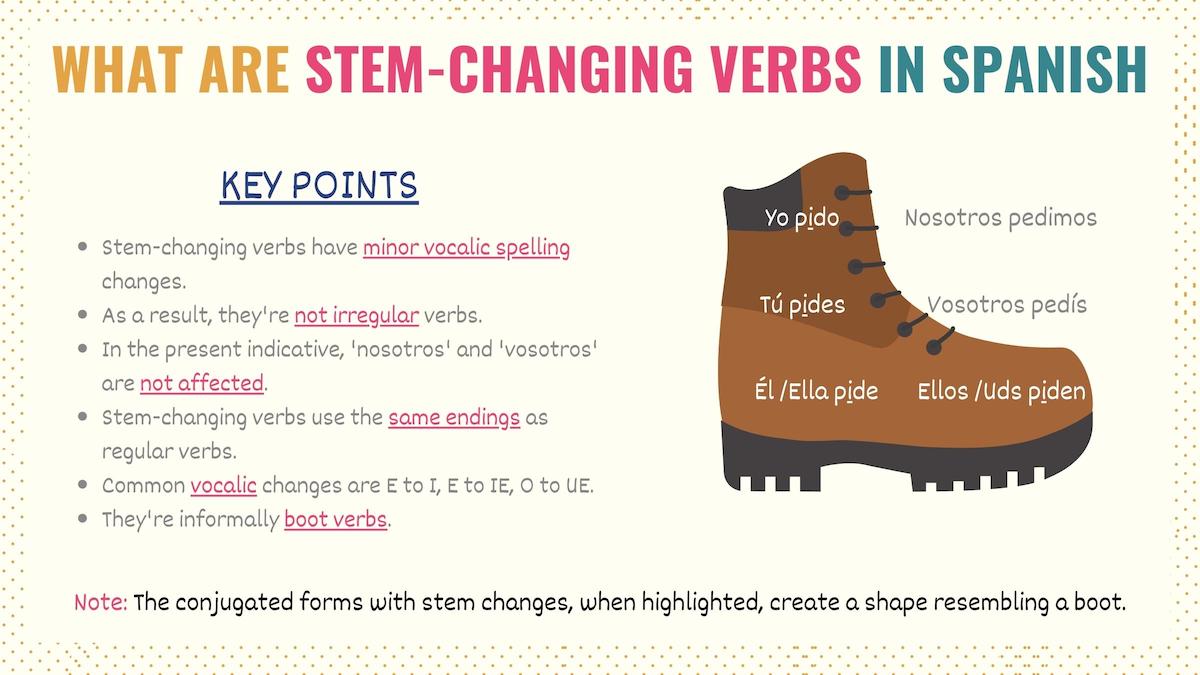
The key takeaway is that the nosotros and vosotros forms never have a stem change in the present tense. They are conjugated just like regular verbs.
To get a dynamic overview of this concept and why these changes happen (it's often to make pronunciation easier!), let's watch a short video.
Stem-Changing Verbs in Spanish: 90% of "Irregular" Verbs Solved
The video 'Stem-Changing Verbs in Spanish' by Tell Me In Spanish provides an excellent introduction to this topic. It clarifies the difference between stem-changing and truly irregular verbs and introduces the main patterns.
Please watch from the beginning until 03:44. Focus on understanding what a stem-changing verb is, the reason for the changes, and the crucial rule about 'nosotros' and 'vosotros' forms being excluded.
2. The Three Main Patterns
Now that you have the general concept, let's break down the three most common stem-change patterns in the present tense. The following article provides a great systematic explanation.
Spanish stem-changing verbs explained: Complete guide ...
The article 'Spanish stem-changing verbs explained' from the Berges Institute offers a clear, structured guide to the three main patterns, complete with verb lists and conjugation examples.
Please read the sections titled 'Stem-changing verbs in the present tense', 'e:ie', 'e:i', and 'o:ue'. As you read, pay attention to the example conjugations and the lists of other verbs that follow each pattern.
As you've just read, the main patterns are e→ie, o→ue, and e→i. Let's consolidate this information.
Pattern 1: e → ie
This is a very common pattern. The last e in the stem changes to ie for all forms inside the boot.
Example: querer (to want)
- yo quiero
- tú quieres
- él/ella/usted quiere
- nosotros queremos (no change)
- vosotros queréis (no change)
- ellos/ellas/ustedes quieren
High-Frequency e→ie Verbs:
pensar- to think (pienso)entender- to understand (entiendo)empezar- to begin (empiezo)cerrar- to close (cierro)preferir- to prefer (prefiero)
Two of the most important verbs in Spanish, tener (to have) and venir (to come), are also e→ie stem-changers, but with an irregular yo form:
tener: tengo, tienes, tiene, tenemos, tenéis, tienenvenir: vengo, vienes, viene, venimos, venís, vienen
Pattern 2: o → ue
Here, the last o in the stem changes to ue inside the boot.
Example: poder (to be able to / can)
- yo puedo
- tú puedes
- él/ella/usted puede
- nosotros podemos (no change)
- vosotros podéis (no change)
- ellos/ellas/ustedes pueden
High-Frequency o→ue Verbs:
dormir- to sleep (duermo)almorzar- to have lunch (almuerzo)encontrar- to find (encuentro)volver- to return (vuelvo)costar- to cost (cuesta)
A unique case: The verb
jugar(to play) is the only common verb with a u→ue stem change (juego,juegas, etc.).
Pattern 3: e → i
In this pattern, the e in the stem changes to i inside the boot. This change typically occurs in -ir verbs.
Example: pedir (to ask for, to order)
- yo pido
- tú pides
- él/ella/usted pide
- nosotros pedimos (no change)
- vosotros pedís (no change)
- ellos/ellas/ustedes piden
High-Frequency e→i Verbs:
servir- to serve (sirvo)repetir- to repeat (repito)seguir- to follow, to continue (sigo- also has an irregularyoform)vestir- to dress (visto)
Unfortunately, there's no simple rule to know which pattern a verb follows just by looking at it. This is something you'll acquire over time through exposure and practice. For now, when you learn a new verb, it's helpful to note if it's a stem-changer and which pattern it follows.
3. Practice Your Skills
Let's apply these patterns. Try to conjugate the verb in parentheses correctly. Remember to check if the subject is inside or outside the boot!
Test your understanding!
Complete the following sentences with the correct present tense form of the verb.
- Cristina no ______ (
poder) ir a la boda esta noche. (Cristina can't go to the wedding tonight.) - ¿Ustedes ________ (
entender) la diferencia? (Do you all understand the difference?) - Nosotros ________ (
almorzar) a la una de la tarde. (We have lunch at one in the afternoon.) - Yo ________ (
pedir) el pescado, por favor. (I'll order the fish, please.) - Mi hermano ________ (
querer) hablar con los novios. (My brother wants to talk with the bride and groom.)
Show answer
- puede (
poderis o→ue;Cristinaisella, which is inside the boot) - entienden (
entenderis e→ie;ustedesis inside the boot) - almorzamos (
almorzaris o→ue;nosotrosis outside the boot, so no change) - pido (
pediris e→i;yois inside the boot) - quiere (
quereris e→ie;mi hermanoisél, which is inside the boot)
Conclusion
Great work today. You've just learned one of the most important verb patterns in Spanish. By understanding this system, you've moved beyond simple regular verbs and can now correctly use a much wider range of vocabulary to express what you and others want, think, feel, and do.
Key Takeaways:
- Stem-changing verbs have a vowel change in their stem for most, but not all, present tense forms.
- The "boot" rule is a practical way to remember that
nosotrosandvosotrosforms do not change. - The three main patterns are e→ie, o→ue, and e→i.
- When learning a new verb, it's useful to memorize its stem-changing pattern.
Preview of the Next Lesson:
Now that you can conjugate more verbs, we'll look at a special category used to talk about daily routines and personal feelings: reflexive verbs. You'll learn how verbs like levantarse (to get up) and sentirse (to feel) work. Interestingly, sentirse is also an e→ie stem-changing verb, so what you've learned today will apply directly.