Hello! Welcome to your next lesson on building conversational Spanish.
In our last session, we tackled stem-changing verbs, giving you a systematic way to conjugate a large number of "irregular" verbs like querer (to want) and pedir (to order). You learned the "boot" rule and saw how verbs like vestir (to dress) change from e to i. This foundation will be very useful today.
This lesson focuses on a special category of verbs that are essential for talking about yourself—your daily routine and how you feel. The learning outcome is to use reflexive verbs (e.g., llamarse, sentirse) to talk about daily routines and feelings. These verbs are incredibly common in everyday conversation, so mastering them is a big step toward your goal of making small talk at the wedding in Colombia.
1. What is a Reflexive Verb?
A reflexive verb describes an action that the subject of the sentence performs on themself. The action "reflects" back onto the doer.
Think about the difference between these two actions:
- I wash the car. (The action, washing, is done to the car).
- I wash myself. (The action, washing, is done to me).
In Spanish, this second type of action requires a reflexive verb. You can identify reflexive verbs in their infinitive (dictionary) form because they end with -se. For example, lavar means "to wash," but lavarse means "to wash oneself."
To see this concept in action, watch the first part of this excellent video from Tell Me In Spanish.
Spanish Reflexive Verbs: How-To, 20 Verbs & My 1 RULE to make them EASY
This video clearly explains the core idea of reflexive verbs: the person doing the action is also the one receiving it. It contrasts a non-reflexive and a reflexive sentence to make the concept clear.
Please watch from 02:20 to 04:26. Focus on understanding the difference between a verb used non-reflexively (e.g., 'yo visto a la bebé' - I dress the baby) and reflexively ('yo me visto' - I dress myself).
As the video explained, to form a reflexive sentence, you need a special reflexive pronoun.
2. Reflexive Pronouns and Conjugation
The key to using reflexive verbs is pairing the correct reflexive pronoun with the subject. These pronouns are placed before the conjugated verb.
Here is a chart of the pronouns:
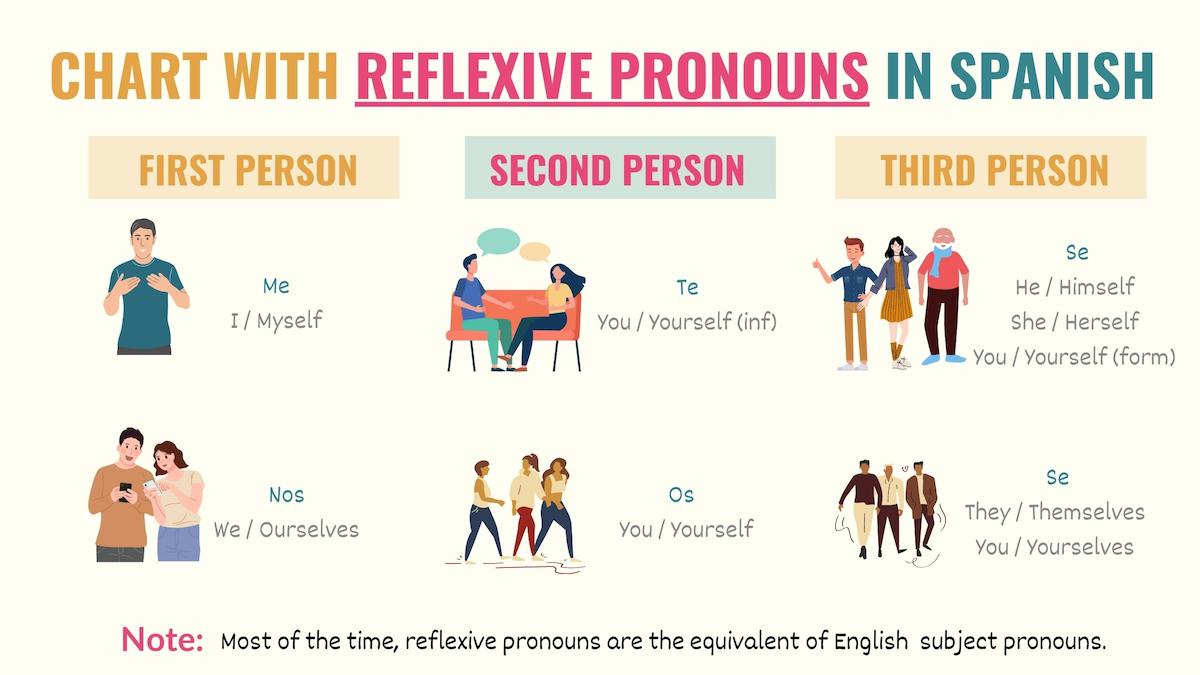
You've actually been using a reflexive verb since your very first lessons without knowing the mechanics: Me llamo... (My name is...). Literally, this means "I call myself..." Now you can see the pattern:
- Subject:
Yo(I) - Reflexive Pronoun:
me(myself) - Verb:
llamo(I call)
The Conjugation Process
The process is systematic, which should appeal to your engineering mindset.
- Start with the infinitive (e.g.,
levantarse- to get up). - Take the
-seoff the end and move it to the front, changing it to match the subject (me,te,se,nos,os,se). - Conjugate the remaining verb stem (
levantar) according to its ending (-ar,-er, or-ir) and any stem changes it might have.
Let's look at a text resource that provides clear examples of this process.
Understanding Reflexive Verbs in Spanish
The article 'Understanding Reflexive Verbs in Spanish' gives a step-by-step guide to conjugation. It covers regular verbs and, importantly, stem-changing reflexive verbs, connecting directly to our previous lesson.
Please read the sections titled 'How to Conjugate Reflexive Verbs in Spanish', 'Regular Reflexive Verb Conjugations', and 'Irregular Reflexive Verb Conjugations'. Pay close attention to the conjugation tables for lavarse (-ar), verse (-er), vestirse (-ir), and the stem-changing examples like despertarse.
As you saw in the reading, stem-changing rules still apply! Let's take two important verbs for this lesson:
vestirse(to get dressed), which you know is ane→istem-changer.sentirse(to feel), which is ane→iestem-changer.
Here is the conjugation for sentirse:
| Subject | Pronoun | Verb (sentir) |
Full Conjugation | Translation |
|---|---|---|---|---|
| Yo | me |
siento | Me siento | I feel |
| Tú | te |
sientes | Te sientes | You feel |
| Él/Ella/Usted | se |
siente | Se siente | He/She/You feel |
| Nosotros/as | nos |
sentimos | Nos sentimos | We feel |
| Vosotros/as | os |
sentís | Os sentís | You all feel |
| Ellos/Ellas/Ustedes | se |
sienten | Se sienten | They/You all feel |
Notice how the nosotros and vosotros forms are "outside the boot" — there is no stem change, just as you learned in the last lesson.
3. Application: Daily Routines and Feelings
Now for the practical part. Reflexive verbs are the primary tool for describing your daily routine and emotional states.
Talking About Your Daily Routine
Many actions you do to get ready for the day are reflexive. Here are some of the most common ones:
despertarse(o→ue) - to wake uplevantarse- to get upducharse- to showerbañarse- to batheafeitarse- to shavecepillarse(los dientes / el pelo) - to brush (one's teeth / hair)vestirse(e→i) - to get dressedacostarse(o→ue) - to go to bed
You can string these together to describe your morning:
Por la mañana, me levanto a las siete. Después, me ducho y me visto. Antes de salir, me cepillo los dientes.
(In the morning, I get up at seven. Afterwards, I shower and get dressed. Before leaving, I brush my teeth.)
Talking About Feelings
Reflexive verbs are also used to express how you feel. The most important one is sentirse. You combine it with adjectives to describe your emotional or physical state. Remember that the adjective must agree in gender with the person feeling the emotion.
sentirse(e→ie) - to feel- Me siento feliz. (I feel happy.)
- ¿Cómo te sientes? (How do you feel?)
- Ella se siente cansada. (She feels tired.)
- Nos sentimos emocionados. (We feel excited.)
preocuparse- to worry- No te preocupes. (Don't worry.)
enojarse- to get angry- Él se enoja fácilmente. (He gets angry easily.)
At the wedding, you could say: "Me siento muy feliz de estar aquí." (I feel very happy to be here.)
Test your understanding!
Fill in the blanks with the correct form of the reflexive verb in parentheses.
- Yo ___________ (
levantarse) a las 6:30 todos los días. - ¿A qué hora ___________ (
acostarse, o→ue) tú normalmente? - Mi amigo Carlos ___________ (
sentirse, e→ie) un poco enfermo hoy. - Nosotros ___________ (
prepararse) para la fiesta. - Ellos ___________ (
vestirse, e→i) para la boda.
Show answer
- me levanto (Subject:
yo-> pronounme, regular-arconjugationlevanto) - te acuestas (Subject:
tú-> pronounte,o→uestem changeacuestas) - se siente (Subject:
Carlos(él) -> pronounse,e→iestem changesiente) - nos preparamos (Subject:
nosotros-> pronounnos, regular-arconjugationpreparamos) - se visten (Subject:
ellos-> pronounse,e→istem changevisten)
Conclusion
Excellent work. You've now unlocked a fundamental structure in Spanish that will significantly increase your expressive power. By understanding the logic of reflexive verbs, you can now talk about personal routines and feelings, which are core components of any friendly conversation.
Key Takeaways:
- Reflexive verbs describe actions performed by the subject on themself. Their infinitive form ends in
-se. - They require a reflexive pronoun (
me,te,se,nos,os,se) placed before the conjugated verb. - The conjugation process is systematic: choose the pronoun, then conjugate the verb stem as usual, applying any stem-changes you've learned.
- These verbs are essential for describing daily routines (
levantarse,vestirse) and feelings (sentirse).
Preview of the Next Lesson:
In the next lesson, we'll explore another structure that uses pronouns: gustar and similar verbs. You'll learn how to express likes and dislikes (e.g., "I like the music," "They like the food"). The pronouns used with gustar are very similar to the reflexive pronouns you learned today, so you're already one step ahead.