Hello! Welcome back to your Spanish course.
In our last lesson, you learned how to use reflexive verbs to talk about daily routines and feelings, like me levanto (I get up) and me siento feliz (I feel happy). You got familiar with using pronouns (me, te, se) that are placed before the verb.
Today, we're going to build on that by exploring a structure that also uses these pronouns but with a completely different logic. This lesson is dedicated to helping you use 'gustar' and similar verbs with indirect object pronouns to express likes and dislikes. Mastering this is crucial for your goal of making small talk, as it allows you to share opinions and ask others about their preferences—a cornerstone of any friendly conversation.
1. The Core Concept: A Shift in Sentence Structure
In English, when you like something, you are the subject performing an action on an object: "I (subject) like (verb) the music (object)."
Spanish approaches this idea from a different angle. Instead of saying you like something, you say that something is pleasing to you. The thing you like becomes the subject of the sentence, and you become the indirect object.
- English: I like the music.
- Spanish Literal: The music is pleasing to me. (
La música me gusta.) - Spanish Common Word Order:
Me gusta la música.
This structural difference is the most important concept to grasp. It's a system with its own internal logic.
To see a clear breakdown of this structural shift, please read the following short article. Its analytical approach should resonate with your engineering background.
The article 'Verbs Like Gustar' from StudySpanish.com provides an excellent explanation of why the Spanish structure differs from English. It methodically breaks down the roles of the subject and object in both languages.
Please read the initial sections, starting from the 'Notes' and ending just before the text 'Notice that the conjugation of gustar changes to 'gusta'...'. Focus on understanding the analysis of the sentence parts: 'I like the room' versus 'The room is pleasing to me'.
The Pronouns You'll Need
Because you are the person to whom something is pleasing, you use an Indirect Object Pronoun (IOP). They look very similar to the reflexive pronouns you just learned, but their function is different.
| Person | Indirect Object Pronoun | Translation |
|---|---|---|
| yo | me | to me |
| tú | te | to you (informal) |
| él/ella/usted | le | to him/her/you (formal) |
| nosotros/as | nos | to us |
| vosotros/as | os | to you all (informal) |
| ellos/ellas/ustedes | les | to them/you all (formal) |
The video below gives a great introduction to this concept, emphasizing from the start that you must use these pronouns, not subject pronouns like yo or tú.
Me gusta - "to like" in Spanish
In this video, 'Me gusta - "to like" in Spanish', the host Ana from Butterfly Spanish explains the basics of 'gustar'. Her enthusiastic delivery helps make this tricky concept stick.
Please watch from the beginning until 04:31. Pay attention to her rule: NEVER use subject pronouns like 'yo' with 'gustar'. Focus on memorizing the list of indirect object pronouns she presents.
2. The Mechanics: gusta or gustan?
Since the thing being liked is the subject of the sentence, the verb gustar must agree with it. This simplifies things greatly. You will almost always use only two forms of gustar in the present tense:
-
gusta(singular): When the thing you like is a singular noun OR an activity (an infinitive verb).Me gusta **la comida**.(I like the food.)Me gusta **bailar**.(I like to dance.)
-
gustan(plural): When the thing you like is a plural noun.Me gustan **los perros**.(I like dogs.)
That's the rule. The verb form depends on what is liked, not on who is doing the liking.
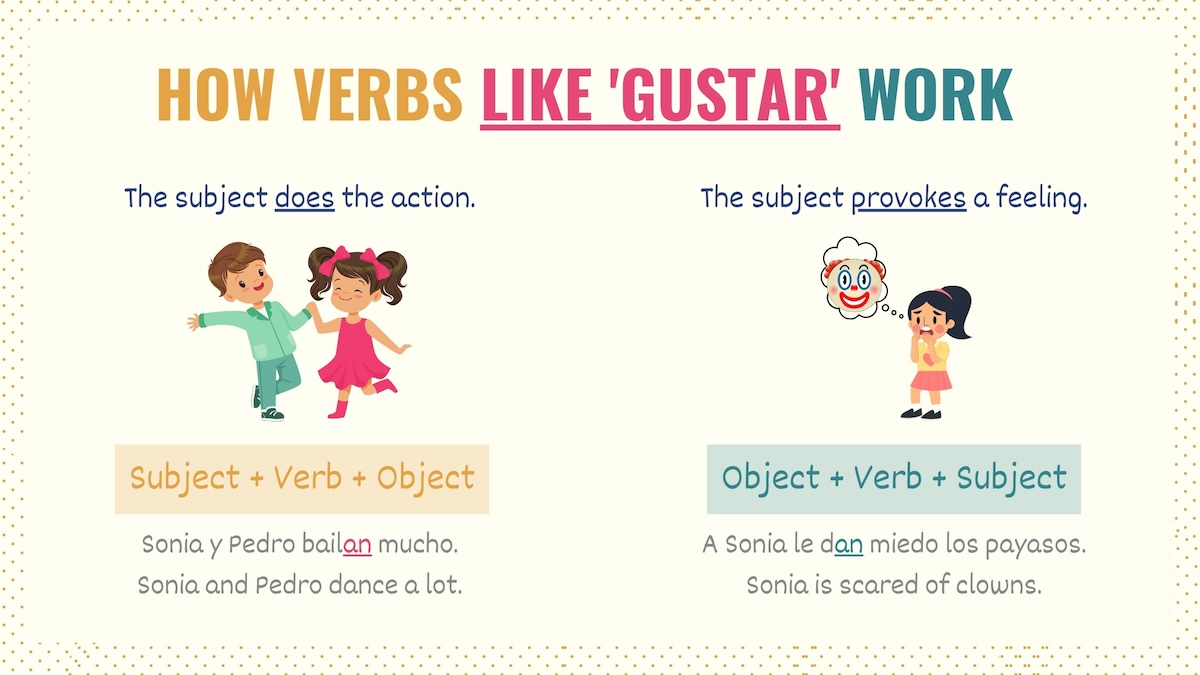
This infographic provides a clear, systematic visual of the sentence structure.

Now, let's see this in action. The next part of the Butterfly Spanish video provides excellent examples.
Me gusta - "to like" in Spanish
This segment of the video clearly demonstrates the difference between 'gusta' and 'gustan' and also shows how to use 'gustar' with infinitives to talk about activities you like.
Please watch from 04:48 to 14:47. Notice how the verb changes for singular subjects ('el árbol') and plural subjects ('las palomitas'). Then, see how it's used with infinitives like 'caminar' (to walk) and 'comer' (to eat).
Test your understanding!
Choose between gusta and gustan to complete the sentences.
- A mí me _________ el café colombiano. (I like Colombian coffee.)
- A ella le _________ las bodas. (She likes weddings.)
- A nosotros nos _________ viajar. (We like to travel.)
- ¿A ti te _________ los postres? (Do you like desserts?)
Show answer
- gusta. The subject is
el café colombiano(singular). - gustan. The subject is
las bodas(plural). - gusta. The subject is
viajar(an infinitive verb). - gustan. The subject is
los postres(plural).
3. Adding Clarification and Emphasis
You may have noticed a potential problem. Le gusta can mean "He likes," "She likes," or "You (formal) like." How do you know which one it is?
To clarify or emphasize who is doing the liking, you add a prepositional phrase at the beginning of the sentence using a + [name/pronoun].
- Clarification:
A Juan le gusta la música.(Juan likes the music.)A ella le gusta la música.(She likes the music.)
- Emphasis: Even when there's no ambiguity, you can use it for contrast or emphasis.
A mí me gusta el vino tinto, pero a ella le gusta el vino blanco.(I like red wine, but she likes white wine.)
This structure is optional for me, te, and nos (used for emphasis), but it's very common with le and les to provide clarity.
This section of the 'Verbs Like Gustar' article clearly explains the logic behind using prepositional phrases like 'A él' or 'A Juan' for both clarification and emphasis.
Please read the section that begins with the table of examples ('Me gusta la casa', etc.) and continues to the list of other verbs. Focus on understanding why and when to add the 'A + person' phrase.
4. Expanding Your Toolbox: Other gustar-like Verbs
The gustar structure isn't a one-off; it's a pattern that applies to a whole category of verbs used for expressing opinions, feelings, and perceptions. Learning the pattern for gustar unlocks all of them.
Here are a few of the most important ones for conversation:
encantar: to love something (in a non-romantic way). It's a stronger version ofgustar.Me encanta la comida colombiana.(I love Colombian food.)
interesar: to interest.¿Te interesa la tecnología?(Does technology interest you?)
caer bien/mal: to like/dislike a person (platonically). This is a crucial expression. Usinggustarfor a person can imply romantic interest. To say you like someone as a friend,caer bienis the correct choice.El novio me cae muy bien.(I really like the groom / The groom seems very nice to me.)
This next video explains these verbs very practically, building on the same gustar logic.
Lesson 7: Gustar, Encantar, Doler and Caer Bien/Mal
The video 'Lesson 7: Gustar, Encantar, Doler and Caer Bien/Mal' explains how the 'gustar' structure applies to other useful verbs. The explanation of 'caer bien/mal' is particularly important for social contexts like a wedding.
Please watch from 09:19 to 20:29. Focus on how 'gustar', 'encantar', and especially 'caer bien' follow the same rules you've just learned. The short list of other verbs at the end will show you how versatile this pattern is.
Conclusion
Fantastic work today. This is one of the trickiest concepts for English speakers to learn, but by approaching it systematically, you've cracked the code. You now have the grammatical tool to express your opinions, a key ingredient for engaging in the kind of small talk you're aiming for.
Key Takeaways:
- The
gustarstructure is "backwards" from English: The thing being liked is the subject, and the person liking is an indirect object. - You must use an Indirect Object Pronoun (
me, te, le, nos, os, les). - The verb is conjugated as
gustafor singular nouns and verbs, andgustanfor plural nouns. - Use the
a + name/pronounstructure to clarify ambiguity (le/les) or add emphasis. - This pattern extends to other useful verbs like
encantar(to love),interesar(to interest), andcaer bien(to like a person).
Preview of the Next Lesson:
You've just learned the structure for talking about what you like to do (Me gusta...). In our next lesson, "Describe hobbies and leisure activities," we'll focus on the vocabulary to fill in those sentences. You'll learn the words for common hobbies and activities, allowing you to have full conversations about your interests and ask others about theirs.