Hello! Welcome to a brand new module: Visual Design and the Brain.
In our last module, we explored the internal, emotional drivers of decision-making, culminating in the Somatic Marker Hypothesis. We learned how our "gut feelings" are rooted in bodily responses to our environment, including sensory experiences. Now, we're going to dive deep into our most dominant sense: vision.
Today's lesson is the first step on that journey. Before we can talk about logo design, website layouts, or color psychology, we need to understand the fundamental mechanics of sight. Your learning outcome is to explain how the visual cortex processes fundamental elements like color, shape, and movement. We will unpack how the brain deconstructs the visual world into basic building blocks before reassembling it into the rich reality we perceive.
This is crucial for your goals. To create visually effective marketing or to explain its success to a client, you need to appreciate that the brain doesn't see like a camera takes a picture. It's an active, interpretive process, and understanding that process from the ground up is the key to influencing it.
1. The Journey of Light: From Eye to Brain
When you look at something—say, a red stop sign—the process of seeing seems instantaneous. But as we'll see, it's a rapid sequence of events.
The journey begins when light, which is made up of different wavelengths corresponding to different colors, reflects off the stop sign and enters your eye. This light is focused onto the retina at the back of your eye. The retina is lined with millions of light-sensitive cells called photoreceptors—rods (for low light vision) and cones (for color vision).
When light hits these cells, they convert the light energy into electrical signals. These signals then travel out the back of the eye along the optic nerve toward their destination in the brain: the occipital lobe.

The main hub within the occipital lobe is the visual cortex. This is where the raw electrical signals from the eye begin to be decoded.
To get a clear, step-by-step summary of this entire pathway, please read this piece from the American Museum of Natural History.
Please read the numbered list under the heading 'What happened?'. It walks you through the entire process from light hitting an object to the brain creating a perception. Pay special attention to steps 6 and 7, which describe the roles of the visual cortex.
2. The Visual Cortex: A Feature Detection Factory
As the reading mentioned, the visual cortex is where the magic of perception begins. However, the first stop for visual information, an area called the primary visual cortex (V1), doesn't "see" a stop sign. Instead, it acts like a disassembly line, breaking the image down into its most fundamental features.
The brain does this using highly specialized neurons. In the 1950s and 60s, neuroscientists David Hubel and Torsten Wiesel won a Nobel Prize for discovering that individual neurons in the visual cortex are tuned to respond to very specific stimuli.
- One neuron might fire only when it detects a vertical line.
- A neighboring neuron might fire only for a horizontal line.
- Others respond specifically to lines at a 45-degree angle.
- Still others are dedicated to detecting movement in a particular direction, or specific colors.
So, when you look at that stop sign, your V1 isn't processing "stop sign." It's activating a whole population of neurons: some for the red color, some for the vertical edges, some for the horizontal edges, and some for the diagonal edges that make up the letters S-T-O-P.
The Occipital Lobe, Visual Cortex - Location and Function
This video from Psych Explained provides a great overview of how the visual cortex processes these basic features. It makes the concept of specialized neurons very clear.
Please watch from 4:51 to 7:21. The video will first explain how the visual cortex processes size, shape, motion, and color. It then introduces the Hubel and Wiesel research on specialized neurons that we just discussed.
3. Building Up Perception: From Lines to Objects
If the primary visual cortex only sees lines, colors, and motion, how do we perceive a complete, unified object? The brain accomplishes this through a hierarchy of processing.
Information flows from the primary visual cortex (V1) to subsequent visual areas (V2, V3, etc.), and at each stage, the processing becomes more complex.
- Simple Cells: In V1, "simple cells" respond to lines of a specific orientation in a specific location in your field of view.
- Complex Cells: Also in V1, "complex cells" receive input from multiple simple cells. This allows them to respond to a line of a specific orientation anywhere within a certain area. They are less picky about location and start to detect features like edges.
- Higher-Level Processing: As the signal moves to other visual areas, neurons there combine the inputs from many complex cells. Neurons in these higher areas might respond to more complex shapes, like corners, curves, or even entire objects like faces.
It’s like an assembly line in reverse. Simple features (lines, colors) are detected first, then combined into slightly more complex features (corners, textures), which are then combined to form recognizable objects.
The Nature of Seeing | How the Brain Constructs the Visual World
The Allen Institute has produced an excellent animation that visualizes this hierarchical process. It shows how the brain builds up our perception of the world from simple spots of light.
Please watch from 1:46 to 3:55. Focus on how the video illustrates the progression from neurons that detect spots, to those that detect edges (simple cells), to those that detect lines more broadly (complex cells), and finally up to shapes, objects, and faces.
Test your understanding!
A brand is designing a new logo. The logo is a simple blue square. Based on what you've learned about hierarchical processing, describe the sequence of events in the visual cortex that allows a customer to perceive this logo.
Show answer
- Retina & Optic Nerve: Light reflecting off the blue square enters the eye, and the cone cells sensitive to blue wavelengths are strongly activated. They send electrical signals down the optic nerve.
- Primary Visual Cortex (V1) - Feature Detection: The signals arrive in V1. Here, specific populations of specialized neurons fire in response to the fundamental elements:
- Neurons tuned to the color blue are activated.
- Neurons tuned to vertical lines fire in response to the left and right sides of the square.
- Neurons tuned to horizontal lines fire in response to the top and bottom sides.
- Higher Visual Areas - Feature Combination: The information from these feature-detecting neurons is passed on.
- Simple and Complex cells combine these line signals to recognize the four edges.
- Cells in higher visual areas (like V2, V4) receive input from the "edge" cells and the "color" cells. They combine these signals to register four corners and a uniform blue surface, ultimately leading to the perception of a single, coherent object: a "blue square."
4. Separate Pathways for "What" and "Where"
A final key principle is that the brain processes this information in parallel streams. After the initial feature breakdown in V1, the information is sent along two major pathways. While we will cover this in more detail later, it's useful to know they exist.
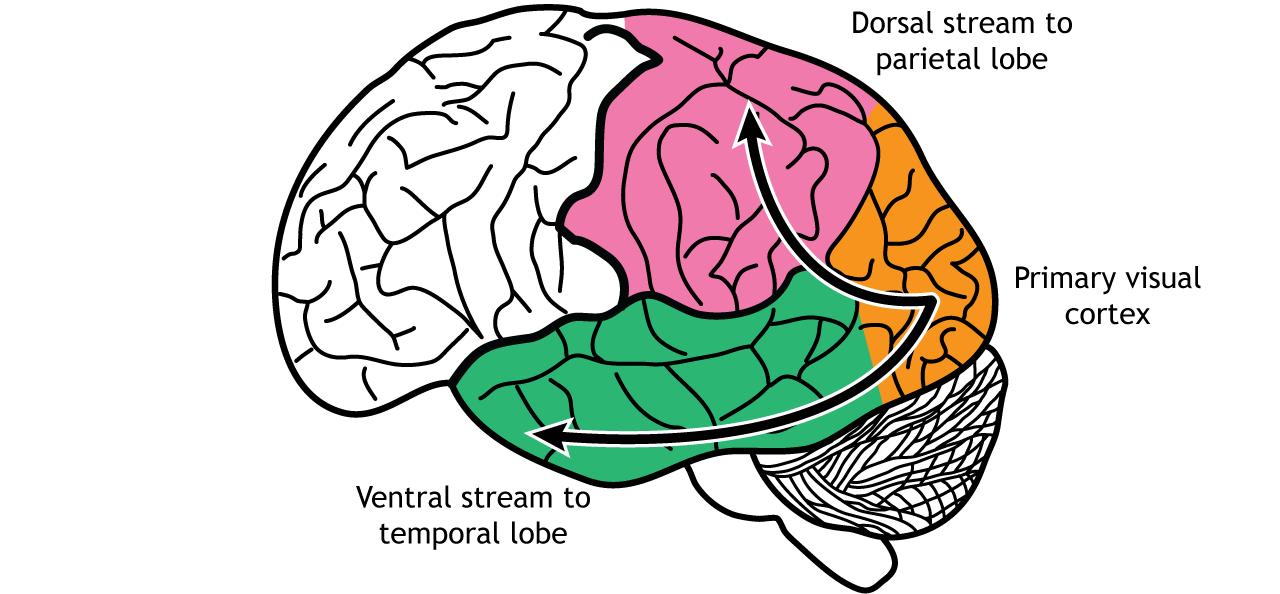
- The Ventral Stream ("What" Pathway): Processes information about object identification, like shape and color. This is the pathway that helps you recognize that you are looking at a logo.
- The Dorsal Stream ("Where" Pathway): Processes spatial information, like location and movement. This pathway helps you see where the logo is on the page or if it's part of an animation.
This division of labor makes the brain incredibly efficient. It can analyze what an object is and where it is at the same time.
Vision: Processing Information
To confirm this idea of separate processing systems, let's read a concise summary from BrainFacts.org.
Please read the two paragraphs under the main heading 'Vision: Processing Information'. Focus on the final paragraph, which explicitly states that visual signals are fed into separate systems for shape, color, and movement/location.
Conclusion
Today, we've laid the essential groundwork for understanding visual marketing. We've seen that the seemingly simple act of seeing is a complex process of deconstruction and reconstruction performed by the brain.
Key Takeaways:
- Vision is not a passive recording but an active construction that begins in the visual cortex within the occipital lobe.
- The primary visual cortex (V1) acts as a feature detector, using specialized neurons to break down images into fundamental elements: color, shape (lines/edges), and movement.
- The brain uses a hierarchical system to build up perception, combining simple features into complex objects as information flows through different visual areas.
- Visual information is processed in parallel streams, most notably the "what" pathway (for color and shape) and the "where" pathway (for motion and location).
How to Communicate This:
When explaining this to someone in business, you can use the analogy of a specialized team. Imagine your brain has a team of experts to look at an ad. One expert only looks for vertical lines. Another only looks for the color red. A third only watches for movement. A manager (a higher brain area) then takes the reports from all these specialists to figure out what the ad is showing. This helps explain why every single visual element matters—it's being analyzed by its own specialist in the brain.
In our next lesson, we will focus on the first of these fundamental elements: color. We'll explore the psychological effects different colors have on our emotions and perceptions, and how marketers leverage this to build powerful brands.