Hello! Welcome to the final lesson in our module on the "Psychology of Decision-Making."
In our last session, we explored how powerful external cues, specifically social proof, influence our choices by leveraging our instinct to follow the herd. We saw how testimonials and popularity signals can calm the brain's risk detectors and build trust.
Today, we're shifting our focus from the external world to the internal. We'll examine how our own bodies create "gut feelings" that guide our decisions, often without us even realizing it. Your learning outcome is to explain the 'somatic marker hypothesis' and how gut feelings, driven by emotion, guide consumer decisions.
This concept is the science behind familiar phrases like "trust your gut" or a product "just feeling right." Understanding this will give you a powerful new way to analyze and explain why some marketing efforts connect with consumers on a deep, intuitive level.
1. The Flaw of Pure Reason: Why We Need Emotions to Decide
We often like to think of ourselves as rational decision-makers. However, groundbreaking work by neuroscientist Antonio Damasio revealed a startling truth: without emotion, our ability to make even simple decisions collapses.
To understand why, let's look at the real-life cases that inspired Damasio. The most famous is a patient he called "Elliot," who, after surgery to remove a brain tumor, lost his ability to feel emotions but retained his full intellect. The consequences were profound.
Do We Need Emotions to Make Decisions? The Somatic Marker Hypothesis
To grasp the importance of emotion in decision-making, let's watch a brief overview of the Somatic Marker Hypothesis from the PsychExamReview channel. This will introduce you to the foundational case studies.
Please watch from the beginning until 4:13. Pay close attention to the story of the patient Elliot. Notice how his intact logic wasn't enough to help him make everyday choices.
As you saw, Elliot could logically analyze the pros and cons of any choice, but because no option felt better than another, he was paralyzed by indecision. He could "know, but not feel." This showed that rational thought alone isn't enough; we need an emotional compass to guide us.
Elliot's damage was in a specific part of the brain called the ventromedial prefrontal cortex (vmPFC). This area acts as a critical hub, integrating our logical thoughts with our emotional and bodily states. When this link is broken, decision-making fails.
2. The Somatic Marker Hypothesis: Your Body's Decision-Making Shortcut
Based on observations like these, Damasio proposed the Somatic Marker Hypothesis. Let's break down the name:
- Somatic: From the Greek word soma, meaning "body."
- Marker: A tag or a label.
The hypothesis suggests that when you face a choice, your brain quickly brings up past experiences related to similar choices. It doesn't just recall the facts; it re-activates the bodily feeling (the emotion) associated with the outcome of that past experience.
This "gut feeling" is a somatic marker.
- A positive outcome from the past creates a pleasant gut feeling, pushing you toward that option.
- A negative outcome creates an unpleasant gut feeling, steering you away from that option.
These markers act as an unconscious, super-fast filtering system. They instantly tag options as "good" or "bad," dramatically simplifying your decision by narrowing down the choices your conscious mind needs to analyze.
The Somatic Marker Hypothesis: What Are You Thinking?
For a clear, written explanation, let's turn to this article from iMotions. It clearly defines the hypothesis and its core components.
Please read the introduction ('What Are You Thinking?'), the section titled 'The Somatic Marker Hypothesis', and the conclusion 'Going With Your Gut'. Focus on the formal definition and the idea that our 'gut instinct' is a real physiological process.
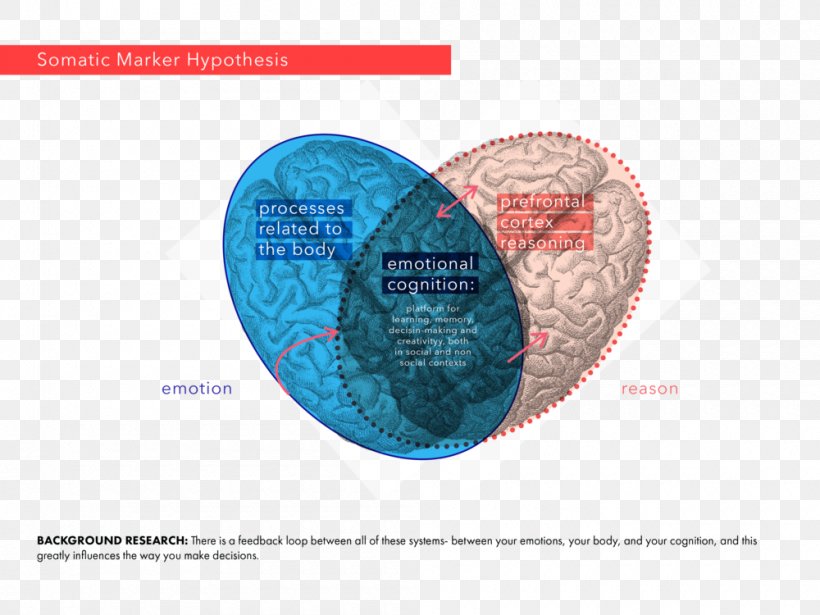
A fascinating aspect of this is the "as-if loop." You don't always need a full-blown physical reaction. Your brain can simulate the feeling of a past emotion, giving you that intuitive nudge without you breaking a sweat. For example, just thinking about a brand you love might create a faint, "as-if" feeling of happiness, biasing you toward choosing it.
3. Proof in the Lab: The Iowa Gambling Task
To test this hypothesis, researchers designed a brilliant experiment called the Iowa Gambling Task. It simulates real-world decision-making under uncertainty, with risks and rewards.
Do We Need Emotions to Make Decisions? The Somatic Marker Hypothesis
Let's return to the PsychExamReview video to see how this experiment works. It provides the crucial evidence for the Somatic Marker Hypothesis.
Please watch from 4:36 to 8:33. Focus on the difference between the 'dangerous' decks (A & B) and the 'safe' decks (C & D), and how the bodies of healthy participants responded differently than those of patients with vmPFC damage.
The findings from this task are the cornerstone of the hypothesis:
- Healthy participants gradually learned to prefer the "good" decks. Crucially, their bodies showed a physiological stress response (measured by Galvanic Skin Response, or GSR) when they merely considered picking from the "bad" decks. This bodily signal—the somatic marker—appeared before they could consciously explain which decks were better. Their gut was guiding them.
- Patients with vmPFC damage (like Elliot) never developed this anticipatory gut feeling. Even if they eventually figured out intellectually which decks were bad, they continued to choose them and lost money. They lacked the emotional markers needed to translate knowledge into good decisions.
4. Application in Marketing: Creating Positive Gut Feelings
This brings us to the core of your interest: how is this relevant to marketing? Brands that succeed are masters at creating positive somatic markers. They design experiences that make consumers feel good, so that later, their product or brand "just feels right."
This is achieved by associating the brand with positive emotional and sensory experiences.
The Influence of Emotions on the Purchasing Decision-Making Process
This research paper on the influence of emotions in purchasing directly connects the Somatic Marker Hypothesis to consumer behavior. Let's read the key section.
Please read section 2.1, 'Somatic Marker Hypothesis' (starting on page 107). Notice the practical e-commerce example given at the end of the section, which perfectly illustrates how positive and negative experiences create somatic markers that influence future purchases.
Here are some ways marketers put this into practice:
- Sensory Marketing: The smell of freshly baked bread in a supermarket, the satisfying weight of a luxury watch, or the sound of a soda can opening in an ad. These sensory inputs create real bodily responses that become linked to the product.
- Emotional Advertising: An ad that tells a heartwarming story doesn't just entertain you. It builds a positive somatic marker. The next time you see that brand on a shelf, the "as-if" loop might trigger a faint echo of that warmth, making you more likely to buy it.
- Customer Experience: A seamless website, a friendly customer service agent, or hassle-free returns all contribute to positive emotional experiences. These experiences create somatic markers that translate into brand loyalty. A bad experience, as the article noted, creates a powerful negative marker that drives customers away.
Marketers can even measure these subtle bodily reactions using tools like facial coding (to detect a subconscious smile) or GSR (to measure emotional arousal), as a way to see if their ads are creating the desired somatic markers.
Test your understanding!
Imagine you are a marketing consultant for two coffee brands.
- Brand A sells its coffee in a standard, flimsy pouch. Its advertising focuses only on the low price.
- Brand B sells its coffee in a thick, textured paper bag with a satisfying resealable zip. Its advertising shows people relaxing and smiling with friends while enjoying the coffee in a cozy setting.
Based on the Somatic Marker Hypothesis, which brand is more likely to build long-term customer preference, and why?
Show answer
Brand B is far more likely to build long-term preference.
Here's why, according to the Somatic Marker Hypothesis:
- Haptic (Touch) Markers: The thick, textured bag of Brand B creates a positive sensory experience. The physical feeling of quality and the satisfying sound of the zip create small, positive somatic markers every time the customer interacts with the product. Brand A's flimsy pouch creates a neutral or even slightly negative marker.
- Emotional Markers: Brand B's advertising focuses on creating a positive emotional association (relaxation, friendship, comfort). This builds a powerful positive somatic marker with the brand itself. When a consumer thinks of Brand B, their brain's "as-if" loop may trigger a faint feeling of that comfort, making the choice feel good.
- Brand A, by contrast, is only building a rational association with price. It is not creating any positive emotional or sensory feelings, and therefore is not building the strong, intuitive preference that drives loyalty.
Conclusion
Today, we've journeyed into the brain's decision-making core and seen that gut feelings are not just vague intuitions—they are real, physiological signals that are essential for navigating our world.
Key Takeaways:
- The Somatic Marker Hypothesis proposes that emotion-driven bodily signals ("gut feelings") guide our decisions by tagging choices as good or bad based on past experiences.
- The ventromedial prefrontal cortex (vmPFC) is the brain region that integrates these emotional markers with our rational thoughts.
- The Iowa Gambling Task provides key evidence, showing that our bodies react to risk before our conscious minds do, and without this reaction, decision-making is impaired.
- In marketing, brands cultivate positive somatic markers through sensory experiences, emotional branding, and excellent customer service to make their products "feel right" to the consumer.
This lesson concludes our module on the Psychology of Decision-Making. You now have a framework that includes conscious vs. unconscious processing, cognitive biases, prospect theory, social proof, and now, the role of gut feelings.
In our next module, "Visual Design and the Brain," we will begin to apply these foundational principles to the specific senses, starting with our most dominant one: vision. We will explore how the brain processes color, shape, and faces, and how you can use this knowledge to create visually compelling marketing.