In our previous lesson, we mapped out the main digital marketing channels, establishing the distinct roles of social media, content, email, and search. You now have a high-level view of the tools marketers use. Today, we'll introduce the strategic framework that guides how and when to use those tools: the digital marketing funnel.
This lesson is crucial because it provides the "why" behind marketing actions. It explains the path people take from being complete strangers to becoming loyal customers. Understanding this journey is the foundation for building effective marketing campaigns. For your goal of mastering Meta Ads, this framework is indispensable, as every successful ad campaign is built around guiding users through these stages. By the end of this lesson, you will be able to explain the four core stages of the funnel: awareness, consideration, conversion, and retention.
From Customer Journey to Marketing Funnel
Before we define the funnel itself, it's important to understand the concept of the customer journey. This is the complete set of interactions a person has with a brand on their path to making a purchase. The marketing funnel is a model that businesses use to visualize and plan for that journey from their perspective.
To get a clear introduction to this idea, please watch the following video from the Google Career Certificates program. It does an excellent job of defining the funnel and explaining how it relates to the customer journey.
The Customer Journey & the Marketing Funnel | Google Digital Marketing & E-commerce Certificate
Start by watching the section that introduces the marketing funnel and its four stages. Pay close attention to the definition of each stage.
Please watch from the main explanation. After that, continue with the next short segment which clarifies the complementary relationship between a customer journey map and a marketing funnel, from this section.
As the video explained, the key distinction is perspective:
- A customer journey map follows the unique, often non-linear path of a specific customer.
- A marketing funnel is the business's simplified, linear model for guiding large numbers of potential customers from one broad stage to the next.
While individual journeys are complex, the funnel gives us a powerful framework to structure our marketing strategy.
The Four Stages of the Digital Marketing Funnel
Marketers often use the acronyms TOFU, MOFU, and BOFU to refer to the different parts of the funnel. This stands for Top of Funnel, Middle of Funnel, and Bottom of Funnel. The image below shows how these map to the stages we are discussing.

Let's break down each stage, focusing on the customer's mindset and the corresponding marketing goals, particularly as they apply to Meta Ads.
1. Awareness (TOFU - Top of Funnel)
This is the "first date" stage. The goal is to introduce your brand to a cold audience—people who have likely never heard of you before. You're not trying to sell anything yet; you're simply making them aware that you exist.
- Customer Mindset: "I'm not looking to buy anything. I'm just scrolling through my feed for interesting content," or "I have this vague problem, but I haven't started looking for a solution."
- Marketing Goal: Capture attention, generate reach, and make a memorable first impression.
- Common Tactics: Entertaining or educational videos, informative blog posts, engaging social media content.
For a deeper look at how this applies directly to Meta Ads, the article "Meta Ads Funnel Strategy" from Stackmatix is an excellent resource.
Meta Ads Funnel Strategy: Full-Funnel Framework 2026
This section explains the specific objectives, targeting methods, and creative approaches for Top-of-Funnel campaigns on Meta's platforms.
Please read the section titled TOFU Campaigns. Focus on the recommended campaign objectives (like Awareness and Video Views) and the broad targeting strategies.
As the article notes, the key at the TOFU stage is to use broad targeting and content that focuses on education or entertainment rather than a hard sell.
2. Consideration (MOFU - Middle of Funnel)
Once someone is aware of your brand, they enter the consideration stage. Here, your goal is to build trust and help a warm audience evaluate your offer. They know who you are, and now they're trying to figure out if you're the right solution for them. This is where your experience in lead generation fits squarely.
- Customer Mindset: "I'm researching my options. Why should I choose this brand over others? Can I trust them?"
- Marketing Goal: Nurture interest, build credibility, and capture leads.
- Common Tactics: Case studies, customer testimonials, detailed product demos, webinars, free guides or checklists (lead magnets).
The following video from digital marketing expert Jamie Stenton provides two fantastic, real-world case studies of effective tactics at this stage. He shows how to create a low-risk offer that moves people from awareness into consideration.
Facebook Ads Funnel Strategy for Business Growth | Build & Scale Your Marketing Funnel in 2025
Watch these two examples to see how businesses use the funnel concept to generate leads without being overly sales-focused at the start.
Please watch the segment from the case studies on Toner Legal and the Surrey Park Clinic. Notice how they use a questionnaire and a free call to engage potential customers.
Now let's return to the Stackmatix article to see how this translates into a Meta Ads strategy.
Meta Ads Funnel Strategy: Full-Funnel Framework 2026
This part of the article details how to target people who have already engaged with your brand and what kind of content to show them.
Read the section on MOFU Campaigns. Pay attention to the types of audiences you target here (e.g., video viewers, social engagers) and the campaign objectives, like Traffic and Lead Generation.
At the MOFU stage, you shift from broad audiences to retargeting people who have already shown interest. Your ad creative becomes more detailed, addressing customer questions and showcasing social proof like testimonials.
3. Conversion (BOFU - Bottom of Funnel)
This is the moment of truth. The audience is hot—they know you, trust you, and are on the verge of making a decision. Your job is to make it as easy and compelling as possible for them to take the final step.
- Customer Mindset: "I'm ready to buy. I just need a final nudge or a good reason to act now."
- Marketing Goal: Drive a specific action, such as a purchase, a form submission, or a booking.
- Common Tactics: Limited-time offers, promotional discounts, clear "Buy Now" calls-to-action, abandoned cart reminders, a seamless checkout process.
Let's look at the final piece from the Stackmatix article on BOFU strategy.
Meta Ads Funnel Strategy: Full-Funnel Framework 2026
This section focuses on the campaign elements designed to close the deal with your most interested prospects.
Read the section on BOFU Campaigns. Note the high-intent audiences (e.g., "Add to Cart") and the direct, action-oriented creative.
BOFU campaigns are highly targeted, focusing only on those who have shown clear purchase intent. The messaging is direct, often featuring specific products and offers designed to prompt immediate action.
4. Retention & Loyalty
The journey doesn't end with a single purchase. The most profitable marketing strategies focus on turning one-time buyers into repeat customers and brand advocates.
- Customer Mindset: "I made the right choice. I like this brand and the experience they provide."
- Marketing Goal: Encourage repeat purchases, increase customer lifetime value (LTV), and generate referrals.
- Common Tactics: Post-purchase follow-up emails, loyalty programs, exclusive content for customers, excellent customer service.
This final stage is about maximizing the value of the customers you've worked so hard to acquire. The Stackmatix article has a great section on this as well.
Meta Ads Funnel Strategy: Full-Funnel Framework 2026
This short section explains how the funnel extends beyond the initial purchase to build long-term value.
Read the section Post-Purchase: Retention and Loyalty Campaigns.
As you can see, even after a conversion, you can continue to use Meta Ads to cross-sell, upsell, and remind customers to repurchase, often with the highest return on investment.
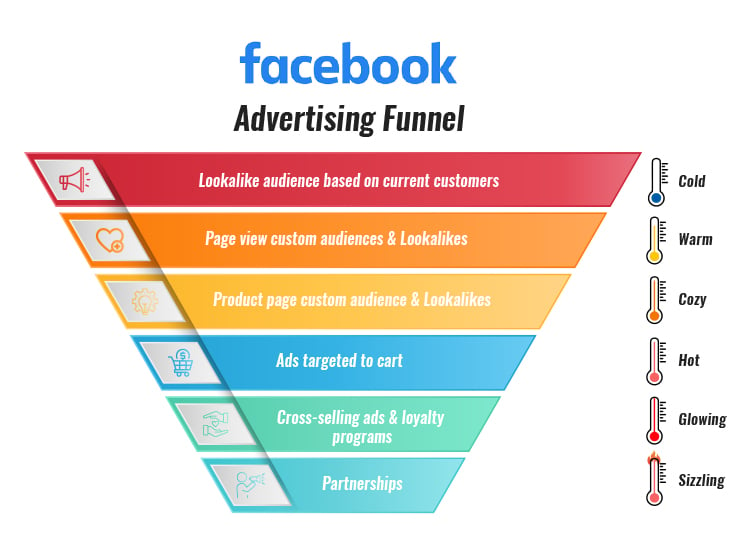
This image of a Facebook Advertising Funnel visually summarizes how audience "temperature" and ad strategies align as people move through the stages.
Conclusion
Today, we've unpacked the digital marketing funnel, the strategic backbone of any successful marketing plan. You now have a clear model for understanding the customer journey and how to tailor your efforts to each stage.
Key Takeaways:
- The marketing funnel is a business's model for guiding potential customers through four key stages: Awareness (TOFU), Consideration (MOFU), Conversion (BOFU), and Retention.
- Awareness is about introducing your brand to new, cold audiences with engaging, non-salesy content.
- Consideration is about building trust with warm audiences by providing value, social proof, and opportunities to learn more (e.g., lead generation).
- Conversion focuses on prompting hot, high-intent audiences to take a specific action with direct offers.
- Retention aims to turn one-time buyers into loyal, repeat customers, maximizing their lifetime value.
We've defined the stages of the journey. In our next lesson, we'll focus on how to measure our progress through it. We will define the key marketing metrics—like impressions, reach, click-through rate, and conversion rate—that tell us how effectively we are moving people from one stage of the funnel to the next.