Welcome back! In our last lesson, we established a clear distinction between traditional and digital marketing, highlighting the advantages of digital in targeting, interaction, and measurement. You now have a solid grasp of what digital marketing is and why it's so powerful.
Today, we'll peel back the next layer. We're moving from the "what" to the "how" by identifying the main channels that marketers use to execute their strategies. We will explore the specific roles of four key players: social media, content, email, and search marketing. Understanding how these channels function individually and, more importantly, together, is crucial for building the integrated strategies you'll need as a marketing professional. This lesson will serve as your map of the digital marketing landscape.
The Digital Marketing Ecosystem
Think of digital marketing not as a single activity, but as an ecosystem of interconnected channels. Each channel has its own strengths and is best suited for different tasks. A successful digital marketer knows which channel to use, and when, to achieve a specific goal.
Let's start with a visual overview of the main channels we'll be discussing.
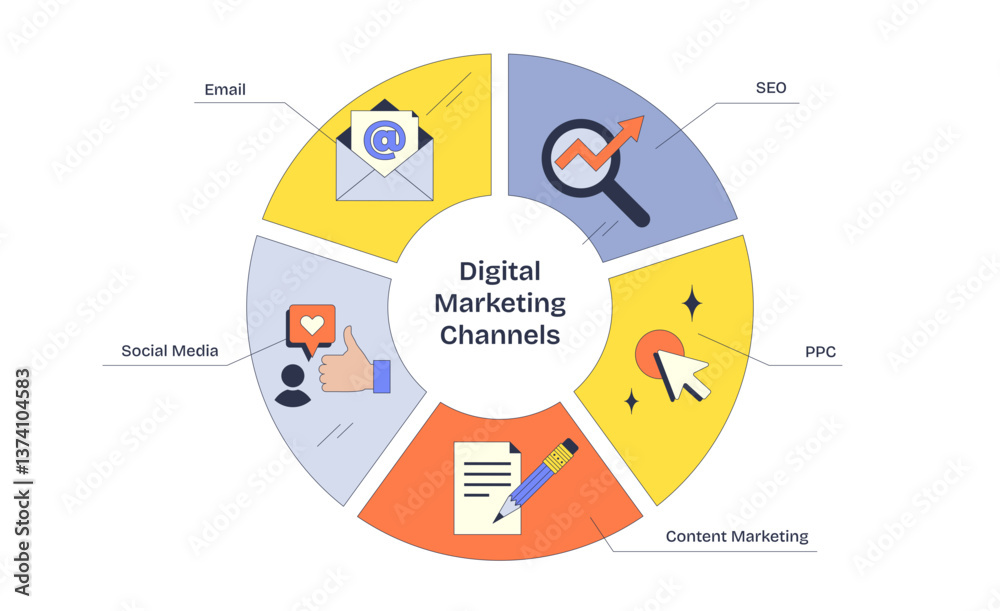
While this diagram shows them as separate pieces of a pie, the reality is that they are constantly overlapping and feeding into one another. The most effective marketing happens when these channels work in harmony.
A Framework for Understanding Channels: Search vs. Discovery
Before we dive into each channel, it's helpful to have a mental model for how users behave on them. Marketing expert Adam Erhart provides a useful distinction between "search" platforms and "discovery" platforms. This concept revolves around user intent.
Please watch this segment of the video "Digital Marketing 101" that you saw in our previous lesson. This time, focus on the distinction he makes between these two types of platforms.
Digital Marketing 101 (A Beginner’s Guide To Marketing)
This video by Adam Erhart introduces a key strategic concept for understanding different marketing channels.
Please watch the section from search vs. discovery marketing. Pay close attention to the idea of user intent on platforms like Google versus platforms like Facebook.
As you just saw:
- Search Marketing (e.g., Google) is powerful because you are meeting users who have high intent. They are actively looking for an answer, a product, or a solution.
- Discovery Marketing (e.g., Facebook, Instagram) is about reaching people who are casually browsing. They aren't necessarily looking to buy something. Your job is to capture their attention and create interest—to help them discover your brand.
Keep this framework in mind as we explore the roles of each specific channel. It will help clarify why we use them in different ways.
Channel 1: Social Media Marketing
Since your primary interest lies here, let's start with social media. Social media marketing is the use of platforms like Meta (Facebook and Instagram), TikTok, and LinkedIn to build your brand, connect with your audience, and drive business goals.
Its primary role is as a discovery channel. People are there to connect, be entertained, and pass the time. Your marketing must fit that context.
Marketing Channels: Your Digital Guide - Adobe for Business
The Adobe for Business blog provides an excellent breakdown of social media marketing, including a crucial distinction between "organic" and "paid" activities.
In the section on Social Media Marketing, please read from the beginning down to the part about achieving great results. This will clarify the difference between posting to your followers for free (organic) and paying to reach a wider, targeted audience (paid).
As the reading highlights, social media's role includes:
- Building Brand Awareness: Introducing your brand to new people who fit your target audience.
- Community Building & Engagement: Creating a two-way conversation with your audience, fostering relationships and loyalty.
- Top-of-Funnel Lead Generation: Capturing the interest of potential customers and guiding them to the next step, which often involves another channel.
Our work on Meta Ads later in this course will focus heavily on the "paid social" side, where you can leverage powerful targeting to accelerate these goals.
Channel 2: Content Marketing
You might have heard the phrase "content is king." Content marketing is the engine that powers almost every other digital channel. It involves creating and sharing valuable, relevant, and consistent material—like blog posts, videos, infographics, and guides—that is designed to attract and help a target audience, rather than to directly sell.
12 Key Digital Marketing Channels & How to Use Them - Terakeet
This article from Terakeet offers a clear and concise definition of content marketing and its function.
Please read the section on Content marketing. Focus on the idea that content "delivers VALUE" and "complements other digital marketing channels."
The key role of content is to be the fuel for your marketing efforts:
- It gives you something to post on social media.
- It's what you send in your email newsletters.
- It's what search engines rank to bring visitors to your site.
Without quality content, your other channels have nothing to say.
Channel 3: Email Marketing
Email marketing is the practice of sending messages to a list of subscribers who have given you permission to contact them. Your experience in lead generation is directly applicable here, as email is the primary channel for nurturing leads into customers.
While social media is great for finding new people, email is where you build a deeper, more direct relationship.
Marketing Channels: Your Digital Guide - Adobe for Business
Let's return to the Adobe article to understand the role of email marketing.
Read the section on Email marketing. Notice the different categories of emails (Prospecting, Sales, Retargeting) and how they map to different stages of a customer's journey.
The role of email is to nurture and convert. It's less about discovery and more about deepening a relationship that has already begun. People on your email list are more qualified and have shown a higher level of interest than a casual social media follower.
How Social Media and Email Work Together
Understanding the synergy between social media and email is fundamental to modern digital marketing. Social media is often the starting point, and email is where you close the loop.
This next video provides a fantastic, data-backed explanation of how these two channels complement each other perfectly.
Social Media vs Email Marketing: Which Is Better For Sales?
In this video, marketing expert Alex Cattoni breaks down the distinct but complementary roles of social media and email.
Watch from the beginning of her explanation to see how she defines both channels and uses her own business data to show their different strengths. Pay close attention to her revenue figures for social vs. email, and where her email leads come from.
As Alex Cattoni demonstrates, social media is incredibly effective for lead generation (top of the funnel), while email is significantly more effective for driving sales (middle and bottom of the funnel). You use social media to grow your email list, and you use email to turn that list into revenue. This is a crucial concept we will return to throughout this course.
Channel 4: Search Marketing (SEO)
Finally, let's look at the ultimate "high-intent" channel: search. When people turn to Google, they have a specific need. Search Engine Optimization, or SEO, is the process of making your website more visible in the unpaid ("organic") search engine results.
Marketing Channels: Your Digital Guide - Adobe for Business
The Adobe article also provides a solid introduction to SEO.
Read the section on Search engine optimization (SEO). The key takeaway is that SEO's role is to bring qualified, organic traffic to your website by ranking high for relevant search terms.
The primary role of SEO is to capture existing demand. Unlike social media, you're not trying to create demand; you're positioning yourself to be the answer for people who are already looking.
A quick note on a related term you'll see: Pay-Per-Click (PPC). This refers to the paid ads that appear at the top of search results. It's another part of search marketing. While it's a major channel, we won't be covering it in detail in this course, as we're focusing on social media and its supporting channels as you requested. However, it's important to know that when marketers talk about "Search," they are usually referring to both SEO and PPC.
Conclusion
Today we've mapped out the main territories of the digital marketing landscape. You now have a foundational understanding of the core channels and the distinct roles they play.
Key Takeaways:
- Digital marketing is an ecosystem of channels: Social Media, Content, Email, and Search (SEO) are the cornerstones.
- Channels can be understood through the lens of user intent: Discovery (e.g., Social Media) vs. Search (e.g., Google/SEO).
- Social Media's primary role is awareness and lead generation at the top of the funnel.
- Content is the fuel that powers all other channels by providing value.
- Email Marketing is the channel for nurturing relationships and converting leads into customers.
- SEO focuses on capturing high-intent users who are actively searching for solutions.
- These channels are most powerful when used together in an integrated strategy.
We've now identified the what (digital marketing) and the where (the channels). In our next lesson, we will explore the path that customers take. We'll introduce the digital marketing funnel, which will help us understand the customer journey from awareness to conversion and show us how to map these different channels to each stage of that journey.