Hello! Welcome to the eighth and final lesson in our module on Employment Law for Corporations.
In our last lesson, we focused on statutory law, specifically the Fair Labor Standards Act (FLSA), which dictates how employers must handle wages and overtime. We saw how a failure to comply with these rules can lead to direct government enforcement and costly lawsuits.
Today, we shift our focus from statutory duties to a fundamental principle of common law liability. What happens when an employee, while doing their job, commits a tort—a civil wrong—that harms a third party? Is the company on the hook? This lesson answers that question by exploring the doctrine of respondeat superior. For a corporate lawyer, understanding this concept is crucial for advising on risk management, as it represents a significant area of potential liability for any business with employees.
Your learning outcome for this lesson is to: Analyze employer liability for employee torts under the doctrine of respondeat superior.
By the end of this lesson, you will be able to:
- Define the doctrine of respondeat superior and explain the policy reasons behind it.
- Apply the two-part test used to establish this form of liability.
- Distinguish between an employee and an independent contractor for liability purposes.
- Analyze whether an employee's act falls within the "scope of employment," including through the "frolic and detour" test.
- Determine when an employer might be liable even for an employee's intentional or criminal acts.
1. What is Respondeat Superior and Why Does it Exist?
The legal doctrine we are examining is known by its Latin name: respondeat superior (), which translates to "let the master answer." In modern terms, it means "let the employer answer." It is the core principle of vicarious liability, where one party (the employer) is held legally responsible for the wrongful acts of another (the employee), even if the employer did nothing wrong itself.
At first glance, this might seem unfair. Why should a company be liable if it didn't tell its delivery driver to run a red light? To understand the logic, let's explore the rationale.
Understanding the theory of Respondeat Superior Liability
This brief article, 'Understanding the theory of Respondeat Superior Liability,' provides a very accessible explanation of the doctrine and its underlying justification. It uses a simple analogy to show why the law holds employers responsible.
Please read the sections titled 'Respondeat superior liability explained' and 'Why it's the law.' Focus on the simple three-part definition and the 'painter paints the wrong color' example, which helps justify why this rule exists.
As the article explains, the law draws a line at the "scope of employment." Courts and legal scholars generally justify this rule with two main policy arguments:
- Control: The employer has the right to control the employee's actions, setting the rules, and directing how the work is done. With this control comes a degree of responsibility.
- Risk Allocation & Cost Spreading: A business profits from the activities of its employees. Therefore, it is considered fair for the business to absorb the costs of the risks created by those activities. The harm caused by an employee is treated as a cost of doing business, which can be spread across customers through pricing or managed with insurance. This is sometimes called the "deep pockets" theory, ensuring that an injured person has a source of compensation.
2. The Two-Part Test for Liability
To hold an employer liable under respondeat superior, a plaintiff must prove two key elements:
- The wrongdoer was an employee of the company.
- The employee committed the tort while acting within the scope of their employment.
If either of these elements fails, the employer is generally not vicariously liable. The chart below provides a helpful visual map of this legal analysis.
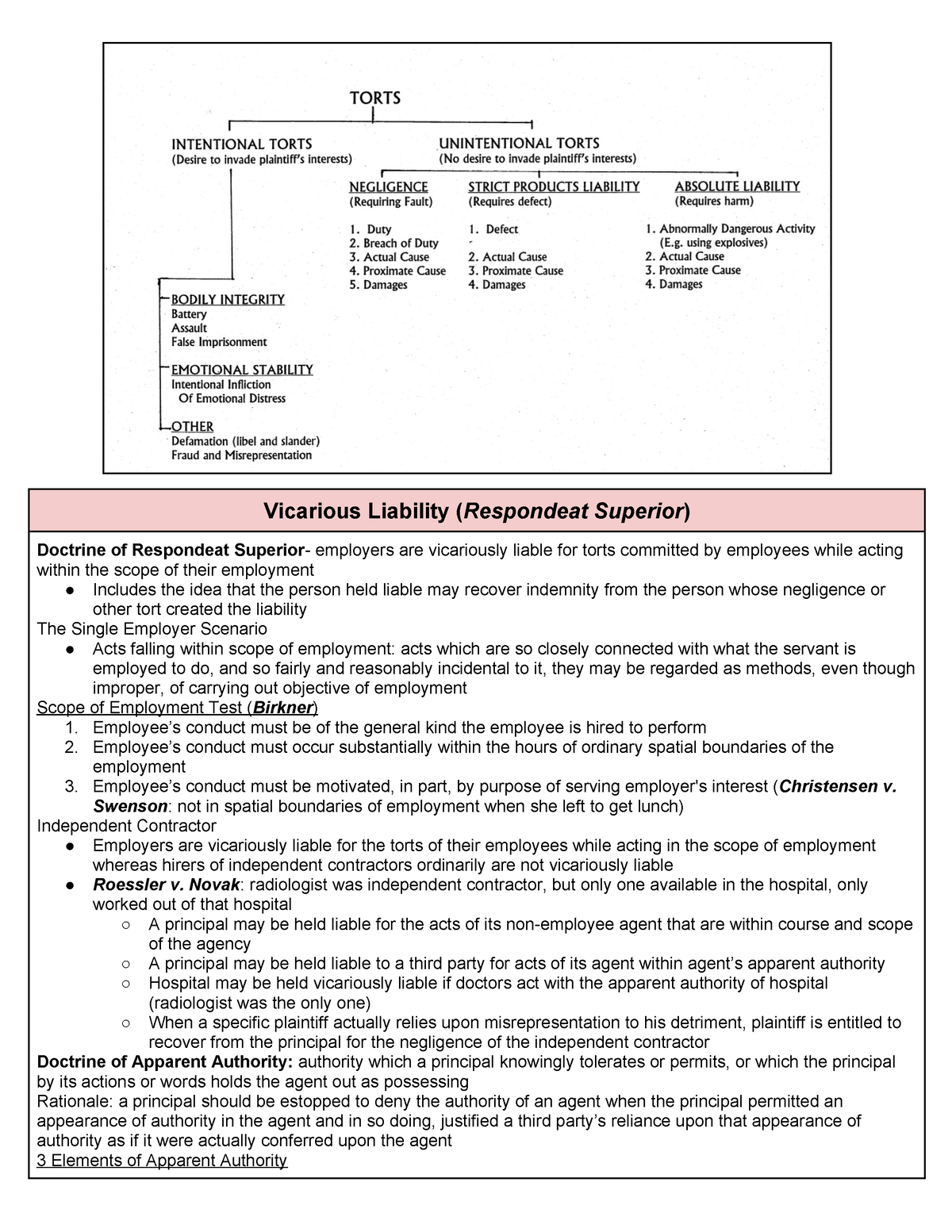
Now, let's break down each of these two prongs.
3. Prong 1: Employee or Independent Contractor?
The first critical distinction is the worker's status. The doctrine of respondeat superior applies to employees, but generally not to independent contractors. This is because a company typically has the right to control what an independent contractor does (the result), but not how they do it (the manner and means).
Courts use a multi-factor "balancing test" to determine whether a worker is an employee or an independent contractor. No single factor is decisive. The most important question is the extent of control the employer has over the details of the work.
respondeat superior | Wex | LII / Legal Information Institute
The Cornell Law School Legal Information Institute (LII) provides a concise summary of the law. Let's read its section on the independent contractor exception, which includes an authoritative list of factors from the Restatement of Torts—a highly influential legal treatise.
Please read the section titled 'Exceptions,' focusing on the part about 'Independent Contractors.' Pay close attention to the 11-factor balancing test listed. You don't need to memorize them, but you should understand the kinds of questions courts ask to determine the level of control.
Key factors from this list include:
- Does the employer control the details of the work?
- Does the worker have a distinct business of their own?
- Who supplies the tools and place of work?
- What is the length and permanence of the relationship?
- How is the worker paid (by the job or by time)?
Test your understanding!
A tech company hires a renowned cybersecurity expert to conduct a one-time security audit of its systems. The expert uses her own proprietary software, works from her own office, and is paid a flat fee for the delivery of a final report. While performing the audit, she negligently crashes the company's main server, causing a significant business interruption.
Is the tech company likely liable for the expert's negligence under respondeat superior? Why or why not?
Show answer
No, the company is likely not liable under respondeat superior. The expert would almost certainly be classified as an independent contractor, not an employee.
Applying the factors:
- Control: The company hired her for a result (the audit report), but she controlled the method of her work, using her own tools and expertise.
- Distinct Business: She is a renowned expert, suggesting she has her own business.
- Tools/Place of Work: She used her own software and office.
- Payment: She was paid a flat fee for the project, not a salary or hourly wage.
- Length of Time: It was a one-time engagement.
Because she is an independent contractor, the doctrine of respondeat superior does not apply. (Note: The company could potentially be sued for direct negligence in hiring her, but that is a different legal theory).
4. Prong 2: Within the "Scope of Employment"
If the worker is determined to be an employee, the next question is whether the tort was committed "within the scope of employment." This phrase is interpreted very broadly by courts and extends well beyond the employee's specific job description.
The "Frolic and Detour" Test
An employee isn't always acting for their employer. Courts distinguish between a detour (a minor deviation from assigned tasks) and a frolic (a major deviation for purely personal reasons).
- Detour: The employer is still liable. A detour is considered a reasonably foreseeable part of doing the job.
- Frolic: The employer is not liable. The employee has abandoned the employer's business.
Let's watch a video that explains this concept with a clear, practical example.
Vicarious Liability in the Employer-Employee Relationship: Module 1 of 5
This video from LawShelf explains the 'frolic and detour' test, which is key to analyzing the scope of employment.
Please watch from 12:28 to 14:50. The video explains the test and then provides two excellent, contrasting examples involving a delivery driver stopping for lunch (a detour) versus stopping at a casino (a frolic).
How Broad is the "Scope of Employment"?
The "detour" concept shows that the scope is broad. But it gets even broader. An act can be within the scope of employment even if it is foolish, disobedient, or not part of the employee's normal duties, as long as it is done in furtherance of the employer's business.
To see just how far this doctrine can stretch, let's watch a segment from the 'Learn Law Better' channel. It presents a series of real-world court cases with surprising outcomes.
Please watch from 01:52 to 05:35. Pay attention to the variety of examples (spilled coffee despite a direct order, the accident after a late-night bar trip, the knife-juggling cook). These cases demonstrate that courts often link the harm back to the employment context, even when the connection seems thin.
5. Liability for Intentional and Criminal Acts
The general rule is that an employer is not liable for an employee's intentional torts (like assault) or criminal acts, as these are typically seen as personal acts outside the scope of employment.
However, there are three very important exceptions where an employer can be held liable:
- The conduct was authorized by the employer.
- The conduct was naturally foreseeable from the nature of the employment (e.g., a bouncer in a bar using force).
- The conduct was motivated by a desire to serve the employer (e.g., an employee harming a bystander while chasing a shoplifter).
Let's watch the final clip that explains these exceptions.
This last segment from 'Learn Law Better' clearly explains the general rule for intentional torts and its three critical exceptions.
Please watch from 05:35 to 07:14. Focus on understanding the three distinct situations where an employer can be held responsible for an employee's intentional wrongdoing.
Test your understanding!
An overzealous salesperson for a software company gets into a heated argument with a potential client who is about to sign with a competitor. In a misguided attempt to "win" for his company, the salesperson intentionally deletes the competitor's proposal from the client's laptop. The client discovers this and sues the software company.
Is the software company likely liable for the salesperson's actions? Which exception might apply?
Show answer
Yes, the company is likely liable. While the salesperson's act was intentional and wrongful, it would probably fall under the third exception: the conduct was motivated by a desire to serve the employer.
The salesperson wasn't acting out of personal malice unrelated to work; their destructive act, however misguided, was done with the intent to secure a sale for the company and prevent a competitor from succeeding. This connection to the employer's business interest is often enough for a court to find the act occurred within the scope of employment, making the company vicariously liable.
Conclusion
This lesson concludes our module on employment law by examining a cornerstone of common law liability. Unlike the statutory rules of the FLSA, respondeat superior is a court-made doctrine that holds businesses accountable for the harm their operations can cause in the community. As a corporate lawyer, you will frequently advise clients on managing this risk through clear policies, proper training, careful hiring, and adequate insurance.
Key Takeaways:
- Respondeat Superior: A form of vicarious liability where an employer is held responsible for an employee's torts committed within the scope of employment.
- Policy Rationale: Justified by the employer's control over the employee and the idea that businesses should bear the risks associated with their profit-making activities.
- Two-Part Test: Liability requires proving both (1) an employee relationship (not an independent contractor) and (2) that the act occurred within the scope of employment.
- Scope of Employment: Interpreted very broadly. It includes minor "detours" but not major "frolics." An act can be included even if it's unauthorized, as long as it's connected to the employer's business.
- Intentional Torts: While employers are generally not liable for these, exceptions exist if the act was authorized, foreseeable due to the job's nature, or motivated by a desire to serve the employer.
Preview of the Next Module:
You have now completed the module on Employment Law! In our next lesson, we will begin a new module: Intellectual Property Strategy. We'll start by exploring the fundamental building blocks of IP, distinguishing between the four main types: patents, trademarks, copyrights, and trade secrets.