Hello! Welcome to the seventh lesson in the module on Employment Law for Corporations.
In our last lesson, we explored restrictive covenants, which are contractual limits on an employee's activities after their employment ends. We saw how the enforceability of these agreements, especially non-competes, is a complex and evolving area of law.
Today, we shift our focus from post-employment restrictions to the fundamental rules governing how employees are paid during their employment. We will dive into the Fair Labor Standards Act (FLSA), the cornerstone of federal wage and hour law in the United States. For a corporate lawyer, understanding the FLSA is not optional; it's a core compliance area where mistakes can lead to significant financial liability for a company.
Your learning outcome for this lesson is to: Apply wage and hour laws under the FLSA, including requirements for overtime and minimum wage.
By the end of this lesson, you will be able to:
- Describe the main provisions of the FLSA.
- Identify the federal minimum wage and understand how it interacts with state laws.
- Explain the FLSA's overtime requirement.
- Distinguish between "exempt" and "non-exempt" employees, the most critical classification under the FLSA.
- Apply the "duties tests" to determine if an employee qualifies for an exemption.
- Analyze the legal and financial risks of misclassifying an employee.
1. The Fair Labor Standards Act (FLSA): An Overview
Enacted in 1938 as part of the New Deal, the FLSA was designed to protect workers from exploitative labor practices and to stimulate the economy by ensuring a baseline standard of living. It establishes federal rules for minimum wage, overtime pay, recordkeeping, and youth employment.
To begin, let's get a formal overview of the act from a report by the Congressional Research Service.
The Fair Labor Standards Act (FLSA): An Overview
This document, 'The Fair Labor Standards Act (FLSA): An Overview,' provides an authoritative summary of the law's purpose and key components. It will give you a solid foundation for the more detailed rules we'll cover next.
Please read the 'Summary' and 'Introduction' sections. As you read, pay attention to the three main pillars of the FLSA: minimum wage, overtime pay, and child labor. Note the important clarification that state laws can provide greater protections for workers, but cannot weaken the federal standard.
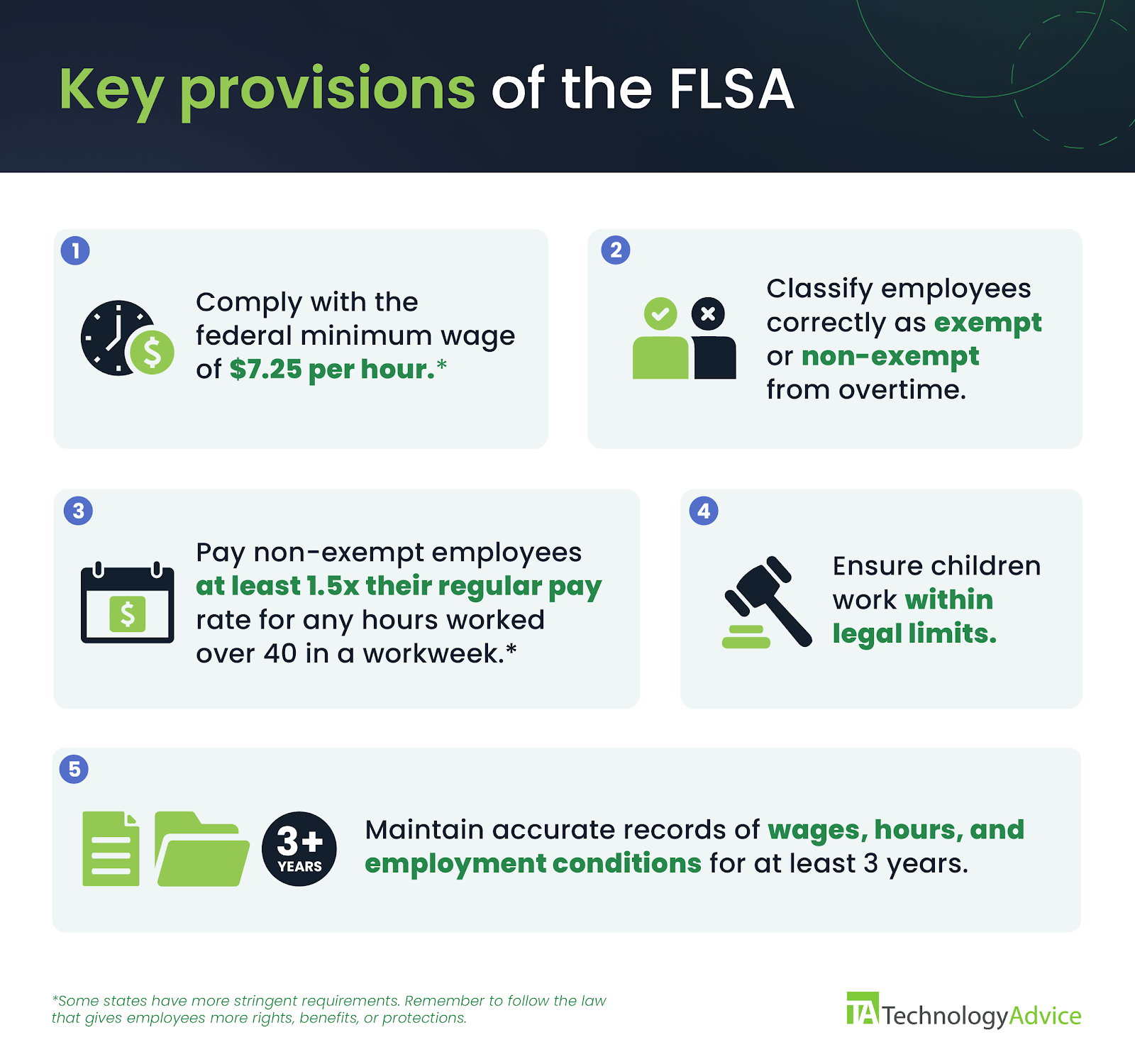
The infographic below provides a great visual summary of the five key employer responsibilities under the FLSA.
2. Minimum Wage and Overtime Pay
The FLSA sets a floor for wages and a standard for overtime compensation for covered, non-exempt employees.
Minimum Wage
The FLSA mandates a federal minimum wage. As you read, the current federal rate is $7.25 per hour. However, many states and even cities have enacted their own, higher minimum wage laws. When federal and state laws conflict, the employer must pay the higher rate.
The FLSA also allows for subminimum wages for certain groups under specific conditions, such as:
- Tipped employees: Can be paid a lower cash wage (currently $2.13/hour) as long as their tips bring their total earnings up to at least the federal minimum wage. This is known as a "tip credit."
- Youth workers: A "youth opportunity wage" of $4.25/hour can be paid to new hires under 20 for their first 90 days.
- Full-time students and student learners in certain vocational programs.
The Fair Labor Standards Act (FLSA): An Overview
Let's return to the CRS report for the specific details on these wage and overtime rules.
Please read the sections titled 'Minimum Wage Rates' and 'Overtime'. Focus on understanding the basic federal requirements and the various subminimum wage categories. For the overtime section, note that the trigger is hours worked over 40 in a workweek, not necessarily in a day or on a weekend.
Overtime Pay
The rule for overtime is straightforward in principle: covered, non-exempt employees must receive 1.5 times their "regular rate of pay" for all hours worked over 40 in a single workweek.
The "regular rate of pay" includes not just the hourly wage but also other forms of compensation like some bonuses and commissions. Calculating this rate correctly is a common source of litigation.
3. The Crucial Classification: Exempt vs. Non-Exempt
This is the heart of FLSA compliance and where corporate lawyers spend much of their time advising clients. The minimum wage and overtime provisions of the FLSA only apply to non-exempt employees. Exempt employees are not entitled to these protections.
A common and costly mistake is assuming that paying an employee a salary automatically makes them exempt from overtime. This is false. To be lawfully classified as exempt, an employee must generally satisfy three tests:
- Salary Basis Test: The employee must be paid a predetermined salary that is not subject to reduction based on the quantity or quality of work.
- Salary Level Test: The salary must meet a minimum threshold. Under current federal law, this is $684 per week ($35,568 per year).
- Duties Test: The employee's primary job duties must involve executive, administrative, or professional tasks as defined by the Department of Labor's regulations.
Misclassified as Exempt? Should You Get Overtime? A Lawyer Explains Hourly vs. Salary
Let's watch a video from employment lawyer Branigan Robertson, who breaks down this classification in a very practical way. He explains the difference between the classifications and introduces the duties tests.
Please watch from 01:32 to 07:05. Note his clear definitions of exempt and non-exempt. As he describes the exemption tests, pay close attention to the types of work that qualify (e.g., managing the business, exercising independent judgment) versus those that do not. Important note: He discusses California law, which requires daily overtime (over 8 hours/day). Remember that the federal FLSA standard is weekly (over 40 hours/week).
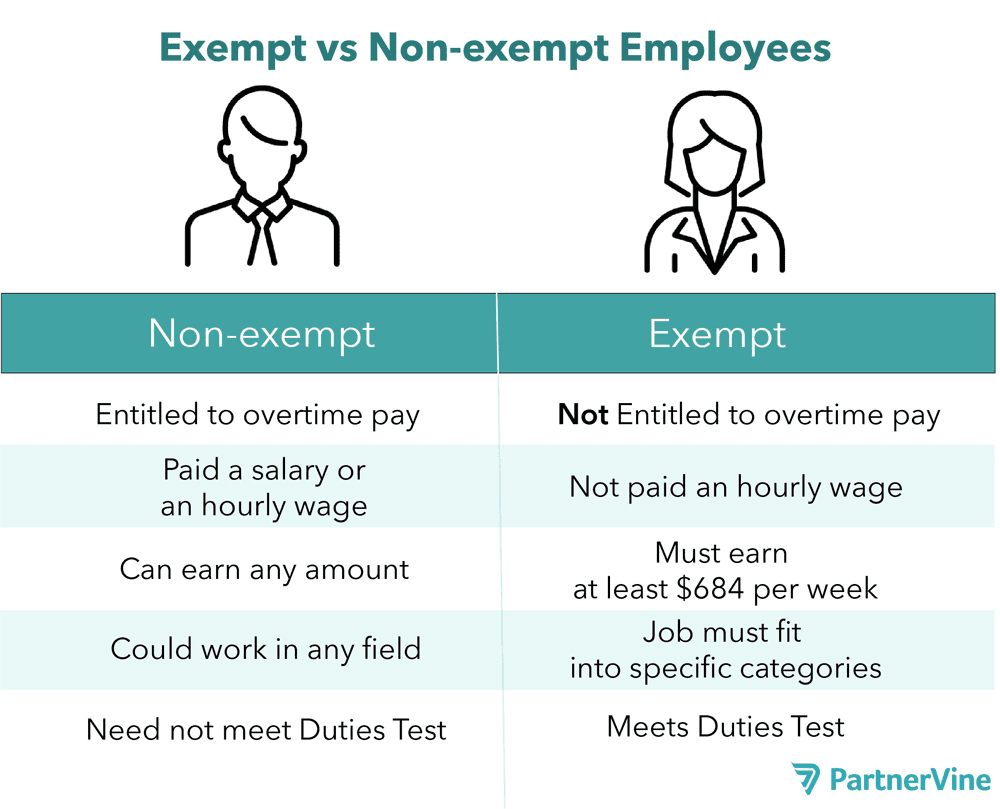
This table provides a clear, at-a-glance comparison of the two classifications.
The "Duties Tests"
As the video explained, an employee's job title is irrelevant. What matters are their actual, primary duties. To be exempt, an employee's role must fit into one of the established categories.
FLSA Exempt and Nonexempt Defined
Now let's dig into the specific criteria for the main exemption tests. This webpage from the University of Minnesota provides a very clear and well-structured summary of the duties required for each category.
Please read the section 'The Exemption Test' and the subsection 'FLSA Exemption Test Summaries'. Focus on the specific criteria for the Executive, Administrative, Professional, and Computer tests. For each one, identify the key phrases that define the required duties (e.g., 'managing the enterprise,' 'exercise of discretion and independent judgment,' 'work requiring advanced knowledge').
To summarize the main "white-collar" exemptions:
- Executive Exemption: Primary duty is managing the enterprise or a department, regularly directs the work of at least two full-time employees, and has authority to hire/fire or make influential recommendations.
- Administrative Exemption: Primary duty is office/non-manual work directly related to the management or general business operations, and includes the exercise of discretion and independent judgment with respect to matters of significance.
- Professional Exemption: Primary duty is work requiring advanced knowledge (e.g., law, medicine, engineering) customarily acquired by a prolonged course of specialized intellectual instruction, OR work requiring invention, imagination, or talent in a recognized artistic or creative field.
Test your understanding!
A large retail company hires a new "Assistant Manager" at one of its stores, paying them a salary of $45,000 per year. The Assistant Manager's primary duties consist of stocking shelves, running the cash register, and cleaning the store—the same tasks performed by the hourly employees. They spend less than 10% of their time on tasks like setting schedules or ordering inventory.
Is this employee likely to be properly classified as exempt under the Executive Exemption? Why or why not?
Show answer
No, this employee is likely misclassified as exempt.
While they meet the salary basis and salary level tests ($45,000/year is above the $35,568 threshold), they fail the duties test for the Executive Exemption.
Their primary duty is not management. The majority of their time is spent on non-exempt work (stocking, cashiering, cleaning). The "exercise of discretion and independent judgment" and the "management of the enterprise" are not their principal functions. The job title "Assistant Manager" is irrelevant; the actual work performed is what matters for the FLSA analysis. This is a classic misclassification scenario that could expose the company to liability for unpaid overtime.
4. Consequences of Misclassification
For a corporation, getting the exempt/non-exempt classification wrong can be incredibly expensive. Misclassification is a common subject of both individual lawsuits and large-scale class-action litigation.
If a court finds that a group of employees was misclassified as exempt, the employer can be liable for:
- Back Wages: Years of unpaid overtime for all affected employees.
- Liquidated Damages: An additional amount equal to the back wages owed, effectively doubling the damages.
- Attorneys' Fees: The employer may be required to pay the plaintiffs' legal fees.
Misclassified as Exempt? Should You Get Overtime? A Lawyer Explains Hourly vs. Salary
Let's return to the video from Branigan Robertson to understand the financial stakes involved when a company gets this wrong.
Please watch the final segment from 08:29 to 10:09. He explains how unpaid overtime is calculated and mentions the various penalties that can accumulate, illustrating why this is such a high-risk area for employers.
The Department of Labor's Wage and Hour Division (WHD) is responsible for enforcing the FLSA. It can conduct investigations and bring enforcement actions against employers, making compliance not just a matter of avoiding private lawsuits, but also of satisfying federal regulators.
Conclusion
Today, we've broken down the Fair Labor Standards Act, a critical piece of legislation for any corporate lawyer to master. We've seen that while the basic rules of minimum wage and overtime seem simple, their application hinges on the complex and fact-intensive distinction between exempt and non-exempt employees. Correctly applying the salary and duties tests is a fundamental risk management function for any business.
Key Takeaways:
- The FLSA establishes the federal minimum wage and overtime requirements for covered, non-exempt employees.
- Employers must pay the higher of the federal or applicable state/local minimum wage.
- Overtime is calculated at 1.5 times the regular rate for hours worked over 40 in a workweek.
- An employee's classification as exempt or non-exempt is determined by their salary and primary job duties, not their job title or whether they are paid a salary.
- To be exempt under the main "white-collar" exemptions, an employee must generally meet a salary basis test, a salary level test, and a duties test (Executive, Administrative, or Professional).
- Misclassification is a major legal risk, potentially exposing a company to substantial liability for back wages, damages, and legal fees.
Preview of the Next Lesson:
This lesson concludes our look at major statutory schemes governing the employment relationship. In our final lesson for this module, we will return to common law principles to address a different kind of corporate liability: when is a company legally responsible for the wrongful acts (torts) committed by its employees? We will analyze the doctrine of 'respondeat superior' to answer this question.