Hello! Welcome back to our module on Intellectual Property Strategy.
In our previous lesson, we established the four main pillars of IP: patents, trademarks, copyrights, and trade secrets. We briefly noted that for works created within a company, the question of who owns the copyright is governed by a special rule called the "work for hire" doctrine. Today, we will dissect that doctrine.
For any company, its most valuable copyrighted materials—software, marketing content, designs, manuals—are created by its people. Understanding who owns that intellectual property by default is a cornerstone of corporate law. This lesson will equip you with the framework to answer that critical question.
Your learning outcome for this lesson is to: Analyze the 'work for hire' doctrine and its application to IP created by employees.
We'll explore the two distinct situations where a company, not the individual creator, is considered the legal author and owner of a copyrighted work from its inception.
1. The Default Rule and Its Major Exception
The foundational principle of copyright law is straightforward: the person who creates an original work is its author and the initial owner of the copyright. However, this simple rule is often not practical in a business context where companies invest significant resources for employees and contractors to create works on their behalf.
This is where the work for hire doctrine comes in. It is a crucial exception in the U.S. Copyright Act that designates the employer or commissioning party as the legal "author" and owner of a work created under specific circumstances.
This is not just a technicality; the designation has significant legal consequences.
The Work Made for Hire Doctrine Revisited
To understand why this doctrine is so important, let's turn to 'The Work Made for Hire Doctrine Revisited,' a law review article that clearly outlines the consequences. This provides the 'why it matters' context that is crucial for legal analysis.
Please read the introduction of this article (pages 490-492). Focus on the four primary ways the work-for-hire designation affects a copyright: ownership, term, moral rights, and termination rights. Pay special attention to the discussion of termination rights—this is a key reason why corporations strongly prefer work-for-hire status.
As you read, you'll see that classifying a work as "made for hire" gives the company much stronger and more predictable control over the asset. The company gets a different (and often longer) copyright term, and critically, it is immune from the original creator later terminating the transfer and reclaiming the copyright.
The U.S. Copyright Act defines two—and only two—scenarios where a work qualifies as a work made for hire. Let's examine each path.
2. Path 1: Work Created by an Employee
The first and more common path for a corporation is for works created by its employees.
The Copyright Act states that a work is "made for hire" if it is "a work prepared by an employee within the scope of his or her employment."
This phrase presents two critical legal questions that courts must often decide:
- Was the creator an employee?
- Was the work created within the scope of employment?
Is the Creator an "Employee"?
The Copyright Act does not define "employee." In a landmark case, Community for Creative Non-Violence v. Reid (1989), the U.S. Supreme Court ruled that courts must use the "general common law of agency" to determine whether a creator is an employee or an independent contractor.
This involves a fact-intensive analysis of the relationship between the parties. The U.S. Copyright Office provides a helpful summary of the factors courts consider, derived from the Reid case.
Circular 30: Works Made For Hire
Let's review the official guidance from the U.S. Copyright Office. This document outlines the questions courts ask to determine employment status for copyright purposes.
Please read the section titled '"Scope of Employment"' on page 3. Focus on the list of questions that help determine if someone is an employee. You'll notice they relate to control, payment, benefits, and the nature of the work relationship.
These factors essentially boil down to the degree of control the hiring party exercises over the worker. This chart provides a clear visual summary of the key differences.
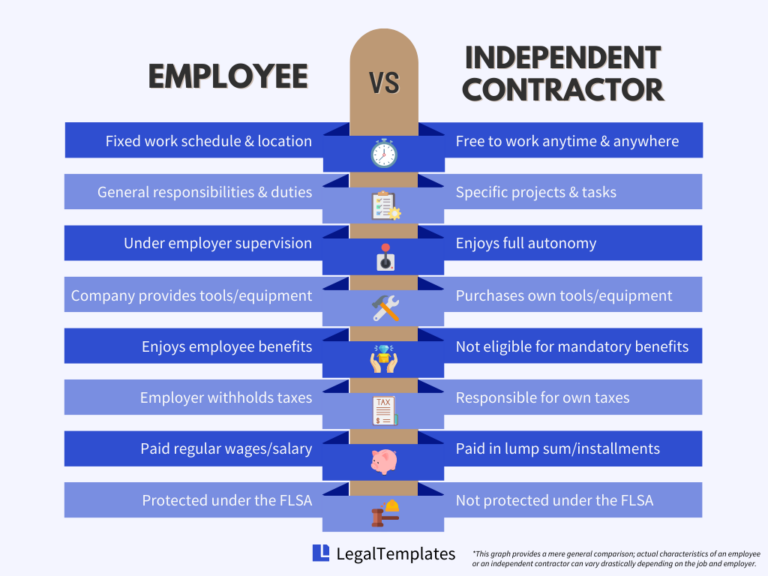
Was the Work "Within the Scope of Employment"?
Even if a creator is an employee, the work-for-hire doctrine only applies if the work was created "within the scope of employment." This doesn't simply mean work done at the office between 9 a.m. and 5 p.m.
A court will look at whether:
- The work is the kind the employee is employed to perform.
- The creation of the work occurred substantially within the authorized time and space limits of the job.
- The work was motivated, at least in part, by a purpose to serve the employer.
A well-defined job description is often a key piece of evidence. A famous case, Mattel, Inc. v. MGA Entertainment, Inc., involved a dispute over whether the initial drawings for the "Bratz" dolls, created by a Mattel employee, belonged to Mattel. A central issue was whether creating such doll concepts fell within the scope of his duties as a designer in the "Barbie Collectibles" department.
Intellectual Property: what is it, and who owns it? A guide for employers and employees.
This video provides a very intuitive explanation of the 'course of employment' concept. Although it's from a UK legal perspective, the core principle is identical to US law and the example is highly illustrative.
Please watch the segment from 04:44 to 07:24. The speaker discusses what 'in the course of their employment' means and uses the example of a game company illustrator. Notice the emphasis on the employment contract and job description to define the scope of work.
3. Path 2: Specially Ordered or Commissioned Works
What about works created by non-employees, such as freelancers, consultants, or independent contractors? This is the second path to work-for-hire status, and it is much narrower and stricter.
A work created by an independent contractor can only be a work for hire if it meets both of the following conditions:
- It is "specially ordered or commissioned" for use as one of nine specific types of works listed in the statute.
- The parties expressly agree in a signed written document that the work shall be considered a work made for hire.
If either condition is not met, the work is NOT a work made for hire. The creator remains the copyright owner, even if they were paid for the work.
Copyright Work For Hire explained by Attorney Steve®
Attorney Steve Vondran provides an excellent breakdown of this second path. He clearly lists the nine categories and explains the critical importance of the written agreement.
Please watch from 01:39 to 06:30. First, he will recap the two main scenarios. Then, focus intently as he lists and explains the nine categories of commissioned works that are eligible for work-for-hire treatment. Note his example of software development not being on the list.
The nine categories are:
- A contribution to a collective work (e.g., an article for a magazine)
- A part of a motion picture or other audiovisual work
- A translation
- A supplementary work (e.g., a foreword, chart, or index for a book)
- A compilation
- An instructional text
- A test
- Answer material for a test
- An atlas
The Essential Backup: A Copyright Assignment
As you just heard, many common types of works created by contractors—like software, a company logo, or a marketing brochure—do not fall into one of the nine categories. In this situation, a "work for hire" agreement is legally ineffective. So, how does a company secure ownership?
The answer is a copyright assignment. This is a separate legal mechanism where the creator, as the initial owner, formally transfers the copyright to the hiring party in writing.
A well-drafted contract for an independent contractor will contain both clauses as a belt-and-suspenders approach.
Copyright Work For Hire explained by Attorney Steve®
Let's continue with the same video, where the speaker explains this crucial fallback strategy.
Please watch from 06:30 to 10:30. He explains what to do when a work is outside the nine categories—get an 'assignment of copyrights.' He then provides an excellent piece of practical legal advice: include a backup assignment clause in your work-for-hire agreements to cover all bases.
Test your understanding!
A technology company hires a freelance software developer to build a new mobile application. The contract they both sign states: "This software is considered a work made for hire, and all rights belong to the company." The developer delivers the finished code. Who owns the copyright?
Show answer
The developer owns the copyright. While there is a written "work for hire" agreement, software is not one of the nine enumerated categories for commissioned works. Therefore, it cannot be a work made for hire. The company only has the rights granted by the contract, which might be an implied license to use the app, but it does not own the copyright. To secure ownership, the company needed a clause where the developer assigns all copyright in the software to the company.
Conclusion
You have now analyzed the work for hire doctrine, a critical exception to the basic rules of copyright ownership. For a future corporate lawyer, the main takeaway is that ownership of creative works is not always intuitive and relies heavily on the nature of the relationship and the existence of a well-drafted contract.
Key Takeaways:
- The work for hire doctrine makes the employer or commissioning party the legal author and owner of a copyrighted work.
- Path 1 (Employee): If a work is created by an employee within the scope of their employment, the employer automatically owns the copyright. Determining "employee" status and "scope of employment" are fact-intensive legal questions.
- Path 2 (Independent Contractor): If a work is created by an independent contractor, it is only a work for hire if it fits into one of nine specific categories AND there is a signed written agreement stating it is a work for hire.
- The Assignment Fallback: For commissioned works that don't fit the nine categories (like most software), a "work for hire" clause is not enough. The company must secure ownership through a separate, written copyright assignment from the creator. The best practice is to include both in contracts with freelancers.
Preview of the Next Lesson:
We've seen that when the work for hire doctrine doesn't apply, a company must rely on a copyright assignment to gain ownership. In our next lesson, we will focus specifically on intellectual property assignment agreements, examining how they function to formally transfer ownership of not just copyrights, but also patents and trademarks, from an individual to a corporation.