Welcome back. In our last lesson, you established the technological foundation for our work in this module, selecting the gold-standard tools for accurate, real-time heart rate variability measurement: an ECG chest strap and a compatible mobile app. You are now equipped to capture the data; today, we will delve into the theory of what that data can tell us and how we can consciously influence it.
We will now explore the concept of coherent or resonance frequency breathing. This is a cornerstone of modern biofeedback, representing a powerful intersection of physiology, neuroscience, and data analysis. Our focus will be on understanding precisely what this state is, the physiological mechanism that underpins it—the baroreflex—and how manipulating this system can lead to dramatic, measurable changes in your heart rate variability.
The State of Coherence
At its core, resonance breathing is a practice designed to create a state of physiological coherence, where the rhythms of your cardiovascular and respiratory systems synchronize. The term "resonance" is borrowed from physics, and the analogy is quite direct. Just as applying a force at the natural resonant frequency of a physical object (like pushing a swing at the perfect moment) causes its oscillations to grow dramatically in amplitude, breathing at a specific frequency can cause the oscillations in your heart rate to reach their maximum amplitude.
Let's begin with a clear introduction to this concept.
How to Personalize Resonance Frequency: HRV Biofeedback Tips
This video, "How to Personalize Resonance Frequency," provides an excellent high-level overview of resonance breathing.
Please watch the first two segments: Begin with the explanation of what resonance breathing is. The speaker defines it as bringing the heart and lungs into a state of resonance by matching the frequencies generated by your breath and your heart. Continue with the discussion on why resonance is important. Note the analogy to strength training for the autonomic nervous system and the introduction of the typical breathing rate for resonance: between 5 and 7 breaths per minute.
As the video explains, this isn't about changing your resting breath rate permanently. It's about strategically practicing at your resonance frequency to "exercise" and strengthen the autonomic nervous system's regulatory capacity. When you are in this state of coherence, your HRV pattern transforms from a chaotic, jagged waveform into a smooth, orderly, sine-wave-like pattern.
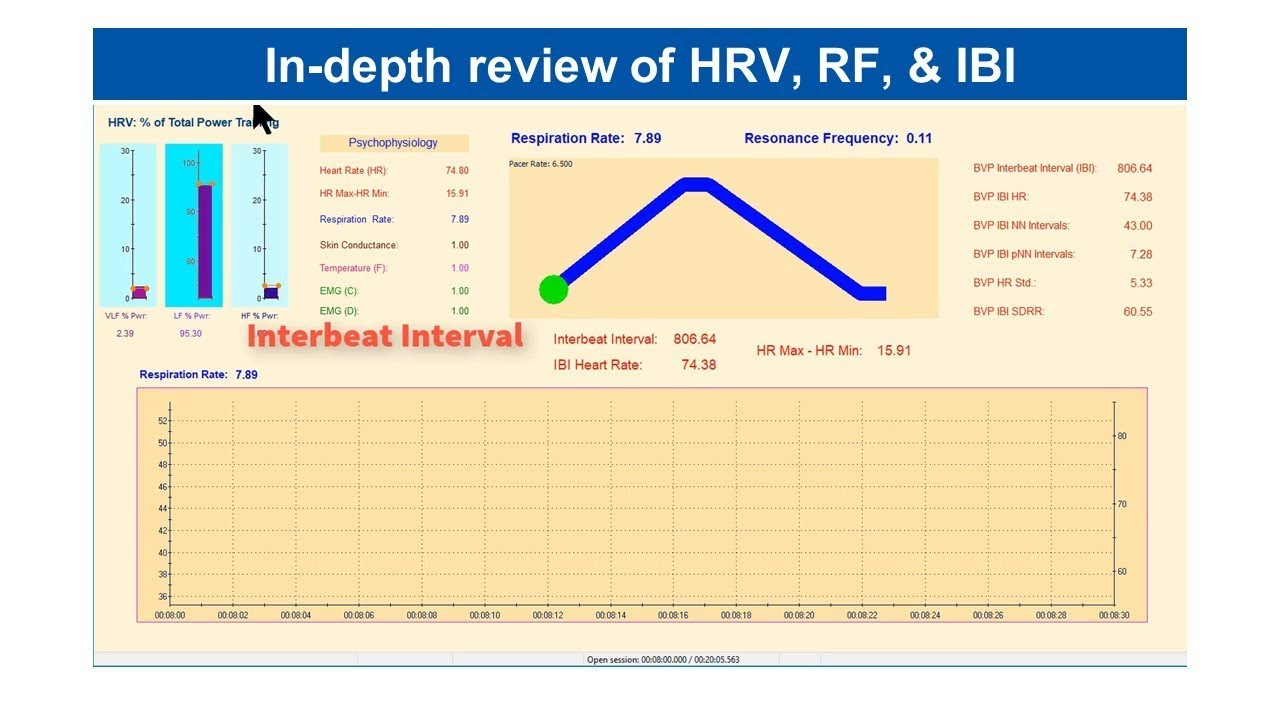
To understand how this transformation is possible, we need to examine the underlying physiological machinery.
The Engine Room: Respiratory Sinus Arrhythmia and the Baroreflex
The phenomenon that allows our breath to influence our heart is called Respiratory Sinus Arrhythmia (RSA). It's a natural and healthy variation in heart rate that occurs with each breath cycle:
- During inhalation, your heart rate slightly speeds up.
- During exhalation, your heart rate slightly slows down.
This is a sign of a responsive and adaptive autonomic nervous system; as the paper we'll see shortly states, "A healthy heart is not a metronome." But why does this happen? The primary mechanism is a negative feedback loop called the baroreceptor reflex or baroreflex.
For a detailed mechanical and neural explanation, Dr. Andrew Huberman provides an exceptionally clear breakdown.
Simple Tool to Boost Heart Rate Variability (HRV) | Dr. Andrew Huberman
In this clip, Dr. Huberman explains the physiological basis of RSA.
Watch the section from his detailed explanation. He outlines the causal chain step-by-step: Inhalation: The diaphragm moves down, creating more space in the chest cavity. The heart expands slightly, and blood flows through it a bit more slowly. Sensing: Neurons in the heart sense this slower blood flow and send a signal to the brain. Response: The brain signals the sympathetic nervous system to speed the heart up to compensate. Exhalation: The diaphragm moves up, there's less space, the heart is slightly compressed, and blood moves through it more quickly. Sensing & Response: Neurons sense this faster flow, signal the brain, and the brain activates the parasympathetic vagus nerve to slow the heart down.
The baroreflex is the body's primary system for the rapid, moment-to-moment regulation of blood pressure. It is a classic homeostatic feedback loop. Let's formalize our understanding with an academic description and a clear anatomical diagram.
A Practical Guide to Resonance Frequency Assessment for Heart ...
This research paper provides a deep dive into the physiology of resonance. We will return to it several times. For now, we will focus on its precise description of the baroreflex.
Please read the section titled The Baroreflex. This section details the neural pathway and explicitly links respiration, blood pressure, and heart rate oscillations. Pay close attention to the role of the glossopharyngeal and vagus nerves and the nucleus tractus solitarius in the medulla.
As you read, refer to the following diagram which illustrates the pathway described.
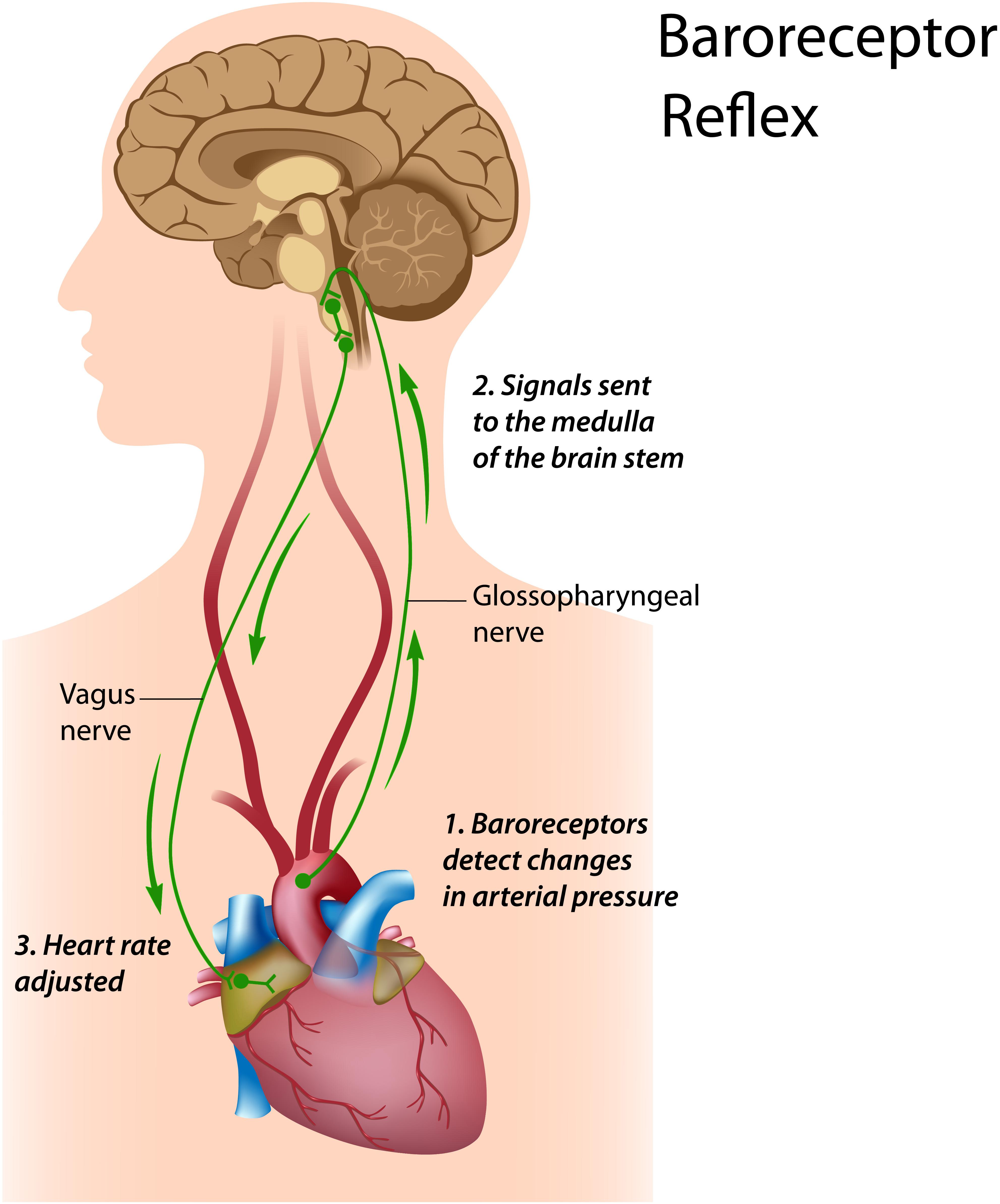
This loop—pressure changes leading to heart rate adjustments, which in turn affect pressure—has a characteristic delay, determined by nerve conduction times and the time it takes for blood to circulate. This delay gives the system an intrinsic frequency, typically around 0.1 Hz (6 cycles per minute) in adults.
Hacking the Baroreflex: Achieving Resonance
Now we can connect all the pieces. By deliberately breathing at a rate that matches the intrinsic frequency of the baroreflex loop, we create resonance. The rhythmic changes in pressure from our breathing reinforce the baroreflex's own oscillations, causing the amplitude of RSA to increase dramatically—often 4 to 10 times higher than at rest. This maximized, coherent heart rate oscillation is the state we are trying to achieve.
Let's look at the research to understand why precision matters.
How to Personalize Resonance Frequency: HRV Biofeedback Tips
Let's return to the Spren video, which presents findings from a 2017 study that elegantly demonstrates this principle.
Watch the segment discussing the scientific backing of resonance breathing. The presenter reviews a study comparing three groups: one breathing at their resonance frequency (RF), one at RF + 1 breath per minute, and a control group. Note the stark difference in HRV outcomes.
The study's finding is crucial: the group breathing just one breath per minute faster than their resonance pace showed no statistically significant improvement in HRV over the control group. This highlights that it is not merely slow breathing, but breathing at the correct slow pace, that produces the powerful physiological effect.
The Statistical Landscape of Resonance
So, what is this "correct" pace? For most adults, the resonance frequency falls somewhere between 4.5 and 6.5 breaths per minute (0.075–0.11 Hz). However, recent large-scale data analysis allows us to get much more granular.
A 2024 study published in Scientific Reports analyzed 1.8 million biofeedback sessions, providing an unprecedented look at the distribution of these frequencies in a real-world population. Given your background in statistics, the findings and their nuances will be of particular interest.
Heart rate variability biofeedback in a global study of the most ...
This paper provides a population-level view of coherence frequencies.
Start by reading the Abstract for a summary of the key findings. Next, examine the results presented in the text and figures. Focus on the section beginning with this paragraph and analyze Figures 4 and 5. Notice the most common frequency, but also where the highest average coherence scores lie. Finally, read the crucial discussion point on interpreting HRV metrics during coherence, starting from this point.
The key statistical takeaways from this paper are profound:
- Central Tendency: The most common coherence frequency observed is indeed around 0.1 Hz (~6 bpm), confirming the theoretical link to the baroreflex.
- A Surprising Skew: While 0.1 Hz is most common, the highest average coherence scores were found at lower frequencies, in the range of 0.047 to 0.10 Hz (roughly 3 to 6 bpm). This suggests that for some individuals, particularly those who are more practiced, a slower pace may yield an even more profound state of coherence.
- A Note on Metrics: The paper makes a critical point for anyone with a statistical eye. During a highly coherent state, the heart's rhythm becomes very orderly and sine-wave-like. This increased regularity can cause time-domain HRV metrics like SDNN and RMSSD to decrease, because the beat-to-beat differences become smaller and more predictable. This does not mean less variability or reduced parasympathetic activity. In this specific context, frequency-domain metrics like Low-Frequency (LF) power become a more appropriate measure of the amplitude of variability. This is a vital nuance to remember when you begin analyzing your own data.
Conclusion
In this lesson, we have dissected the theory of coherent breathing, moving from a high-level concept to the specific neural pathways and statistical realities that govern it. You now have a robust mental model of how this powerful technique works.
Key Takeaways:
- Coherent breathing is the practice of breathing at a specific slow rate to synchronize the rhythms of the heart and lungs, creating a state of physiological resonance.
- The underlying mechanism is the targeted stimulation of the baroreflex, a homeostatic feedback loop that regulates blood pressure.
- Breathing at the baroreflex's intrinsic frequency (typically ~0.1 Hz) causes a massive amplification of Respiratory Sinus Arrhythmia (RSA), which manifests as a large, smooth, sine-wave-like oscillation in your heart rate pattern.
- While the most common resonance frequency is ~6 breaths per minute, an individual's optimal frequency can vary. Population data shows that even greater coherence can sometimes be achieved at slower rates.
- When analyzing data from a coherent state, it is crucial to understand that frequency-domain power (specifically LF power) is a better indicator of the magnitude of variability than time-domain metrics like SDNN or RMSSD, which can be paradoxically suppressed by the rhythm's regularity.
You now understand the "what" and the "why." In our next lesson, we will move to the "how." You will use the hardware and software you've prepared to conduct a systematic experiment to discover your own personal resonance frequency.