In our previous lesson, we established a firm theoretical understanding of resonance frequency breathing. You learned how deliberately pacing your breath at the intrinsic frequency of your baroreflex system—typically around 6 cycles per minute—can synchronize your cardiovascular and respiratory systems, leading to a state of high physiological coherence and dramatically amplified heart rate variability.
Today, we transition from theory to practice. This lesson is a hands-on workshop where you will serve as both experimenter and subject. Your objective is to move beyond the population average and discover your unique, personal resonance frequency. By the end of this session, you will have conducted a systematic assessment using your HRV biofeedback tools and identified the precise breathing rate that maximizes your own HRV. This personalized pace will become a fundamental tool in your breathwork toolkit.
Framing the Experiment
Given your background in statistics and research methodology, we will approach this as a structured self-experiment.
- Objective: To identify the breathing rate that produces the greatest amplitude of heart rate oscillations, indicating resonance.
- Independent Variable: Breathing Rate (breaths per minute).
- Dependent Variables:
- Objective physiological metrics (HRV, specifically its amplitude).
- Subjective psychological metrics (the perceived ease or difficulty of maintaining the pace).
The general protocol is straightforward: you will systematically test a range of slow breathing rates while monitoring your HRV in real-time.
The Protocol: A Practical Walkthrough
For a clear, visual demonstration of the testing protocol, the following video provides an excellent step-by-step guide. It uses the Elite HRV app, but the principles are universal to any HRV biofeedback software.
How to Personalize Resonance Frequency: HRV Biofeedback Tips
This segment from "How to Personalize Resonance Frequency" by Spren methodically details the experimental process.
Please watch the following two sections: Start with the step-by-step process. The speaker outlines testing five different paces from 7.0 down to 5.0 breaths per minute (bpm). Pay close attention to the procedure: Breathe at each pace for at least two minutes. Rest for at least two minutes between paces. After each pace, record two key pieces of data: your average HRV score from the app and a subjective easiness rating on a 1-to-5 scale. Next, watch the "extra credit" section on the 4:6 inhale-to-exhale ratio. This introduces a refinement to the protocol that we will discuss later.
The video provides a solid, practical framework. Now, let's deepen our understanding by examining the more rigorous criteria used in clinical and research settings.
Clinical Assessment Criteria
While "highest average HRV" and "subjective ease" are excellent starting points, a formal resonance frequency assessment uses a more nuanced set of criteria. The goal is not just to find a high HRV number, but to identify the breathing rate that produces the most coherent and powerful resonance effect across the cardiorespiratory system.
The following paper, which we briefly touched on in the last lesson, provides the definitive clinical guide. We will focus on the section that details the six weighted criteria for selecting the optimal frequency.
A Practical Guide to Resonance Frequency Assessment for Heart ...
This paper by Shaffer et al. outlines the gold-standard protocol for RF assessment.
Please read the section titled Resonance Frequency Selection. This section details six weighted criteria used to evaluate and compare different breathing rates. As you read, focus on understanding not just what each criterion is, but why it is an indicator of resonance.
The six criteria from the paper, in order of importance, are:
- Phase Synchrony: The degree to which the heart rate and respiration waveforms peak and trough at the same time. A phase angle near 0° is the strongest indicator of baroreflex resonance.
- Peak-Trough Amplitude (HR Max – HR Min): The magnitude of the heart rate swing within each breath cycle. Bigger is better, as it signifies a more powerful RSA response.
- LF Power: The absolute power in the Low-Frequency band (0.04–0.15 Hz). As we discussed, this becomes the most reliable metric for HRV amplitude during a coherent state.
- Maximum LF Amplitude Peak: A single, tall, sharp peak in the LF band of the spectral analysis indicates that all the body's oscillatory power is being consolidated at one frequency—the essence of resonance.
- Smoothness of the Heart Rate Curve: A visually smooth, sine-wave-like heart rate pattern indicates an orderly, coherent system, as opposed to a jagged, chaotic one.
- Fewest LF Peaks: Related to #4, a single peak is ideal. Multiple peaks suggest the system is not fully entrained to the breathing rhythm.
The image below illustrates the ideal relationship between respiration, heart rate (HR), and blood pressure (BP) during resonance. Notice the clear phase synchrony: HR and BP rise and fall in a smooth, coordinated rhythm with the breath.

Your Personal Resonance Frequency Experiment
Now, it is time to conduct the experiment on yourself. Ensure you have your ECG chest strap on and your chosen biofeedback app ready. Find a quiet, comfortable place where you can sit upright without being disturbed for about 20-30 minutes.
Protocol:
- Baseline: Sit quietly for 2-3 minutes to establish a baseline before you begin.
- Pacing: Use a breathing pacer app (the one in your biofeedback app or a standalone one like "Paced Breathing") to guide your breath rate. If your app allows, set the inhale-to-exhale ratio to 1:1 (e.g., 5 seconds in, 5 seconds out for 6 bpm). If it doesn't, just follow the pacer smoothly.
- Test Sequence: You will test five different breathing rates. For each rate:
- Breathe at the target pace for 2 minutes while recording your HRV.
- Stop the recording.
- Rest for 2 minutes (breathe normally).
- Record your data in the table below.
- Data Collection: Fill out the following table as you complete each step.
| Pace (bpm) | Inhale:Exhale (sec) | Avg. HRV (app metric) | Subjective Easiness (1-5) | Notes (e.g., smoothness) |
|---|---|---|---|---|
| 7.0 | 4.3 : 4.3 | |||
| 6.5 | 4.6 : 4.6 | |||
| 6.0 | 5.0 : 5.0 | |||
| 5.5 | 5.5 : 5.5 | |||
| 5.0 | 6.0 : 6.0 |
A note on the HRV metric: Different apps will present different summary statistics. Use the primary HRV score it provides (often a proprietary "coherence score" or simply the average RMSSD/SDNN). The absolute value is less important than its change from one pace to the next.
Data Analysis:
Once your table is complete, identify your preliminary resonance frequency.
- Look for the breathing rate that produced the highest Avg. HRV score.
- Among the top contenders, use the Subjective Easiness score as a tie-breaker. A pace that feels strained or difficult, even if it produces a high score, is not sustainable for practice. Choose the one that feels most comfortable and natural.
- If you still have a tie (e.g., 6.0 and 5.5 bpm produce similar high HRV scores and both feel easy), the standard recommendation is to choose the slower pace.
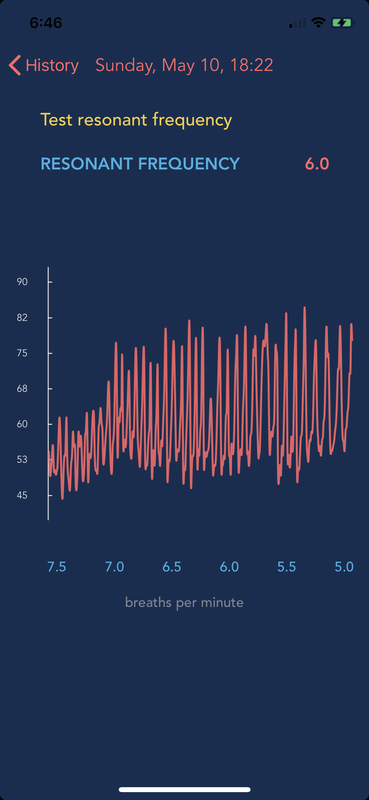
The screenshot below shows a real example from an RF test. You can see how the amplitude of the HRV signal (the red waveform) grows as the breathing rate slows down, peaking at 6.0 bpm before decreasing again at faster and slower rates. This peak is what you are looking for in your own data.
Refinement and Further Considerations
- The 4:6 Ratio: As mentioned in the video and the Practical Guide, some protocols advocate for an inhale-to-exhale ratio where the exhale is longer than the inhale (e.g., 4:6). The rationale is that a longer exhale further emphasizes parasympathetic activity. For "extra credit," you can take your top one or two candidate frequencies and re-test them using a 4:6 ratio (e.g., for 6 bpm, try a 4-second inhale and 6-second exhale) to see if it improves your HRV score or subjective feel.
- Is RF Stable? Your resonance frequency is determined by the physical properties of your cardiovascular system (e.g., blood volume, arterial elasticity). As such, it is quite stable. Dr. Richard Gevirtz, a pioneer in this field, suggests that for an adult, the frequency is essentially fixed for life. However, other practitioners suggest re-testing every 3-6 months, as significant changes in health, fitness, or body size could potentially shift it slightly. This reflects an ongoing area of discussion in the field, but you can be confident your result today is a reliable target for the foreseeable future.
Conclusion
You have now completed a foundational biofeedback protocol and have an objective, data-driven answer to the question: "What is my personal resonance frequency?" This is a significant step beyond generic breathing instructions.
Key Takeaways:
- Discovering your personal resonance frequency is an empirical process of testing a range of slow breathing rates (typically 5.0-7.0 bpm).
- The primary criteria for selection are maximizing a quantitative HRV metric (like LF Power or a coherence score) and a qualitative sense of subjective ease.
- More rigorous clinical assessment involves a weighted hierarchy of criteria, including phase synchrony, peak-trough amplitude, and spectral power characteristics.
- Your identified resonance frequency is a stable and reliable target for practice, designed to produce the most potent physiological effect on your autonomic nervous system.
In our next lesson, we will put this practical experience into a broader research context. Now that you have performed the protocol yourself, you are perfectly positioned to critically analyze the clinical trials that use this very methodology to study the long-term effects of resonance frequency training on health and well-being.