Welcome to our next lesson. In our previous session, we examined the inner workings of an e-commerce business from the operational side—the "how" of listing products, processing payments, and fulfilling orders. We looked at the process from the company's point of view.
Today, we will flip that perspective entirely. Instead of looking out from the business, we will look in from the customer's vantage point. This lesson will map the customer journey, which is the path a person takes from having never heard of your brand to becoming a loyal, repeat buyer. Understanding this journey is fundamental to building an effective e-commerce strategy, as it explains the why behind customer behavior. By the end of this lesson, you will be able to map the typical online customer journey and describe the key stages from initial awareness to post-purchase advocacy.
What is the Customer Journey?
The customer journey is the complete story of a customer's experience with a brand. It includes every single interaction, or touchpoint, they have along the way—from seeing an ad, to browsing the website, talking to customer support, and even receiving the package.
To build a solid foundation, let's start with a clear definition and a relatable example. The following video from the Google Career Certificates channel provides an excellent introduction to the concept.
The Customer Journey & the Marketing Funnel | Google Digital Marketing & E-commerce Certificate
This video, "The Customer Journey & the Marketing Funnel," offers a clear, non-technical explanation of the customer journey, using the simple example of choosing a weather app to illustrate the concept of touchpoints.
Please watch the segment from the beginning of the section. As you watch, focus on how the user's path to purchasing the app isn't a single event but a series of distinct interactions (touchpoints) like searching online, seeing an ad, reading reviews, and contacting support.
As the video illustrates, a customer's path is rarely a straight line. It's a series of steps, decisions, and experiences. To better understand and improve this path, businesses create a customer journey map. This is a visual representation of the customer's story, helping the company see the process through the customer's eyes and identify where they can make the experience smoother and more helpful.
The Five Stages of the Customer Journey
While every customer's path is unique, we can group their experiences into a series of predictable stages. Most e-commerce models use a five-stage framework to describe the journey. This framework helps organize marketing and operational efforts to meet the customer's needs at each step.
The article "Ecommerce Customer Journey from Beginner to Pro" by Elogic provides a fantastic, detailed breakdown of these five stages. It explains what customers want, what actions they typically take, and how a business can effectively respond at each stage.
Ecommerce Customer Journey from Beginner to Pro
This reading forms the core of our lesson. It provides a structured explanation of each stage of the customer journey, complete with examples of customer needs and business strategies.
Please read the section titled 5 Stages of the Customer Journey. For each of the five stages—Awareness, Consideration, Conversion, Retention, and Advocacy—focus on understanding these three elements: The Customer's Goal: What is the customer trying to accomplish at this stage? The Customer's Actions: What are they actually doing (e.g., searching, comparing, buying)? The Business's Role: How can the business support the customer at this stage?
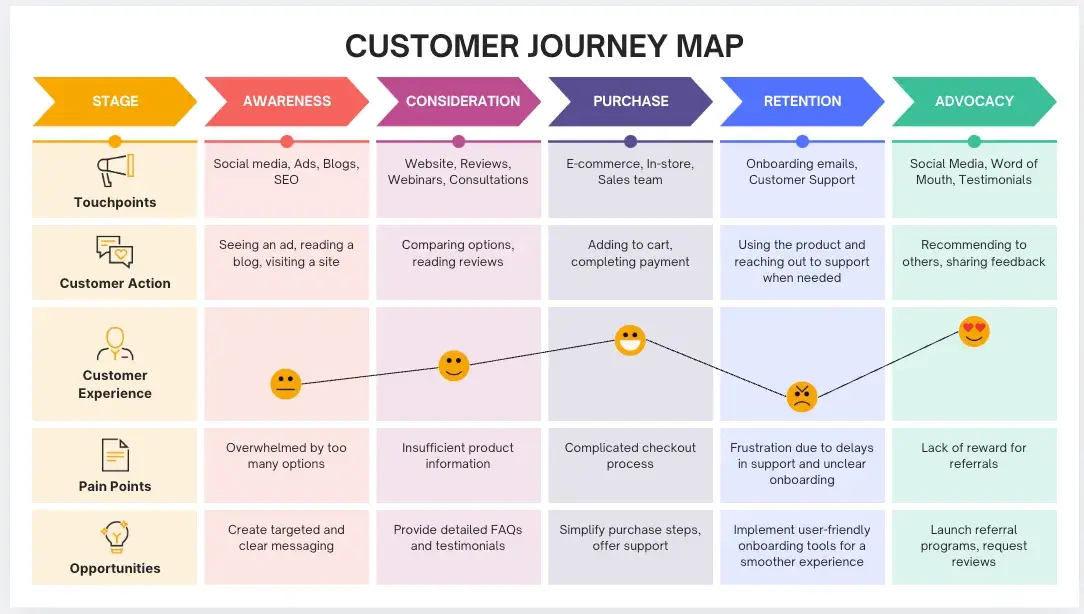
To summarize and visualize the key stages you just read about:
- Awareness: The customer becomes aware that a problem, need, or desire exists and discovers that your brand offers a potential solution. This is the "first hello."
- Consideration: The customer actively researches and evaluates your products against competitors. They are looking for the best solution and need information, reviews, and comparisons to build trust.
- Conversion (or Acquisition/Purchase): The customer decides to buy. The business's goal here is to make this step as seamless and secure as possible, removing any friction from the checkout process.
- Retention: The journey doesn't end at purchase. This stage focuses on the post-purchase experience, ensuring the customer is happy with their product and encouraging them to return.
- Advocacy: The customer is so satisfied with their product and overall experience that they become a brand promoter, recommending the business to others through word-of-mouth, social media, or positive reviews.
This image provides a helpful visualization of how these stages connect to customer actions, pain points, and business opportunities.
Customer Journey vs. The Marketing Funnel
You will often hear the term "marketing funnel" used alongside the customer journey. While they are related, they represent two different viewpoints.
- A Customer Journey Map attempts to model the actual, sometimes messy, path of an individual customer. It is from the customer's perspective.
- A Marketing Funnel is a linear model used by a business to visualize and measure how it guides a large number of potential customers from one stage to the next. It is from the business's perspective.
The marketing funnel is a plan; the customer journey is the reality. The Google video we watched earlier has a great segment that clarifies this distinction.
The Customer Journey & the Marketing Funnel | Google Digital Marketing & E-commerce Certificate
This segment of the video clearly explains how the marketing funnel complements the customer journey map by providing a business-centric framework for the same process.
Please watch the portion from the introduction of the marketing funnel. Pay close attention to the explanation of how a funnel is a business plan for moving customers along their journey.
Understanding this difference is important. Businesses design a funnel to create a smooth journey, but they study the actual customer journey maps to see what's really happening and how they can improve their funnel.
The Customer Journey in Action: Warby Parker
Theory is useful, but seeing these stages in a real-world context makes them much clearer. The eyewear company Warby Parker is often cited as a brand that masterfully manages its customer journey.
The following video from HubSpot uses Warby Parker to demonstrate how a company can create specific, purpose-driven content and experiences for each stage.
How to Build a Marketing Funnel that Actually Works for your Business
This video, "How to Build a Marketing Funnel that Actually Works," uses Warby Parker as a case study to show how a brand's actions map directly to the stages of the customer journey.
Watch the segment analyzing Warby Parker, from the introduction of the case study. Notice how they use different tools for different stages: Awareness: Blog posts about eye health to attract people with a problem. Consideration: A virtual try-on tool and free home try-on kits to help people evaluate their options. Decision (Conversion): A first-time buyer discount and a streamlined checkout process to make purchasing easy.
Warby Parker’s strategy is a perfect example of a business that has deeply understood its customer journey and built a marketing funnel to match it, addressing potential pain points (like "Will these frames look good on me?") with innovative solutions at exactly the right moment.
Conclusion
In this lesson, we shifted our focus from the business's internal operations to the customer's external experience. We have mapped the path a customer takes from discovery to loyalty, providing a crucial framework for understanding consumer behavior in an online environment.
Here are your key takeaways:
- The customer journey is the complete story of a customer's interactions with a brand across all touchpoints.
- This journey is typically broken down into five stages: Awareness, Consideration, Conversion, Retention, and Advocacy.
- A customer journey map is a visual tool from the customer's perspective, while a marketing funnel is a business model used to guide many customers through these stages.
- By understanding the customer journey, businesses can identify customer needs and pain points at each stage and create tailored experiences that build trust and drive sales.
Now that we have a clear map of the customer's path, our next lesson will explore the specific tools businesses use to meet customers at each point on that path. We will identify the key digital marketing channels—such as Search Engine Optimization (SEO), social media marketing, and email campaigns—and discuss how they are used to guide customers from one stage of the journey to the next.