Introduction
Welcome to the third module, "Content Inventory and Gap Analysis." In the previous module, we established the strategic and operational alignment between sales and marketing, culminating in the creation of a Service Level Agreement (SLA) for lead handoffs. We defined the "rules of engagement" for how your teams will work together.
Now, we turn our attention inward to the assets you already possess: your content. Before you can build new things, you must take stock of what you already have. This lesson will equip you to do just that.
Our objective is to design a content audit framework with categories for funnel stage, buyer persona, format, and performance. Think of this framework as the architectural blueprint for a comprehensive content inventory. For someone with your background in computer applications, this is analogous to designing the schema for a database before populating it with records. A well-designed schema ensures the data is organized, meaningful, and ready for analysis.
1. What is a Content Audit?
A content audit is a systematic process of inventorying and evaluating all the content assets your organization has created. It's not just about listing URLs; it's about strategically assessing each piece to determine its value, relevance, and performance against business goals. The primary goal of this audit, in our context, is to support the entire marketing and sales funnel.
To understand the specific lens we'll be using, let's look at how a sales-focused content audit is defined.
How to do a sales content audit
The article 'How to do a sales content audit' by ContentCamel provides a great starting point. It clarifies the purpose of an audit and differentiates it from a purely marketing-focused one.
Please read the section 'What Is a Sales Content Audit?'. Note how it emphasizes supporting prospects at any stage of the sales funnel.
As the article notes, the audit gives you a "clear view of what content you already have and what gaps need to be filled." This is the foundational step for transforming your existing library of content from a simple collection of assets into a strategic engine that supports sales and drives revenue.
2. The Core Categories of Your Audit Framework
A powerful audit framework is built on clear, strategic categories. These categories act as the columns in your audit spreadsheet, allowing you to slice and dice your content inventory to reveal critical insights. Let's design our framework around the four key pillars mentioned in our learning outcome.
a) Funnel Stage
You need to know where each piece of content fits in the buyer's journey. Does it generate initial awareness, help leads consider their options, or persuade them to make a decision?
Let's watch a quick video to refresh our memory on the funnel stages and the types of content and metrics associated with each.
How to Build a Marketing Funnel that Actually Works for your Business
This clip from HubSpot's 'How to Build a Marketing Funnel' video provides a concise overview of the funnel stages and the kind of purpose-driven content that fits into each.
Please watch the sections covering the funnel stages (00:33-01:26), the example of Warby Parker's content at each stage (02:36-04:11), and the metrics for each stage (04:21-04:53). This will help you think about how to classify your own content.
In your framework, you'll create a category (a column) for "Funnel Stage" and typically use values like TOFU (Top-of-Funnel), MOFU (Middle-of-Funnel), and BOFU (Bottom-of-Funnel). This allows you to quickly see if you have, for example, a lot of TOFU content but very little to help prospects in the consideration (MOFU) stage.
b) Buyer Persona
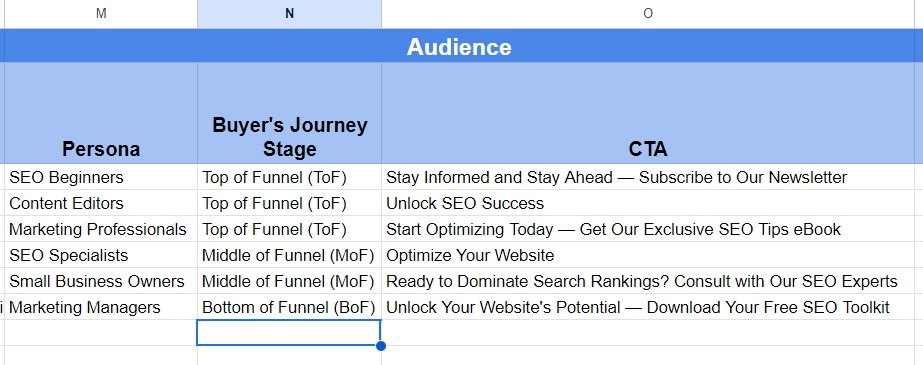
Content is only effective if it resonates with its intended audience. Since your organization has already defined its buyer personas, we must map each content asset to the specific persona it targets. This helps you identify which personas are well-supported with content and which are being neglected.
This image shows a simple but effective way to visualize this mapping in an audit.
c) Content Format
This is a straightforward but essential piece of data. Is the asset a blog post, a video, a case study, a webinar, or a one-pager? Cataloging the format helps you understand your content mix. You might discover you're heavily reliant on blog posts and have an opportunity to repurpose top-performing topics into other formats, like videos or infographics, to reach a wider audience.
d) Performance Metrics
This is where your audit becomes a tool for data-driven decisions. You need to assess how each piece of content is actually performing. We can break performance into two types of data: quantitative and qualitative.
- Quantitative Data (The Numbers): These are hard metrics that tell you about reach, engagement, and conversion.
- Qualitative Data (The Assessment): This is your expert judgment on the content's quality, accuracy, and relevance.
The image below gives an idea of what a performance-focused audit dashboard can look like, combining high-level KPIs with URL-specific data.

To build out this part of our framework, we need a comprehensive menu of potential data points to choose from.
How to Run a Content Audit: Full Guide + 6 Free Templates
The article 'How to Run a Content Audit: Full Guide + 6 Free Templates' from WordStream is an excellent, detailed resource. It provides extensive checklists for the data points you can include in your audit.
Please read the section 'What should you include in a content audit?'. Skim through the 'Informational', 'Qualitative', and 'Quantitative' checklists. Don't worry about memorizing every item; the goal is to see the range of possibilities for what you can measure.
3. Assembling Your Content Audit Framework
Now, let's bring these categories together into a practical framework. The most common tool for this is a spreadsheet. Each row will represent a single piece of content, and each column will represent one of our audit categories.
Based on the resources and concepts we've covered, here is a starter template for your framework. It balances strategic information with key performance indicators.
| Column Header | Description | Example | Category |
|---|---|---|---|
| Content Title | The official title of the content asset. | "The Ultimate Guide to B2B Content Marketing" | Informational |
| URL | The public link to the asset. | https://yourcompany.com/blog/b2b-content-guide |
Informational |
| Content Format | The type of asset (e.g., Blog Post, Video, Case Study). | Ebook |
Informational |
| Target Persona | The primary buyer persona this content is for. | Marketing Mary |
Strategic |
| Funnel Stage | The buyer's journey stage this content serves (TOFU, MOFU, BOFU). | TOFU |
Strategic |
| Pageviews (12 mo.) | Total unique pageviews over the last year (from Google Analytics). | 12,500 |
Performance |
| Avg. Time on Page | The average time visitors spend on the page. | 00:04:32 |
Performance |
| Conversions | Number of leads generated (e.g., form fills, downloads). | 412 |
Performance |
| Qualitative Score | Your rating of the content's quality, relevance, and visual appeal (e.g., scale of 1-5). | 4 |
Qualitative |
| Action Item | The next step for this content: Keep, Update, Repurpose, or Archive. | Update |
Action |
This template is a starting point. The WordStream and ContentCamel resources offer many more columns you could add, such as Date Published, Keywords, Backlinks, or Sales Team Feedback.
Your Turn: Design Your Framework
Your task is to design the content audit framework you will use for your own content library. You don't need to populate it with data yet; the goal is to finalize the structure (the column headers) of your spreadsheet.
Task:
- Start with the template provided above.
- Review the checklists in the WordStream article (LINK) and the concepts in the ContentCamel article (LINK).
- Customize the template for your needs. Add, remove, or modify columns to create a framework that you believe will give you the most strategic insights. For instance, you might want to add a column for "Secondary Persona" or "Key Topic/Pillar".
- In your response, list the final column headers for your framework and write a one-sentence justification for each one, especially for any you've added or significantly changed from the template.
This exercise will solidify your understanding of what makes a useful audit and prepare you for the next step: actually cataloging your content.
Conclusion
In this lesson, we laid the critical groundwork for analyzing your existing content. You've learned that a content audit is a strategic review, not just an inventory, and that its power comes from a well-designed framework.
Key Takeaways:
- A Content Audit Framework is Your Blueprint: It's a structured system (usually a spreadsheet) for cataloging and evaluating content.
- Strategic Categories are Essential: A strong framework must categorize content by Funnel Stage, Buyer Persona, Format, and Performance (both quantitative and qualitative).
- Start with a Template, then Customize: A good framework is tailored to your business goals. You should select the metrics and categories that will provide the most actionable insights for your organization.
Preview of the Next Lesson:
Now that you have designed your audit framework, you're ready to put it to use. In our next lesson, you will catalog a representative sample of your existing content assets using the very framework you just created. This hands-on process will begin to reveal the real-world strengths, weaknesses, and gaps in your current content library.