Introduction
In our last lesson, we focused on selecting the right Key Performance Indicators (KPIs)—the shared, revenue-focused metrics that allow marketing and sales to speak the same language. We established what success looks like in financial terms. Now, we'll define the operational mechanics that make achieving those KPIs possible.
Today's lesson addresses a critical point of friction in many organizations: the lead handoff. Our goal is to draft a sample Service Level Agreement (SLA) section defining lead handoff criteria and required response times. This is where the abstract goal of "alignment" becomes a concrete, time-bound process.
Think of the marketing and sales departments as two complex systems. The SLA for lead handoff acts as the Application Programming Interface (API) between them—it defines the exact data format (a qualified lead), the call protocol (the handoff process), and the expected response time. Without a clearly defined API, communication fails. By creating one, you are building a crucial component of your strategic content engine.
1. The Handoff Process: From Interest to Action
A successful handoff is not a single event but a multi-step process. Each step must be clearly defined in the SLA to prevent leads from falling through the cracks. The core purpose is to ensure that marketing delivers truly "sales-ready" leads and that sales acts on them with urgency.
Let's review a standard structure for this process.
How to define SQLs: An SLA for marketing and sales teams
The article 'How to define SQLs: An SLA for marketing and sales teams' from Arise GTM provides a clear, templated approach to this process. We will focus on the section that breaks down the specific steps involved.
Please read the section titled 'Handoff Process'. As you read, identify the five distinct steps it outlines, from initial identification by marketing to follow-up by sales.
As the article outlines, a robust handoff process includes these five stages:
- Lead Identification: Marketing identifies potential leads based on their engagement and demographic data. This is often automated using a lead scoring system, as described in the article.
- Lead Qualification: The lead meets a pre-agreed threshold to be considered a Sales Qualified Lead (SQL). This is the trigger for the handoff. For example, the trigger could be accumulating 100 points in a lead score or taking a high-intent action like requesting a demo.
- Lead Handoff: Marketing officially passes the lead to the sales team, typically by changing its status or assigning ownership within a shared CRM system.
- Sales Acknowledgment: The assigned salesperson confirms they have received the lead and accept responsibility. This is a critical internal-facing step that starts the clock for the sales team.
- Follow-Up: The salesperson makes their first meaningful contact with the prospect (e.g., a call or personalized email). This is the external-facing action that the prospect experiences.
Defining these stages eliminates ambiguity. Marketing's job is done at step 3; the sales commitment begins at step 4.
2. The Clock is Ticking: Defining Response Times
The value of a lead decays exponentially over time. A lead contacted within 5 minutes is dramatically more likely to convert than one contacted after 24 hours. Therefore, your SLA must include specific, aggressive, and realistic response time commitments.
These timeframes are often broken down by the channel or source of the lead, as different sources imply different levels of intent.
Speed-to-Lead SLA Templates & Follow-Up Workflows That Win Deals
The article 'Speed-to-Lead SLA Templates & Follow-Up Workflows That Win Deals' from HeyReach offers excellent, data-informed benchmarks for response times.
Read the subsections 'Default SLA bands (by channel)' and 'First-response SLA matrix (owners + escalations)'. Focus on the specific time targets for different lead types (inbound form, LinkedIn, referral) and the concept of an escalation path.
This resource introduces two vital concepts:
- Channel-Specific Benchmarks: A "Request a Demo" form submission implies higher urgency than a LinkedIn message. The SLA should reflect this.
- Inbound form: ≤5 minutes
- LinkedIn reply: ≤15 minutes
- Referral: ≤60 minutes
- Escalation Paths: What happens if the salesperson is in a meeting and misses the 5-minute window? A good SLA defines an automated escalation path (e.g., after 10 minutes, the sales manager gets a notification). This ensures accountability without manual "babysitting."
These time-bound commitments are what give an SLA its power. They transform a general goal ("follow up with leads quickly") into a measurable and enforceable process.
3. Assembling the SLA Section
Now, let's combine the process and the timings into a structured SLA section. A clear template ensures all necessary details are included. The best SLAs are concise and unambiguous.
Below are two examples of how this information can be visually organized in a final SLA document.

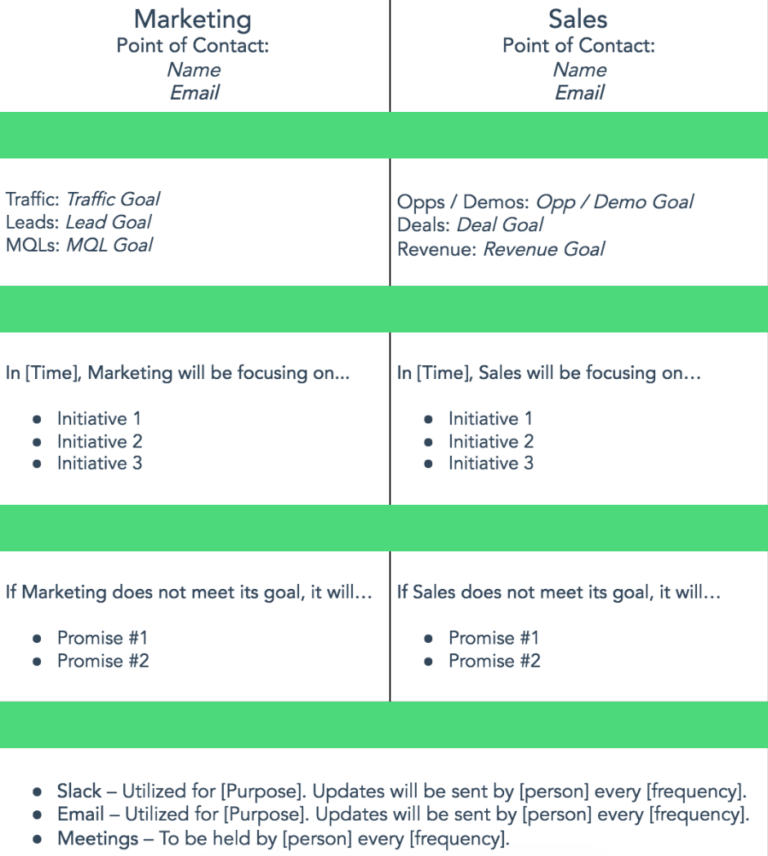
Drawing from these examples and our readings, here is a simple but effective template you can use to draft your SLA section.
SLA Section: Lead Handoff Process & Response Times
- Lead Source: [e.g., "Request a Demo" Form Submission]
- Handoff Trigger (SQL Criteria): [Describe the specific event that qualifies the lead and initiates the handoff. e.g., "Successful submission of the 'Request a Demo' form on the company website."]
- Handoff Mechanism: [Describe the technical process. e.g., "Lead is automatically created in the CRM, assigned to the on-call SDR, and a notification is sent to the #sales-inbound Slack channel."]
- Sales Commitment: Acknowledgement:
- Action: [e.g., "SDR to change lead status from 'New' to 'Working' in the CRM."]
- Response Time: [e.g., "Within 5 minutes of handoff during business hours (9am-5pm)."]
- Sales Commitment: First Follow-Up:
- Action: [e.g., "SDR to initiate first contact via email and/or phone call."]
- Response Time: [e.g., "Within 1 hour of handoff during business hours."]
- Escalation Protocol:
- Acknowledgement Breach: [e.g., "If status is not changed to 'Working' within 10 minutes, the Sales Manager is automatically notified via Slack."]
- Follow-Up Breach: [e.g., "If no outbound activity is logged in the CRM within 1.5 hours, the lead is re-assigned to the next available SDR and the Sales Manager is notified."]
Your Turn: Draft an SLA Section
Now it's time to apply what you've learned. Using the template above, complete the following exercise.
Scenario: A prospect has downloaded a "Bottom-of-Funnel" (BOFU) piece of content: a detailed pricing guide. Your lead scoring system automatically qualifies anyone who downloads this guide as an SQL.
Task: Draft the SLA section for the handoff of a lead who has downloaded the pricing guide. Make reasonable assumptions based on the benchmarks and processes we've discussed. Focus on being specific and clear in each field of the template.
Take about 10 minutes to fill out the template for this scenario.
Conclusion
In this lesson, you moved from the "what" of strategic alignment to the "how." You learned to deconstruct the lead handoff into a series of defined steps and, most importantly, to attach time-based commitments and accountability mechanisms to that process.
Key Takeaways:
- Process is Paramount: A successful handoff relies on a clearly defined process: Identification, Qualification, Handoff, Acknowledgment, and Follow-Up.
- Speed is a Strategy: The value of a lead decays rapidly. Your SLA must enforce aggressive response times, ideally measured in minutes for high-intent leads.
- Accountability Requires Escalation: A simple escalation path (e.g., auto-notifying a manager) ensures the system works without constant manual oversight.
- Clarity is King: A well-drafted SLA section leaves no room for ambiguity. It clearly states the trigger, mechanism, owner, timeframe, and consequences for each step.
Preview of the Next Lesson:
With the foundational agreements for sales and marketing alignment now in place, our next module, "Content Inventory and Gap Analysis," will shift focus to your existing assets. In the first lesson, you will design a content audit framework with categories for funnel stage, buyer persona, format, and performance. This will be the first step in analyzing the content you already have and identifying where the strategic gaps are, setting the stage for building the new content your engine needs.