Introduction
Welcome back. In our last lesson, we established that a Service Level Agreement (SLA) is the formal contract that turns the goal of sales and marketing alignment into a set of concrete, measurable commitments. One of the most critical components of that contract is the section on "Performance Metrics," or Key Performance Indicators (KPIs).
Today, we will focus exclusively on that component. Our goal is to learn how to select shared KPIs that connect marketing activities directly to revenue outcomes. This is where your journey toward demonstrating strategic influence truly begins. As a Content Lead, you are used to tracking metrics like page views or downloads. As the architect of a content engine, you must learn to speak the language of the C-suite, which is the language of pipeline, cost of acquisition, and return on investment.
Given your background in computer applications, you can think of this as moving from monitoring basic server health (like CPU usage) to tracking application performance metrics that matter to the business (like transaction throughput, error rates, and user session duration). Both are important, but only the latter group tells you if the system is successfully delivering value.
1. Moving Beyond "Vanity Metrics"
The first and most important shift in mindset is from tracking activity to tracking impact. Many marketing teams get stuck reporting on "vanity metrics"—numbers that look good on a chart but don't correlate to business success. Your Chief Financial Officer (CFO) doesn't care about social media shares; they care about revenue generated for a given cost.
To build a credible, revenue-focused content engine, you must learn to distinguish between vanity metrics and the KPIs that truly matter.
The Ultimate Guide to B2B Content Marketing ROI - Directive
Let's start with a short reading from an article titled 'The Ultimate Guide to B2B Content Marketing ROI' by Directive. This section makes a very clear and forceful case for why vanity metrics are a trap.
Please read the section titled 'Vanity Metrics Sabotage Your Budget'. Focus on the distinction it makes between metrics like 'page views' and 'real metrics' that connect to revenue.
As the article argues, real metrics are those you can trace to revenue. This is the fundamental principle we will build upon throughout this lesson. The article, "B2B Marketing KPIs: Metrics That Actually Drive Pipeline and Revenue," provides a useful table to illustrate this distinction.
| KPIs (Strategic, Revenue-Focused) | Metrics (Tactical, Activity-Focused) |
|---|---|
| Pipeline created from marketing | Click-through rate on ads |
| Marketing-sourced revenue | Email open rates |
| MQL→SQL conversion rate | Website session duration |
| Customer Acquisition Cost (CAC) | Cost per click |
| Customer Lifetime Value (CLV) | Page views per session |
Your goal is to become an expert in the left column.
2. A Framework for Revenue-Focused KPIs
To organize our thinking, it's helpful to group KPIs into categories that map to the B2B buyer's journey and business model. The article from In Motion Marketing provides an excellent framework.
B2B Marketing KPIs: Metrics That Actually Drive Pipeline and Revenue
This article will be our main guide for the rest of the lesson. Let's begin by understanding its framework for categorizing KPIs.
Please read the section 'Core Categories of B2B Marketing KPIs'. Pay attention to the five main categories it proposes, from 'Demand & Website Performance' to 'Account-Based Marketing (ABM)'.
This framework gives us a complete picture of performance, from attracting initial interest to retaining and growing customer accounts. The key is that even the top-of-funnel categories are ultimately judged by their ability to influence the revenue-focused categories later on.
3. The Economic Engine: LTV, CAC, and the 3:1 Ratio
Before we dive into a list of specific KPIs, we need to understand the fundamental economic engine of a B2B business, especially a SaaS (Software-as-a-Service) one. This engine is powered by the relationship between two master KPIs:
- Customer Lifetime Value (LTV or CLV): The total revenue you can expect to generate from a single customer over the entire duration of their relationship with your company.
- Customer Acquisition Cost (CAC): The total cost of sales and marketing required to acquire one new customer.
The health of your business depends on a simple rule: LTV must be significantly greater than CAC.
The SaaS business model & metrics: Understand the key drivers for success
To understand these concepts clearly, we'll watch a segment from a talk by David Skok, a renowned venture capitalist. He provides a crystal-clear explanation of LTV, CAC, and the target ratios that signal a healthy business.
Please watch the following two clips: Unit Economics (CAC and LTV): from 12:01 to 12:42. Focus on his definition of these two core concepts. Guidelines for Success: from 18:20 to 19:06. Pay close attention to the specific guideline he gives for the LTV:CAC ratio and CAC payback period.
As Skok explains, the time-tested guidelines for a viable B2B business are:
- LTV should be at least 3x your CAC.
- You should be able to recover your CAC in under 12 months.
These two numbers—LTV:CAC ratio and CAC Payback Period—are among the most important KPIs you can track. They are the ultimate measure of whether your entire marketing and sales engine is profitable and scalable.
4. The "Board-Level" KPIs: What Leadership Cares About
With the LTV:CAC framework in mind, we can now select a core set of shared KPIs that directly inform strategic decisions and answer the questions your leadership team and board of directors will ask.
B2B Marketing KPIs: Metrics That Actually Drive Pipeline and Revenue
Let's return to the In Motion Marketing article to define these essential KPIs. You don't need to track everything, but you must master these.
Read the sections titled 'Revenue, Profitability & Efficiency KPIs' and 'Subscription, Retention & Lifetime Value KPIs'. Focus on understanding the definition, formula, and 'Why it matters' for these five key KPIs: Marketing-Sourced Pipeline Customer Acquisition Cost (CAC) Return on Marketing Investment (ROMI) Customer Lifetime Value (CLV/LTV) Net Revenue Retention (NRR)
Let's briefly summarize the story these five KPIs tell together:
- Marketing-Sourced Pipeline (a leading indicator): "Are we creating enough qualified sales opportunities now to hit our revenue targets next quarter?"
- CAC (an efficiency metric): "How much does it cost us to win a new customer?"
- LTV (a value metric): "How much is a new customer worth to us over time?"
- ROMI (a lagging indicator): "For every dollar we invested in marketing last year, how many dollars of revenue did we generate?"
- NRR (a retention & growth metric): "Are we keeping and growing the customers we already have?" An NRR over 100% means you're growing even without acquiring new customers, which is a powerful sign of a healthy business.
When you can confidently report on these numbers, you are no longer just a "Content Lead"; you are a strategic partner in the business.
5. Aligning KPIs with Business Strategy
The final piece of the puzzle is understanding that the KPIs you prioritize should change depending on your company's immediate business objectives. Is the goal to enter a new market, support a struggling sales team, or grow revenue from existing clients? Each objective requires a different focus.
A B2B marketing masterclass with PwC's Global CMO, Antonia Wade
In this clip from 'A B2B marketing masterclass,' PwC's Global CMO, Antonia Wade, explains how marketing's role—and by extension, its KPIs—should adapt to the company's strategic needs.
Please watch from 30:03 to 32:54. Listen for how she describes the different jobs marketing can be asked to do and how that should influence where you put your marketing dollars and focus.
Wade’s point is crucial: the conversation about KPIs is fundamentally a strategy conversation.
- If your company is entering a new market, your primary KPIs might be around building brand awareness in target accounts and generating the first few sales-qualified opportunities (SQOs).
- If your company needs to boost short-term sales, your focus will be on pipeline velocity and lead-to-customer conversion rate.
- If your company sees a big opportunity in its existing customer base, your most important KPIs will be Net Revenue Retention (NRR) and the LTV of expanded accounts.
This strategic flexibility is what elevates your role from operational to influential.
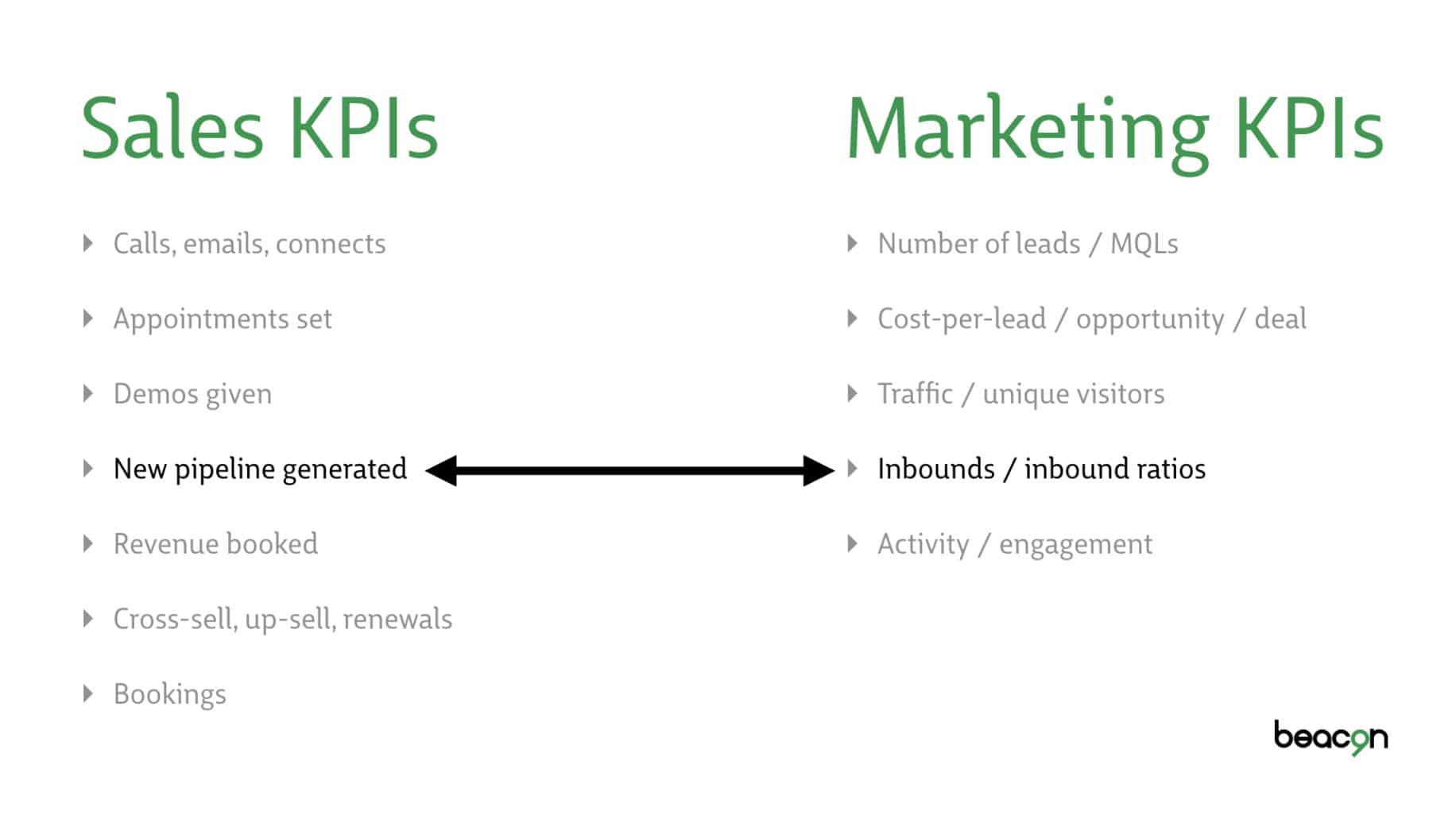
Finally, remember that these KPIs must be shared. Sales and marketing must look at the same dashboard. This image simply illustrates how a sales KPI and a marketing KPI can reflect two sides of the same coin—in this case, the creation of new pipeline.
Conclusion
In this lesson, we made the critical shift from activity-based metrics to revenue-focused KPIs. You now have a framework for selecting and understanding the metrics that demonstrate the financial impact of your marketing efforts.
Key Takeaways:
- Ditch vanity metrics: Move beyond page views and social shares to metrics that your CFO cares about.
- Master the economic engine: The LTV:CAC ratio is the ultimate measure of a sustainable business model. A healthy business aims for a ratio of 3:1 or better.
- Focus on "board-level" KPIs: Prioritize Marketing-Sourced Pipeline, CAC, LTV, ROMI, and NRR to demonstrate strategic value.
- Align KPIs with business goals: The most important KPIs depend on whether your company's strategic priority is market expansion, short-term sales support, or existing customer growth.
Preview of the Next Lesson:
We have now defined the purpose of an SLA and identified the key metrics to measure its success. In the next lesson, we will get practical and apply these concepts. You will draft a sample SLA section defining lead handoff criteria and required response times. This hands-on exercise will be your first step in building the formal operating system for your content engine.