Introduction
Welcome to the first lesson of our module on Content Distribution and Amplification. In the previous module, you honed your skills in targeted content deployment for Account-Based Marketing, learning how to map specific assets to a high-value account's journey. Now, we're zooming out to address a fundamental challenge for any content engine: how to ensure your valuable content reaches the widest possible relevant audience.
Your learning outcome for this lesson is to develop a multi-channel distribution plan using the PESO model (Paid, Earned, Shared, Owned) to maximize content reach.
Simply creating great content is no longer enough. To have a strategic impact and generate ROI, your content must be seen, engaged with, and acted upon. This lesson provides the strategic framework—the PESO model—to move beyond a "publish and pray" approach and build a deliberate, measurable distribution machine.
1. Why Distribution Demands a Strategy
In today's digital landscape, you're not just competing with direct competitors for your audience's attention; you're competing with every piece of content published online. This saturation makes a formal distribution strategy essential.
Let's start with a short video that frames this challenge and underscores why distribution is a critical, non-negotiable part of the content process.
The Content Distribution Playbook - Whiteboard Friday
This 'Whiteboard Friday' video from Moz clearly articulates the problem of declining organic reach and the need for proactive content distribution to stand out.
Please watch the beginning of the video, from 00:00 to 01:50. Pay attention to the argument that simply creating content and hoping for traffic is a failing strategy.
As the video highlights, the days of "if you build it, they will come" are over for content marketing. Success requires a deliberate plan to push your content into the channels where your audience spends their time.
2. The PESO Model: A Framework for Distribution
To build a comprehensive plan, we need a mental model to organize the vast landscape of distribution channels. The PESO model is the industry standard for this. It categorizes all media into four distinct but interconnected types: Paid, Earned, Shared, and Owned.
Let's begin by defining these four pillars.
Adopting the PESO model for your communication strategy
The article 'Adopting the PESO model for your communication strategy' from DinMo provides a clear and concise introduction to the framework and its components.
Please read the sections 'What is the PESO Model?' and 'A four-pillar model'. Focus on understanding the core definition of each of the four media types (Paid, Earned, Shared, Owned) and the examples provided for each.
Now that you have a foundational understanding, let's deepen it by examining the strategic role of each media type. A powerful distribution plan doesn't just use these channels; it understands their unique strengths, trade-offs, and how they contribute to business goals.
PESO Model (Paid, Earned, Shared, Owned Media)
This resource from Umbrex, 'PESO Model (Paid, Earned, Shared, Owned Media)', offers a more detailed, strategic breakdown of each component.
Please read the section 'How the PESO Model Works'. For each media type, pay close attention to the lists of 'Strengths,' 'Trade-offs,' 'Typical roles,' and 'Metrics.' This will help you think like a strategist when choosing your channels.
This diagram visually represents how the four media types are distinct yet overlap, creating a holistic strategy.
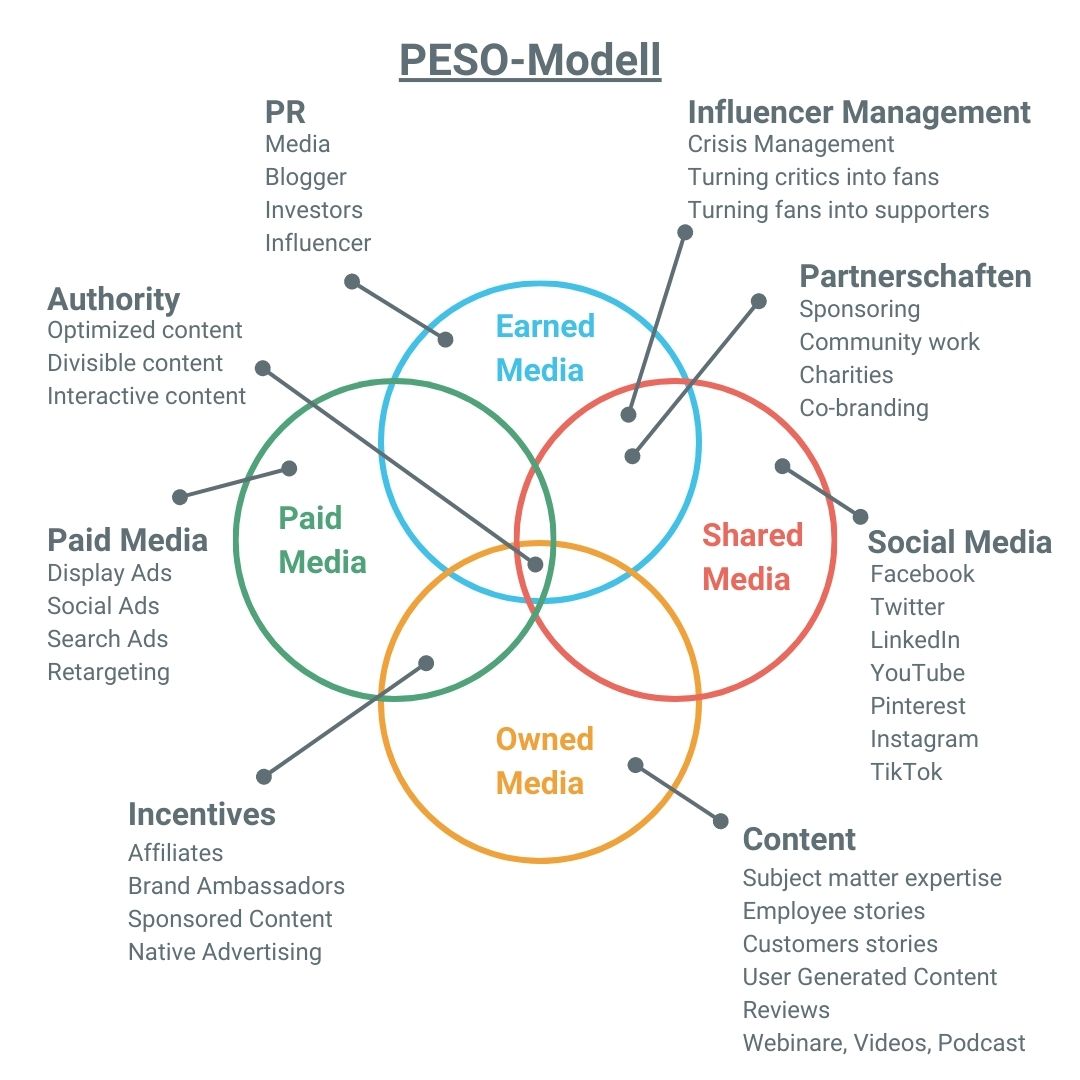
The power of the PESO model lies in its integrated nature. As the Umbrex article notes, a well-architected program makes these elements reinforce one another. For example:
- You use Paid media to amplify a great piece of Earned media (like a positive press mention).
- You design your Owned content (like a blog post) with built-in features to encourage Shared media (social sharing).
3. A Practical Distribution Playbook
The PESO model gives us the "what," but we also need the "how." Let's return to the Moz video to get a wealth of practical tactics you can use within each category.
Owned Media: Your Content Hub
These are the channels you control completely. They are the foundation of your content engine.
The Content Distribution Playbook - Whiteboard Friday
Let's explore specific tactics for your Owned channels.
Watch the segment from 02:09 to 03:48. Note the different Owned channels mentioned, especially the idea of empowering your sales team to distribute content one-to-one.
Key Owned channels include your email list, website (blog, banners), in-app notifications, and, crucially for B2B, your sales team. Enabling sales to share the right content with leads is a high-impact distribution tactic.
Shared & Earned Media: Community and Credibility
These channels are about participating in communities and earning third-party validation. Control is lower, but credibility and potential reach are high. The video offers a rapid-fire list of tactics that span both Shared and Earned media.
The Content Distribution Playbook - Whiteboard Friday
Now, let's look at a wide array of tactics for getting your content into communities and in front of new audiences.
Watch the extensive segment from 03:48 to 09:52. Don't worry about memorizing every tactic. Instead, listen for 2-3 ideas that seem new or particularly relevant to your audience (e.g., Slack communities, Quora, repurposing on Medium, Reddit).
Paid Media: Amplification and Acceleration
Paid channels allow you to guarantee reach to a specific, targeted audience. They are best used to amplify content that is already performing well or to reach high-value segments quickly.
The Content Distribution Playbook - Whiteboard Friday
Finally, let's cover how to use paid advertising to boost your content's reach.
Watch from 10:14 to 11:48. Focus on the concept of 'remarketing'—targeting ads to people who have already engaged with you in some way.
As you can see, a comprehensive distribution plan requires you to think far beyond just posting on your company's social media page. It involves a creative mix of Owned, Shared, Earned, and Paid tactics tailored to your content and audience.
4. Activity: Develop a PESO Distribution Plan
It's time to put this framework into practice. Your task is to take one significant piece of content you've already created and build a multi-channel distribution plan for it using the PESO model.
Activity (Allow ~20-25 minutes):
- Select a Content Asset: Choose a substantial piece of content from your library. This could be a comprehensive blog post, a case study, a recorded webinar, or an ebook.
- Create Your Plan: In a document or spreadsheet, create a table with four columns: PESO Category, Channel/Tactic, Specific Action, and Goal/KPI.
- Populate the Plan: For your chosen asset, fill in the table. Aim to list at least two distinct tactics for each of the four PESO categories. This will ensure you're thinking across the entire model.
Example Plan for a B2B Case Study: "How Acme Corp Increased Efficiency by 30%"
| PESO Category | Channel/Tactic | Specific Action | Goal/KPI |
|---|---|---|---|
| Owned | Company Blog | Publish the case study as a detailed blog post with strong visuals and a clear CTA. | Goal: Educate existing audience. KPI: Page views, Time on page. |
| Owned | Email Newsletter | Feature the case study as the main story in the next monthly newsletter. | Goal: Nurture leads. KPI: Click-through rate (CTR). |
| Shared | LinkedIn (Company) | Create a carousel post summarizing the key results (Problem, Solution, Outcome). Link to the full study. | Goal: Drive engagement and traffic. KPI: Shares, Comments, Clicks. |
| Shared | Sales Team Enablement | Create a one-sentence summary and a link for the sales team to share with relevant prospects in their pipeline. | Goal: Accelerate deals. KPI: Sales feedback on prospect engagement. |
| Paid | LinkedIn Ads | Promote the carousel post to a targeted audience of VPs of Operations in the manufacturing industry. | Goal: Generate new leads. KPI: Cost per lead (CPL). |
| Paid | Remarketing | Run display ads showing the case study headline to users who visited the product page but didn't convert. | Goal: Re-engage warm traffic. KPI: View-through conversions. |
| Earned | Influencer Outreach | Send a personalized note to 3 industry bloggers, offering an exclusive quote from the client featured in the study. | Goal: Gain third-party credibility. KPI: Number of mentions/backlinks. |
| Earned | PR | Pitch the story to a trade publication, focusing on the newsworthy "30% efficiency" angle. | Goal: Build brand authority. KPI: Media placements. |
Conclusion
Excellent work. You have just created a strategic, multi-channel distribution plan. This process transforms content from a static asset into a dynamic tool for achieving business objectives. By systematically planning how you will leverage Paid, Earned, Shared, and Owned media, you build a true content engine—one that not only produces but also delivers value at scale.
Key Takeaways:
- Content distribution is a mandatory discipline for achieving content marketing ROI.
- The PESO model (Paid, Earned, Shared, Owned) provides a comprehensive framework for organizing your distribution channels.
- Each media type has unique strengths: Owned for control and data, Shared for engagement, Earned for credibility, and Paid for targeted reach.
- The most effective strategies integrate all four PESO components, using them to reinforce and amplify one another.
Preview of the Next Lesson:
In this lesson, you designed a broad, multi-channel plan. In our next lesson, we will begin a deep dive into one of the most powerful and sustainable distribution channels within the "Owned" and "Earned" categories: Search Engine Optimization (SEO). You will learn how to conduct keyword research to align a content topic with B2B buyer search intent, ensuring your content is discovered by prospects at the exact moment they are looking for solutions.