Introduction
Welcome to the final lesson in our module on Targeted Account-Based Marketing. In the past two lessons, you've done the strategic work of an ABM leader: first, by designing a multi-touch sequence framework to engage a high-value account, and second, by crafting a personalized executive brief—a key asset for influencing senior decision-makers.
Today, we will tie all the pieces together. Your learning outcome is to map specific content assets from your playbook to each stage of the ABM sequence. This means moving beyond single assets to orchestrating a complete, value-driven conversation through content. This skill is the engine of a successful ABM program, connecting your content directly to pipeline progression and demonstrating its strategic impact on revenue.
1. From a List of Assets to a Strategic Map
In traditional content marketing, you might create a blog post and hope the right people find it. In ABM, hope is not a strategy. Every content asset must have a specific job to do at a specific moment in the sales cycle for a specific account. This is the essence of content mapping.
To start, let's explore the core principles that guide an effective ABM content strategy. It's not just about what you create, but how and when you deploy it.
ABM Content Strategy: How B2B & SaaS Teams Drive Revenue
The article 'ABM Content Strategy' by Factors.ai lays out the essential operating principles for content that influences the sales pipeline. As you read, focus on how these principles shift the mindset from 'creating content' to 'unblocking deals'.
Please read the section 'The Operating Principles Behind ABM Content That Actually Works'. Pay close attention to the concepts of using intent signals to determine timing and the importance of covering the entire buying group, not just a single persona.
The key takeaways from that reading are foundational:
- Accounts first, content second: Your content ideas must originate from the needs of your target account list.
- Intent determines timing: You deploy content based on an account's demonstrated behavior (e.g., visiting your pricing page), not a rigid calendar.
- Cover the buying committee: A deal involves multiple stakeholders (e.g., economic buyer, technical user, champion). Your content plan must address the questions and concerns of each.
- Sales must be enabled: Your sales colleagues are the primary users of ABM content. They must know exactly when and how to use each asset.
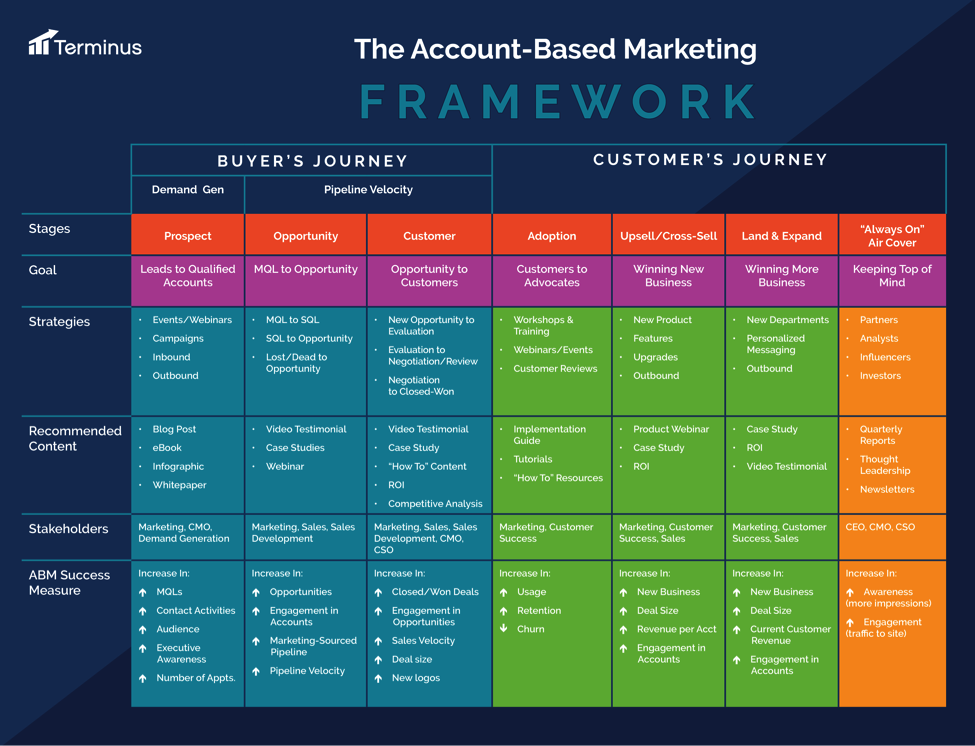
This image provides a powerful visual for this concept, mapping recommended content across the entire buyer and customer journey.
2. A Stage-by-Stage Content Playbook
Now that we have the guiding principles, let's build a practical playbook. We can group the ABM journey into three main stages, each with a distinct goal and a corresponding set of content assets.
The article you just read from Factors.ai provides an excellent breakdown of this.
ABM Content Strategy: How B2B & SaaS Teams Drive Revenue
Let's dive deeper into the same article to see concrete examples of which content types to use at each stage of the sales cycle.
Please read the section 'Types of ABM Content That Hold Up in Real Sales Cycles'. As you review the Early-Stage, Mid-Stage, and Late-Stage content types, think about the assets you already have in your library and where they might fit.
Let's synthesize this into a clear framework for your playbook:
Early-Stage: Create a Reason to Engage
At this stage, your target account may be aware of a problem but isn't actively trying to solve it with you. Your goal is to get their attention and establish credibility.
- Goal: Capture attention, start a conversation.
- Content Assets:
- Lightly personalized ads on platforms like LinkedIn.
- Industry Point-of-View (POV) articles or memos that address a challenge relevant to their sector.
- Problem-specific landing pages that focus on pain points rather than product features.
Mid-Stage: Help Accounts Choose, Not Just Browse
Here, the account is actively evaluating solutions. Multiple stakeholders are involved, and they are comparing you to competitors. Your goal is to build trust and demonstrate your unique value.
- Goal: Build credibility, handle objections, and educate the buying committee.
- Content Assets:
- Targeted webinars or workshops that address a specific buying concern (like the one detailed in the Orbit Media video below).
- Industry-specific case studies proving you've solved this problem for a similar company.
- Competitive comparison guides that honestly frame your advantages.
To see what a powerful mid-stage play looks like in action, let's look at a detailed case study of a content-driven ABM program.
Account-Based Content Marketing: 8-Steps for Building a Content-Driven ABM Program
This video from Orbit Media Studios breaks down an entire ABM campaign, but we will focus on the follow-up sequence. It provides an outstanding example of using multiple content formats in a coordinated way to deepen engagement after a single event.
Watch the segment from 08:30 to 11:24. Pay close attention to the list of assets used in the personalized follow-up: a post-event landing page, personalized emails, a reformatted PDF, a physical book, and a consultation offer. This demonstrates a mini-sequence within the larger ABM campaign.
Late-Stage: Reduce Risk and Justify the Decision
The account is close to a decision, but now they need to justify the purchase internally. This often involves finance, legal, and security teams. Your goal is to de-risk the decision and make it easy to buy.
- Goal: Validate the choice, provide justification for purchase.
- Content Assets:
- ROI calculators customized to the account's scale.
- Security and compliance documentation.
- The Personalized Executive Brief (the asset you drafted in our last lesson!) to arm your champion for internal conversations.
3. Activity: Map Your Multi-Touch Sequence
Now it's time to apply this framework. In a previous lesson, you outlined a multi-touch sequence for a target account. Let's bring that sequence to life by mapping specific content assets to each touchpoint.
Activity (Allow ~25-30 minutes):
- Retrieve Your Framework: Revisit the 5-7 touchpoint sequence you designed for your target persona.
- Populate the Sequence: For each touchpoint in your sequence, define the following:
- Touchpoint # and Channel: (e.g., "Touch 1: LinkedIn Ad")
- Content Asset: Name the specific piece of content you will use. (e.g., "Link to blog post: '5 Supply Chain Trends Affecting Mid-Market Retail'")
- Purpose & Stage: Explain the asset's job. Why this content, for this person, at this moment? (e.g., "Purpose: Early-stage awareness. Show we understand their industry without asking for anything in return.")
- Personalization Level: Based on the "content scaling pyramid" concept, note if this is low (templated), medium (segment-specific), or high (fully bespoke).
Use your existing content library where possible, and invent new, ideal assets where you see gaps.
Example Mapping:
- Target Account: Global Retail Corp
- Target Persona: VP of Operations
| Touchpoint & Channel | Content Asset | Purpose & Stage | Personalization Level |
|---|---|---|---|
| 1. LinkedIn Ad | Link to an ungated blog post: "The Hidden Costs of Inefficient Warehouse Management." | Early-Stage: Generate awareness of a key business problem. | Low |
| 2. Email Outreach | Personalized email referencing their company's recent expansion news. Attach a Case Study of a similar retail client. | Mid-Stage: Build credibility and show tangible results for a peer. | Medium (email is bespoke, asset is segment-specific) |
| 3. LinkedIn Message | Link to a registration page for a Targeted Webinar: "How to Scale Warehouse Ops Without Scaling Headcount." | Mid-Stage: Nurture interest by offering deeper, expert content. | Low (webinar is for a segment, not one account) |
| 4. Post-Webinar Email | Email thanking them for attending. Attach a summary PDF of the webinar slides. | Mid-Stage: Provide a shareable asset they can pass to colleagues. | Medium |
| 5. Email to Champion | Personalized email with the Executive Brief attached. | Late-Stage: Arm the champion to make the business case internally. | High |
| 6. Email to Finance | Email with a link to a pre-filled ROI Calculator showing projected savings for Global Retail Corp. | Late-Stage: Address specific financial objections and de-risk the purchase. | High |
Conclusion
Fantastic work. You have successfully mapped your content playbook to a strategic ABM sequence. This is the operational bridge between content creation and revenue generation. By delivering the right asset at the right time, you guide the buying committee, build consensus, and make it easier for sales to close high-value deals.
Key Takeaways:
- ABM content mapping is the process of orchestrating assets to move a specific account through its buying journey.
- Content should be mapped to three key stages: Early-Stage (Engage), Mid-Stage (Choose), and Late-Stage (Justify).
- Each stage has distinct goals and requires different types of content, from broad thought leadership to highly personalized ROI calculators.
- The most effective mapping uses intent signals to trigger the deployment of the right asset to the right person at the right time.
Preview of the Next Module:
You have now completed the module on Targeted Account-Based Marketing, equipping you with a powerful strategy for influencing your most important accounts. In the next module, "Content Distribution and Amplification," we will broaden our focus. You'll learn how to maximize the reach and impact of all your content—whether for broad audiences or targeted accounts—using powerful channels like SEO, email nurturing, and social media.