Introduction
Welcome back! In our last lesson, you designed a multi-touch sequence framework, creating an operational plan to engage key decision-makers within a target account. You learned that effective Account-Based Marketing (ABM) isn't about single touchpoints but about orchestrating a sustained, value-driven conversation.
Today, we will focus on crafting one of the most powerful assets in that sequence: the personalized executive brief. This document is your opportunity to communicate directly with a high-level stakeholder, demonstrating that you have done your homework and have a valuable perspective on their specific challenges and goals.
Your learning outcome for this lesson is to draft a personalized executive brief for a key decision-maker within a target account. Mastering this skill is a critical step toward your goal of building a content engine that has strategic influence and revenue impact. This is how you move from being a content creator to a strategic partner in the sales process.
1. The Executive Brief as a Strategic Tool
First, let's be clear about what an executive brief is. It is not a generic sales pitch, a full proposal, or a product brochure. It is a concise, highly-customized document that synthesizes intelligence about a target account to present a compelling, personalized point of view.
Its purpose is to:
- Grab the attention of a busy executive.
- Demonstrate a deep understanding of their business context.
- Connect their known priorities to a potential solution.
- Earn you the right to have a deeper conversation.
To write an effective brief, you must first gather the necessary intelligence.
A Winning Executive Briefing Template for B2B Sales Teams
The article 'A Winning Executive Briefing Template for B2B Sales Teams' explains the strategic purpose of a briefing and the foundational research required. As you read, focus on how raw data is transformed into strategic insight.
Please read the sections 'The Core Components of a Powerful Briefing Template' and 'Turning Raw Signals into Actionable Sales Insights'. Pay attention to how market triggers (like a new hire or a funding announcement) are translated into an understanding of a prospect's potential pain points.
As the article highlights, the foundation of a powerful brief is turning signals into insights. A signal is a piece of raw data (e.g., "Company X hired a new CIO"). An insight is the strategic interpretation of that signal (e.g., "The new CIO was hired from a competitor known for cloud transformation, signaling a likely push to modernize their legacy tech stack in the next 6-12 months").
Your brief must be built on these kinds of actionable insights.
2. Structuring Your Brief for Persuasion
Once you have your insights, you need to structure them into a persuasive narrative. A common mistake is to simply list facts. Instead, you need to tell a story that makes your conclusion feel inevitable to the reader.
There are several excellent frameworks for this. A highly effective one, common in management consulting, is the Situation-Complication-Resolution (SCR) framework.
How To Write Killer Executive Summaries For Your Slide Deck [BCG Example]
This video breaks down an executive summary from Boston Consulting Group (BCG) and explains the SCR structure. This logical framework is perfectly suited for crafting a brief for a busy executive.
Watch the segment from 02:58 to 04:32. Focus on the explanation of the Situation-Complication-Resolution (SCR) structure and how it creates a natural, compelling narrative.
Let's map the SCR structure to our executive brief:
- Situation: This is the opening hook. It sets the scene by stating a fact about the executive's world that you both can agree on. It shows you've done your research and understand their context.
- Complication: This is the core of your brief. It introduces the challenge, problem, or opportunity that arises from the situation. You use your key insights and data points here to build urgency and relevance.
- Resolution: This is your proposed path forward. You briefly introduce your solution not as a product, but as the answer to the complication you just outlined. It concludes with a clear, low-friction call to action.
This narrative structure guides the executive's thinking and positions your recommendation as a logical next step.
3. Writing Techniques that Command Attention
With the structure in place, the final step is to refine the language. Your goal is clarity, confidence, and conciseness.
How to Write an Executive Summary That Gets Read
The article 'How to Write an Executive Summary That Gets Read' offers excellent advice on both structure and style. We will now focus on the writing techniques that make a brief compelling and easy to digest.
Please read the sections 'Tailoring Your Message to the Decision Maker,' 'Structuring Your Summary for Maximum Impact,' and 'Writing Techniques That Command Attention.' Focus on the principles of using active voice, quantifying impact with metrics, and framing your message around the reader's priorities.
Here are the key takeaways to apply to your writing:
- Tailor to the Persona: A brief for a CFO should emphasize ROI and cost savings. A brief for a VP of Engineering should focus on efficiency, latency, and integration. Use their language.
- Quantify Everything: Replace vague statements like "improves efficiency" with concrete metrics like "reduces manual processing time by 15%."
- Use Active Voice: Write "We will implement a new strategy" instead of "A new strategy will be implemented." Active voice is direct and authoritative.
- End with a Decisive CTA: Don't say, "Let me know your thoughts." Say, "I recommend we schedule a 20-minute call next week to explore this further."
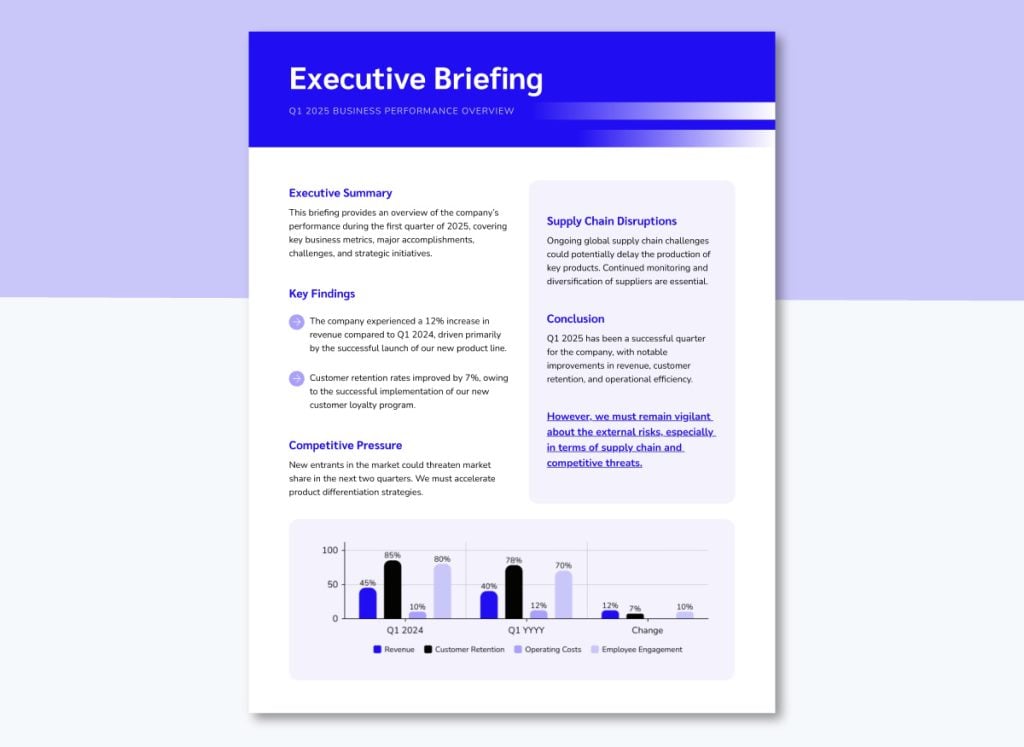
These images show two different visual formats for executive briefings, both emphasizing clarity, key data points, and scannable structure.

4. Activity: Draft Your Executive Brief
Now it's time to put these principles into practice. You will draft a short, personalized executive brief for the target persona you identified in the last lesson.
Activity (Allow ~25-30 minutes):
-
Set the Context:
- Target Account & Persona: Use the same Tier 1 account and key decision-maker from your multi-touch sequence framework.
- Hypothesize Your Insight: For this exercise, invent a key insight based on plausible research. Examples:
- "Their CEO mentioned 'improving customer retention' three times on the last earnings call."
- "They just acquired a smaller company and likely face challenges integrating their data systems."
- "Their careers page shows 10 new openings for 'Sales Enablement' roles, indicating a major push to improve sales productivity."
-
Draft the Brief:
- Write a client-facing executive brief of no more than 300 words.
- Structure it using the Situation-Complication-Resolution framework.
- Apply the writing techniques we discussed (active voice, metrics, persona-focused language).
- Use the example below as a model for tone and structure.
Example Brief (Modeled after the Salesmotion proposal summary):
To: Jane Doe, Chief Revenue Officer at Global Logistics Inc.
Subject: Addressing the 12% Rise in Your Operational Overhead
Situation:
Global Logistics is grappling with rising operational costs, with supply chain issues driving a 12% increase in overhead in the last six months alone. This directly impacts margin and profitability, key metrics under your purview.
Complication:
From our analysis of your operations and conversations with your team, we understand the core challenges are:
- Inefficient last-mile routes burning excess fuel.
- A lack of real-time shipment tracking, leading to costly delays and customer dissatisfaction penalties.
- High driver turnover linked to frustrating manual scheduling processes.
Resolution:
This brief outlines how our RouteOptimize AI platform can directly address these issues by cutting fuel expenditures by 15-20% and reducing delivery delays by up to 30% within the first quarter. Based on our work with logistics firms of your scale, we project an estimated $450,000 in annual savings, with a full return on investment in under seven months.
Next Step:
I am confident our platform is the right solution for your current challenges. I recommend we schedule a 30-minute implementation planning session with your operational stakeholders next week to finalize the project timeline and build a precise ROI model for Global Logistics.
Conclusion
Excellent work. You have now learned how to research, structure, and write a personalized executive brief—a critical asset for any strategic ABM campaign. This document is a powerful tool for earning the attention of senior decision-makers and demonstrating your value beyond your product's features.
Key Takeaways:
- An executive brief is a strategic tool built on actionable insights, not just raw data.
- The Situation-Complication-Resolution (SCR) framework provides a persuasive narrative structure.
- Effective briefs are tailored to the persona, quantify the business impact with metrics, and use a confident, active voice.
- The goal is not to sell, but to earn the next conversation with a clear, direct call to action.
Preview of the Next Lesson:
You've designed a multi-touch sequence and crafted a key asset to use within it. In our final lesson for this module, "Map specific content assets from your playbook to each stage of the ABM sequence," we will bring it all together. You will learn how to strategically place your executive brief, case studies, blog posts, and other content into your sequence framework to create a complete, actionable ABM play.