Introduction
Welcome back! In our last lesson, you created a personalization matrix, a strategic blueprint mapping specific content ideas to the needs of your target accounts and the roles of their key decision-makers. You now have a clear plan for what to say.
Today, we transition from what to how and when. A single, brilliant piece of content sent into the void is unlikely to make an impact. The real power of Account-Based Marketing (ABM) lies in orchestrating a series of connected touchpoints that build a narrative and guide your target audience through their journey.
This lesson directly addresses your goal of building a strategic content engine. Your learning outcome is to outline a multi-touch sequence framework for engaging key decision-makers in a target account. This framework will serve as the operational playbook for your ABM campaigns, turning your content strategy into a coordinated engagement plan designed to capture attention and drive action.
1. The Principle of Orchestration
Effective ABM is not about a single "big bang" campaign but rather a sustained, intelligent conversation. It's about playing the long game to build trust and awareness before you ever ask for a demo. This requires coordinating, or "orchestrating," your marketing and sales activities.
A useful way to think about this is as a continuous cycle. This concept will likely be familiar given your background in computer applications, as it closely mirrors logical process flows.
Understanding ABM Orchestration for B2B Marketing
The article 'Understanding ABM Orchestration' provides a robust mental model for this process. As you read, focus on understanding the four key phases that make up this cycle.
Read the section 'How Does ABM Orchestration Work?'. Pay close attention to the explanation of the continuous cycle: Trigger → Action → Feedback → Optimization.
As the article explains, this cycle is the engine of your ABM strategy:
- Trigger: An event that initiates the sequence. This could be an account showing high buying intent on a specific topic, a key contact visiting your pricing page, or a public announcement about a company initiative.
- Action: The coordinated, multi-touch sequence that you launch in response to the trigger. This is the "play" you run.
- Feedback: As the account engages (or doesn't), you collect data—email opens, ad clicks, content downloads—that tells you what's working.
- Optimization: You use this feedback to refine your approach, either within the current sequence or for future ones.
This systematic approach ensures your efforts are timely, relevant, and constantly improving.
2. The "Surround Sound" Strategy
Your orchestration shouldn't just target one person. In any significant B2B purchase, there's a buying committee. Your goal is to create a "surround sound" effect, where multiple stakeholders within the account encounter your valuable content across different channels, building familiarity and credibility for your brand.
How to use Account-Based Marketing to drive enterprise sales | Bev Burgess
ABM expert Bev Burgess uses a powerful 'dart board' analogy to explain how to think about influencing a target account. This will help you visualize who your sequence should be designed to reach.
Watch the segment from 44:50 to 46:30. Listen for her description of the three 'rings of influence': the decision-makers (bullseye), the significant influencers, and the wider network.
Your multi-touch sequence should be designed to engage these different rings. While a personalized email might be reserved for the bullseye (the key decision-maker), a broader LinkedIn ad campaign or a valuable webinar could engage the surrounding rings of influencers and advisors, creating consensus and internal momentum.
3. Anatomy of a Multi-Touch Sequence
Now, let's break down the practical components of a multi-touch sequence. A well-designed sequence is a narrative that unfolds over time, using different channels to deliver a consistent and compelling story.
This image provides a great high-level view of how different content and tactics align with the various stages of a full-funnel ABM strategy.
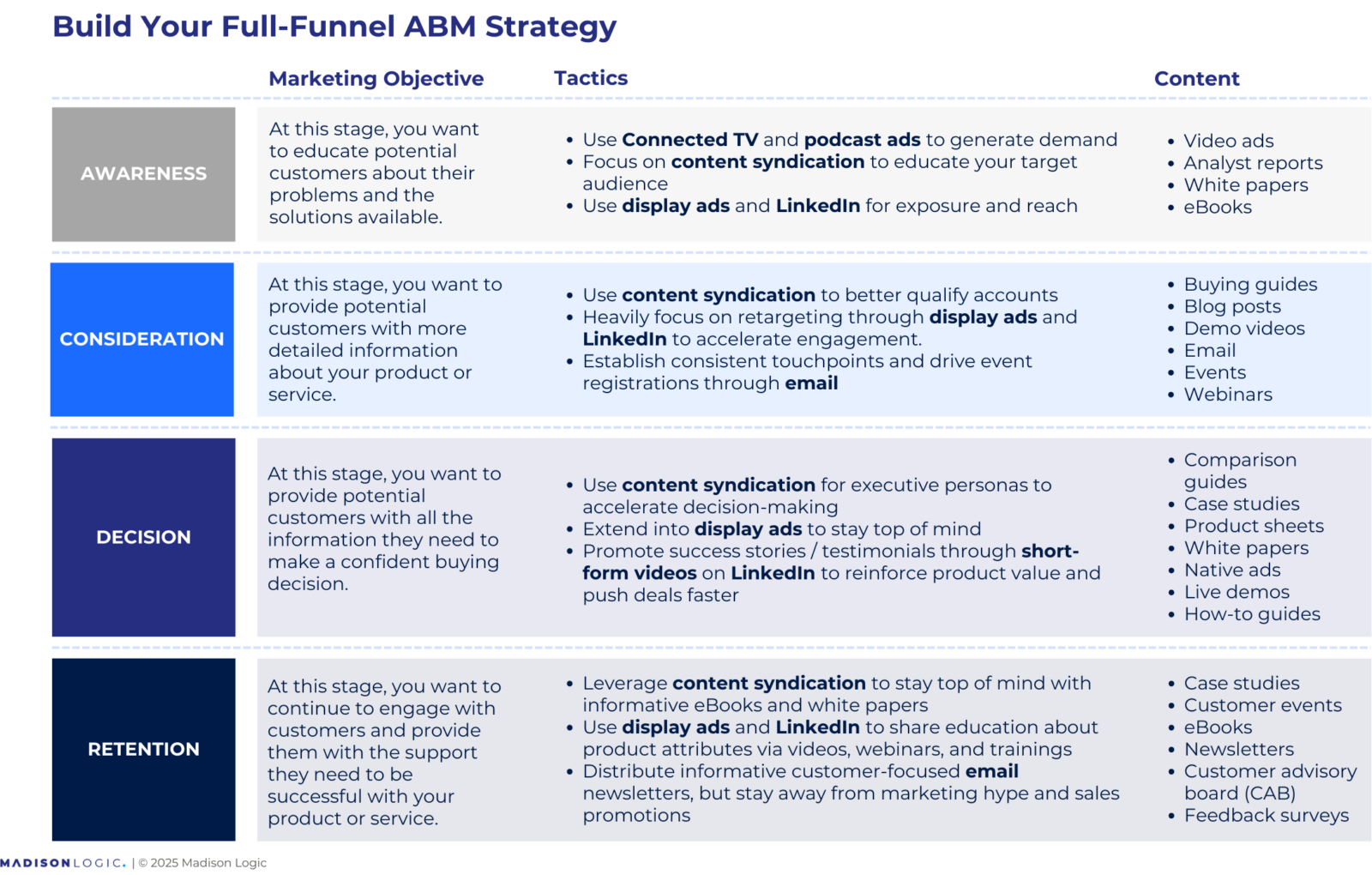
To build your sequence, you need to define three core elements: the channels, the cadence, and the content progression.
How To Implement a Target Account Strategy for ABM Success
The article 'How To Implement a Target Account Strategy for ABM Success' contains a perfect, concrete example of what a multi-touch sequence looks like in practice. Let's study its structure.
Scroll down to the section titled 'Launch coordinated, multi-channel campaigns'. Carefully study the table showing a 14-day multi-touch sequence. Pay attention to three things: The mix of channels used (Email, LinkedIn, Phone, Video). The cadence (the number of days between each touchpoint). The message progression (how the content evolves from an intro to a final CTA).
Based on this example, a strong sequence framework includes:
- A Mix of Channels: It combines automated touches (ads) with personalized ones (emails, video messages) and sales touches (phone calls). This creates the surround sound effect we discussed.
- A Deliberate Cadence: The touchpoints are spaced out over 1-3 days. This keeps your brand top-of-mind without being intrusive. Bombarding a contact with five touches in two days is a recipe for being ignored.
- A Logical Message Progression: The sequence tells a story.
- Day 1: Starts with a personalized introduction and a value hook.
- Day 3: Builds credibility with social proof or relevant content.
- Day 5: Educates with a use case or comparison.
- Day 14: Creates urgency with a strong case study and a clear Call to Action (CTA).
This structure moves a prospect from "Who are you?" to "I see how you can help me."
4. Your Turn: Outline a Multi-Touch Sequence Framework
Now it's time to design your own framework. This activity brings together everything we've covered and connects directly to the personalization matrix you developed in the last lesson.
Activity (Allow ~20-25 minutes):
In a document or spreadsheet, create an outline for a multi-touch sequence. The goal is to create the framework, not write the final copy for each step.
-
Define the Context:
- Target Account: Choose one of your Tier 1 target accounts.
- Target Persona: Select one key decision-maker from your personalization matrix (e.g., VP of Sales, Head of IT).
- Sequence Goal: What is the single, primary action you want this sequence to achieve? (e.g., Book a 15-minute discovery call, Register for our upcoming webinar).
- Trigger: What event would launch this sequence? (e.g., Target persona downloads the 'Future of X' whitepaper AND their company has visited our pricing page 2+ times in the last week.).
-
Build the Sequence Table: Create a table with the following columns:
Day,Channel,Message / Content Asset, andGoal of Touchpoint.- For the
Message / Content Assetcolumn, pull the specific ideas you brainstormed in your personalization matrix from the last lesson. - Use the example below as a guide to structure your own 10-14 day sequence.
- For the
Example Template:
| Day | Channel | Message / Content Asset | Goal of Touchpoint |
|---|---|---|---|
| 1 | View profile & send connection request with a personalized note referencing a shared connection or recent company news. | Establish a professional connection and initial awareness. | |
| 3 | Personalized email referencing the account's strategic need (from your matrix). Link to a high-level blog post or article. | Provide initial value and introduce your point of view on their problem. | |
| 5 | LinkedIn Ad | Retarget the persona (and their colleagues) with an ad promoting a relevant case study video. | Build social proof and influence the wider buying committee. |
| 7 | Follow-up email with a specific, high-value asset from your matrix (e.g., "ROI Calculator for [Their Industry]"). | Demonstrate tangible value and potential business impact. | |
| 10 | Video Message | Send a short (60-90 sec) personalized video message via email or LinkedIn, summarizing the key benefit for their role. | Create a human connection and stand out from text-based noise. |
| 14 | Final email with a clear and direct Call to Action related to your sequence goal. (e.g., "Would you be open to a 15-min call next week to discuss how we achieved this for [Competitor]?") | Drive the desired action and convert interest into a meeting. |
Conclusion
Congratulations on designing your first multi-touch sequence framework. This is a cornerstone of a functional content engine, providing a repeatable and scalable process for engaging high-value accounts. You have moved beyond just creating content to strategically orchestrating its delivery for maximum impact.
Key Takeaways:
- Effective ABM relies on orchestration—a coordinated series of actions governed by a Trigger → Action → Feedback → Optimization cycle.
- The goal is to create a "surround sound" effect, influencing the key decision-makers and the advisors around them.
- A multi-touch sequence framework is a plan that defines the channels, cadence, and message progression over a set period.
- Your framework should be a living document, optimized over time based on the feedback you gather from account engagement.
Preview of the Next Lesson:
Your sequence framework likely includes a powerful, highly-personalized piece of content designed for a key decision-maker. In the next lesson, "Draft a personalized executive brief for a key decision-maker within a target account," we will do a deep dive into creating one of these critical, high-impact assets that you can use to anchor a multi-touch campaign.