Introduction
Welcome back. In our previous lesson, you created a high-level distribution plan using the PESO model, giving you a strategic framework for amplifying your content across Paid, Earned, Shared, and Owned channels. Now, we will zoom in on one of the most powerful and sustainable methods for getting your content discovered: Search Engine Optimization (SEO).
Your learning outcome for this lesson is to conduct keyword research to align a content topic with B2B buyer search intent.
Instead of "pushing" your content out, SEO allows you to "pull" in prospects who are actively looking for the solutions you provide. Understanding the language they use and the motivation behind their searches—their intent—is the foundation of a successful content engine. This lesson will equip you with the frameworks and tactics to uncover the keywords that connect your content to qualified, high-intent B2B buyers.
1. Decoding B2B Search Intent
At the heart of modern SEO is the concept of search intent—the "why" behind a search query. Google's primary goal is to satisfy this intent. To rank, your content must be the most relevant and helpful answer to the user's underlying need.

In B2B, this concept is especially critical. The search terms are different, the stakes are higher, and the journey is more complex.
Mastering B2B Marketing Keywords: A Complete Guide for 2025
To start, let's explore what makes B2B keyword research unique. This article from AgencyJet provides an excellent overview.
Please read the first two sections: 'Understanding B2B Marketing Keywords' and 'Distinguishing B2B Keywords from B2C Keywords'. Focus on the differences in context, intent, and the complexity of the buying committee.
As the article notes, a single B2B purchase can involve over 11 stakeholders, from C-suite executives to end-users. Each may use different search terms to solve their specific problem. Your job is to understand and cater to these different intents.
A Practical Framework for Analyzing Intent
But how do you figure out the intent for a given keyword? The simplest way is to look at what Google is already rewarding.
Keyword Research Pt 1: How to Analyze Searcher Intent - 1.2. SEO Course by Ahrefs
The SEO experts at Ahrefs offer a simple but powerful framework for analyzing search results called the 'Three C's of Search Intent.'
Please watch from the beginning to 03:13. Pay close attention to the definitions of the 'Three C's': Content Type, Content Format, and Content Angle. Notice how analyzing these elements in the top-ranking pages reveals the dominant search intent.
By analyzing the SERP (Search Engine Results Page) through this lens, you can quickly deduce what kind of content you need to create. For a B2B query like "how to improve lead qualification process," you'd likely see:
- Content Type: Blog posts.
- Content Format: "How-to" guides or listicles ("X ways to improve...").
- Content Angle: Focused on efficiency, accuracy, or sales alignment.
This analysis gives you a clear blueprint before you even start writing.
2. A Strategic Framework for B2B Keywords
To build a content engine, you need a systematic way to organize keywords. Randomly targeting terms leads to content gaps and a disjointed buyer experience. We need to categorize keywords and map them to the buyer journey you're already familiar with from our earlier modules.
First, let's establish a vocabulary for the different kinds of B2B keywords you'll encounter.
Mastering B2B Marketing Keywords: A Complete Guide for 2025
Let's return to the 'Mastering B2B Marketing Keywords' guide to learn about the different categories of high-value B2B keywords.
Read the section 'Types of High-Value B2B Keywords'. As you read about each type (Industry-Specific, Problem-Solution, etc.), think about where it might fit in the Awareness, Consideration, or Decision stages of the buyer journey.
Now, let's put it all together. The following framework connects these keyword types to the B2B buyer journey, helping you plan content that meets buyers wherever they are in their process.
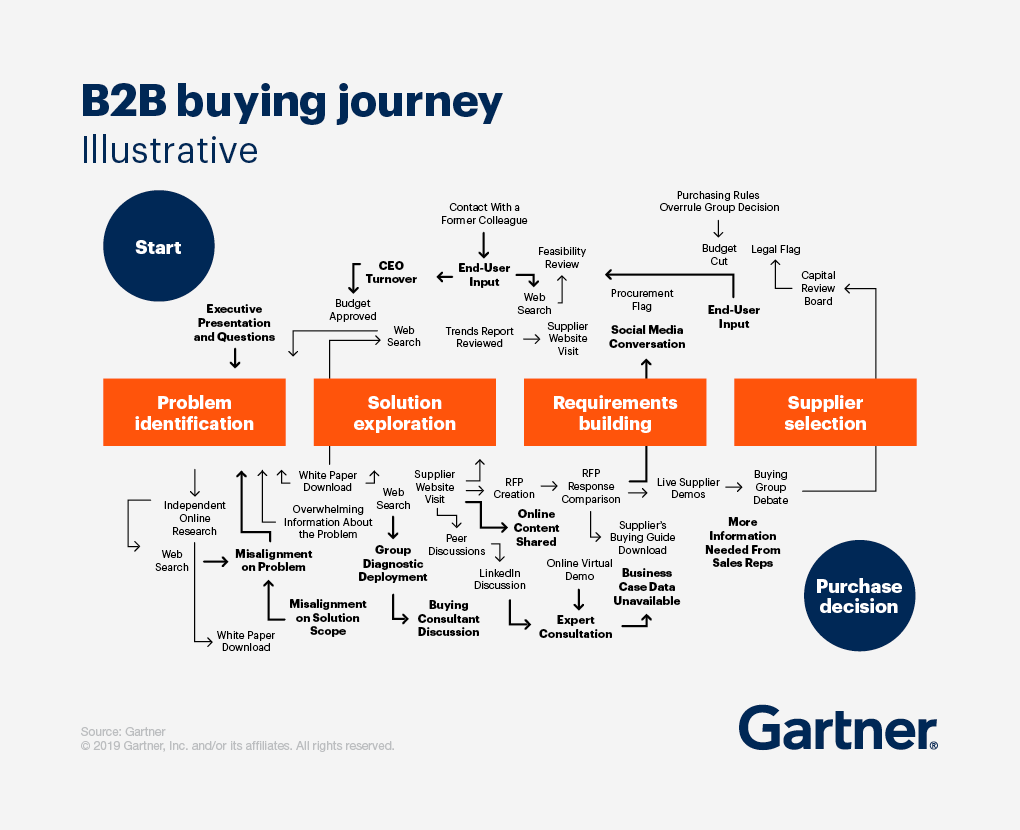
The key is to map specific keywords to the roles, stages, and intents of your buying committee.
Mastering B2B Marketing Keywords: A Complete Guide for 2025
The 'Mastering B2B Marketing Keywords' guide provides an excellent table that operationalizes this mapping process. It's a critical tool for strategic content planning.
Study the 'B2B Keyword Mapping Framework' table within the section 'Aligning Keywords with Search Intent and Buyer Journey'. This is a powerful template for organizing your own keyword strategy.
This framework is your bridge from raw keyword lists to a strategic content plan that systematically addresses your buyers' needs from initial problem awareness to final purchase decision.
3. Finding the Keywords That Convert
Now that you have the frameworks, where do you find the best keywords? While tools like Semrush and Ahrefs are essential, the highest-intent keywords often aren't in a database—they're in your customer conversations. This aligns directly with your goal of building a stronger connection between marketing and sales.
Strategy 1: Mine Your Internal Gold—Sales & Customer Insights
Your sales team talks to prospects every day. They hear their unfiltered pain points, objections, and goals. This language is keyword gold.
B2B Keyword Research: How to Use Customer & Sales Insights
This article from CXL makes a compelling case for shifting your keyword research focus from SEO tools to sales calls. It's a transformative perspective for B2B marketing.
Please read from the beginning through 'The 5-Step Framework: From Sales Call to SEO Win'. Focus on understanding why sales call data is so valuable and the practical steps for turning those conversations into high-converting content topics.
This approach creates a powerful feedback loop:
- Sales conversations reveal true buyer pain points.
- Marketing creates content that directly addresses these pains.
- This content attracts more high-quality leads.
- Sales has an easier time closing these well-informed leads.
Strategy 2: Advanced Tool-Based Tactics
Once you have pain-point-driven topics, you can use SEO tools to expand your list and find even more opportunities.
How to Find BUYER Intent Keywords (5 Advanced Tactics)
The video 'How to Find BUYER Intent Keywords' demonstrates several advanced tactics. We'll focus on two that are particularly powerful for B2B.
Watch the sections on 'Investigational Keyword Modifiers' (09:41 - 12:44) and 'Comparative Keyword Modifiers' (12:44 - 16:38). Note how adding words like 'software,' 'platform,' 'best,' 'vs,' and 'alternatives' uncovers users who are actively evaluating solutions.
By combining the "voice of the customer" insights from sales calls with these smart modifier tactics, you can build a keyword list that is both strategically relevant and comprehensive.
4. Activity: Conduct Keyword Research for a Core Topic
It's time to apply these concepts. Your task is to perform initial keyword research for a topic relevant to your business.
Activity (Allow ~20 minutes):
-
Choose a Core Topic: Select a central theme, product category, or customer pain point. For example, "sales-marketing alignment," "content ROI," or "lead nurturing automation."
-
Generate Keywords & Analyze Intent:
- Seed Keyword: Write down your core topic as a "seed" keyword.
- SERP Analysis: Search for your seed keyword on Google. Using the "Three C's" framework (Content Type, Format, Angle), analyze the top 5 results to determine the dominant search intent. Is it informational, commercial?
- Pain-Point Keywords: Based on your knowledge (or imagining a sales call), list 3-5 long-tail keywords that frame the topic as a problem. Example: "how to fix poor sales and marketing communication."
- Modifier Keywords: Using the tactics from the video, create 3-5 keywords using investigational or comparative modifiers. Example: "best software for sales and marketing alignment" or "HubSpot vs Marketo for lead scoring."
-
Map Your Keywords:
- Choose three of the new keywords you generated.
- Create a simple table based on the B2B Keyword Mapping Framework.
- Fill in the table for your three chosen keywords.
Example Table for the Topic "Content ROI"
| Keyword | Buyer Stage | Intent Type | Potential Content Format |
|---|---|---|---|
| "what is content marketing ROI" | Awareness | Informational | Blog post or glossary page |
| "how to measure content marketing ROI" | Consideration | Commercial | In-depth guide or webinar |
| "best content ROI tracking software" | Decision | Transactional | Comparison guide or product page |
Conclusion
In this lesson, you've moved beyond generic keyword lists to a strategic process for uncovering B2B buyer intent. You now have a set of frameworks to find, categorize, and map keywords directly to your buyer's journey and business goals.
Key Takeaways:
- Intent is King: In B2B, aligning with search intent is more important than chasing high search volume.
- Look Inward First: The most valuable, high-intent keywords are often found in your sales calls and customer support tickets, not just SEO tools.
- Map to the Journey: Use a framework to systematically map keywords to different stages (Awareness, Consideration, Decision) and stakeholder roles to ensure you're creating a complete content experience.
- Modifiers Matter: Words like "best," "software," "vs," and "alternatives" are strong signals of commercial or transactional intent and are invaluable for capturing late-stage buyers.
Preview of the Next Lesson:
You've learned how to find the right keywords. But what do you do with them? In our next lesson, you will learn how to apply on-page SEO principles (title, headings, meta description, internal links) to optimize a piece of B2B content. We will take the "what" from this lesson and turn it into the practical "how" of content creation.