Introduction
Welcome to the first lesson of our second module, "Strategic Sales and Marketing Alignment."
In our last module, we built a strong foundation for understanding the B2B buyer journey. We mapped the funnel, identified potential gaps, and, most recently, defined the key performance indicators (KPIs) to measure content effectiveness at each stage. You now have a framework for tracking everything from top-of-funnel traffic to bottom-of-funnel revenue influence.
However, the most sophisticated dashboard is useless if the two teams responsible for the funnel—sales and marketing—are working at cross-purposes. This brings us to the core objective of this lesson: to identify the common causes of sales-marketing misalignment in B2B organizations.
Think of this as moving from a technical diagnosis of the funnel to a cultural and operational one. Before we can build bridges between these two critical functions, we must first understand why the canyon exists in the first place. For you, as a Content Lead aiming for strategic influence, understanding these root causes is the first step toward creating content that not only attracts buyers but also empowers sellers and demonstrably drives revenue.
1. The Historical Divide: Why Silos Are the Default
Sales and marketing misalignment isn't just an accident; it's often a result of how B2B companies have historically grown. In many organizations, sales was the original engine of growth, and marketing was added later as a support function. This history creates a fundamental misunderstanding of marketing's strategic role.
To understand the roots of this conflict, let's explore why these teams often operate in silos and what the true strategic role of B2B marketing should be.
The ultimate guide to marketing and sales alignment in B2B companies
The article 'The ultimate guide to marketing and sales alignment in B2B' by Andrei Zinkevich provides an excellent overview of this historical context and clarifies marketing's modern strategic responsibilities.
Please read the first two sections: 'Why do sales and marketing work in silos?' and 'Role of marketing in B2B companies'. As you read, focus on the contrast between the perception of marketing as a 'sales assistant' and its actual strategic duties, such as defining the GTM strategy and generating demand.
As the article explains, when sales views marketing as an "arts and crafts department" focused on making things "look nicer," a fundamental disconnect is inevitable. True alignment begins when both teams recognize that marketing's role is not just to support sales, but to strategically generate demand and guide the buyer through the majority of their journey before sales even gets involved.
2. Diagnosing Misalignment: Symptoms vs. Causes
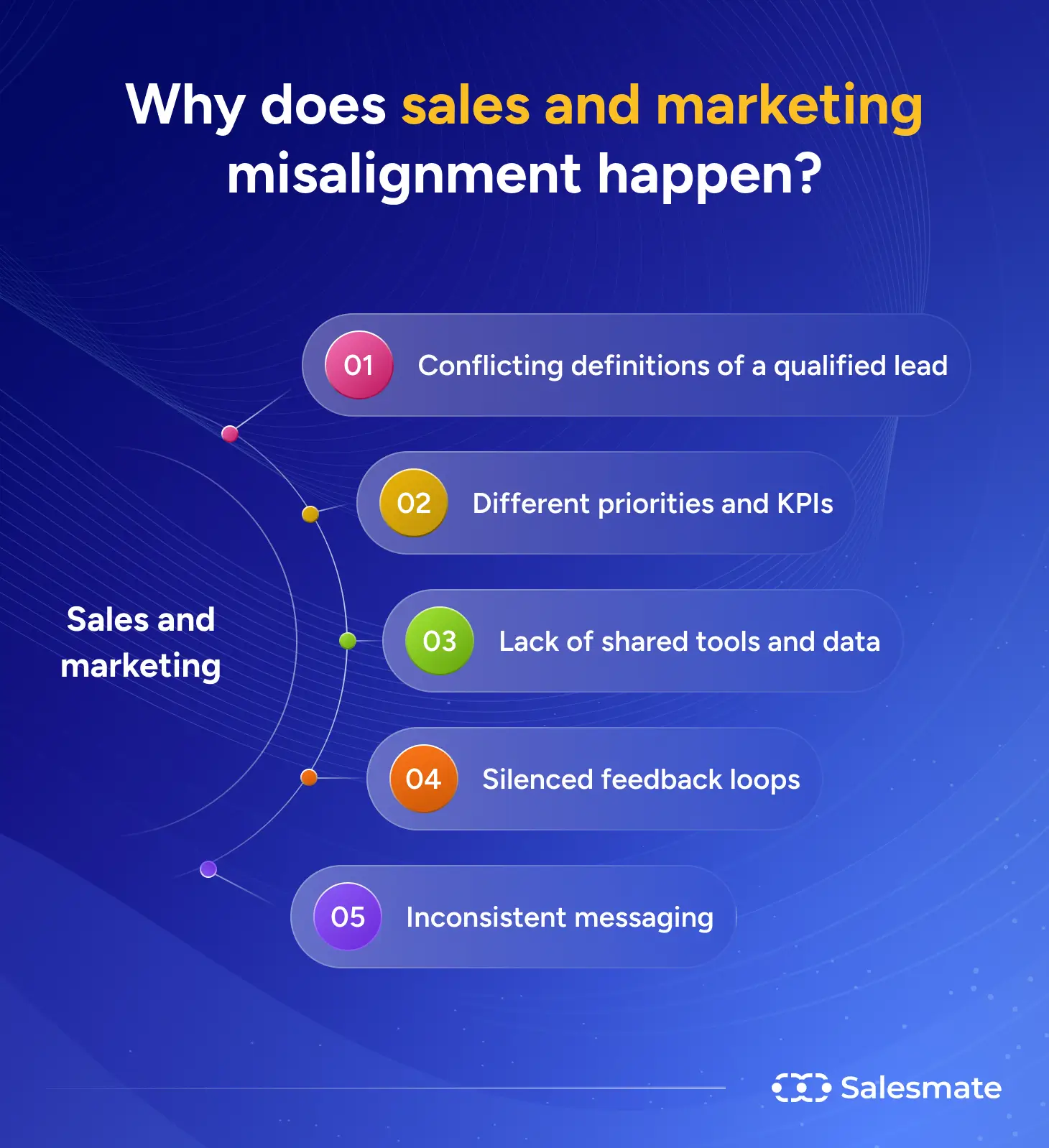
Misalignment manifests in daily frustrations—what we can call symptoms. These are the visible signs of a deeper problem. The infographic below from Salesmate provides a high-level summary of the underlying causes.
Now, let's look at the symptoms these causes produce. This next image lists common warning signs you might observe in an organization. How many of these feel familiar?

Recognizing these symptoms is the first step. The crucial next step is to trace them back to their root causes. A "blaming game" (symptom) often points to "different priorities and KPIs" (cause). "Marketing collateral collecting dust" (symptom) is a direct result of "misalignment between marketing and sales teams" (cause).
3. A Deep Dive into the Root Causes
Now that we have a high-level view, let's drill down into a comprehensive list of the root causes of misalignment. Understanding these specifics is critical for creating targeted solutions later on.
A staggering statistic from Martal Group's research highlights the scale of the problem: 65% of marketing content is never used by sales. As a Content Lead, this figure is particularly important. It's a direct measure of the gap between what marketing produces and what sales finds valuable. This waste is a direct consequence of the causes we're about to explore.
The ultimate guide to marketing and sales alignment in B2B companies
We'll return to the FullFunnel.io guide, which provides a detailed list of 14 specific root causes. This will give us a comprehensive framework for understanding the problem.
Please read the section titled '14 root causes of marketing and sales misalignment.' As you read, try to group the causes into broader themes. For example, which causes are about strategy? Which are about process? Which are about metrics?
Let's categorize those 14 causes to make them easier to analyze:
A. Strategic & Foundational Misalignment
This is a failure to agree on the fundamentals of the market and the customer.
- Lack of customer research: Both teams operate on different, unproven assumptions about the buyer.
- Vague and broad ICP (Ideal Customer Profile): Without a sharp, shared definition of the target customer, sales and marketing will inevitably target different people.
- Unvalidated messaging and value proposition: Marketing creates messages that don't resonate with buyers, a fact sales discovers in real-time on their calls.
B. Operational & Process Misalignment
This is a breakdown in the day-to-day workflow and campaign execution.
- Targeting different market segments: The most obvious sign of working in silos.
- No clear playbooks for lead handoff: A lead is passed from marketing to sales with no context, leaving the sales rep to ask, "What am I supposed to do with this?"
- Misaligned messaging in ads and landing pages: The message changes from ad to landing page to sales call, creating a confusing and untrustworthy buyer experience.
- Marketing doesn't run demand generation programs: Sales wants marketing to "warm-up" accounts, but marketing is focused on other activities.
C. Metric & Goal Misalignment
This happens when teams are measured and rewarded for different, sometimes conflicting, outcomes.
- Different KPIs: Sales has a revenue quota, while marketing celebrates hitting an MQL target. This creates friction, especially if the MQLs don't convert to revenue, reinforcing the "vanity metrics" issue we discussed in the last module.
- Marketing doesn't care about pipeline progress: Marketing's job is seen as "done" once a lead is generated, with no shared ownership over moving that lead through the sales pipeline.
D. Content & Expertise Misalignment
This directly impacts your work as a Content Lead.
- SEO-based content that ignores the buyer journey: Content is created to rank for keywords, not to answer real buyer questions, making it useless for sales conversations.
- Marketing has no product and market expertise: Sales perceives that marketing doesn't understand the product, customer, or competitive landscape, leading them to dismiss marketing's work.
E. Cultural & Communication Misalignment
These are the human factors that prevent collaboration.
- No regular sync meetings: Without a dedicated forum for communication, alignment happens by chance, not by design.
- Sales has a protective mindset: Sales reps may be unwilling to share contacts or insights, viewing their network as their private asset.
As you can see, the problem is multi-faceted, spanning strategy, process, metrics, and culture.
Conclusion
In this lesson, we dissected the complex issue of sales and marketing misalignment. We moved from observing surface-level symptoms to identifying the deep-seated root causes that prevent these two teams from functioning as a single revenue engine.
Key Takeaways:
- Misalignment is often historical: It stems from a traditional view of marketing as a tactical support function rather than a strategic partner.
- Symptoms are not causes: Frustrations like "blaming games" or unused content are symptoms of deeper issues like misaligned KPIs or a lack of shared customer understanding.
- The causes are multifaceted: Misalignment isn't a single problem. It's a combination of failures in strategy (who we sell to), process (how we work), metrics (how we measure success), and culture (how we communicate).
- Content is a major casualty: A significant portion of content goes unused when it's created without sales input and doesn't address real buyer needs at specific journey stages.
Preview of the Next Lesson:
Now that we have thoroughly diagnosed the problem, we can begin building the solution. The first and most fundamental step in aligning two teams is to ensure they are speaking the same language. In our next lesson, we will focus on how to establish a shared vocabulary for lead stages, handoff criteria, and deal stages. This is the bedrock upon which all other alignment initiatives are built.