Introduction
Hello! Welcome to the final lesson of our first module, "Foundations of the B2B Buyer Journey."
In our last lesson, we learned how to be funnel diagnosticians, identifying common gaps and leaks where high-potential leads disengage. We discovered that these leaks—whether at the Top, Middle, or Bottom of the funnel—represent significant lost revenue.
Today, we move from diagnosis to measurement. Our goal is to define key performance indicators (KPIs) for content marketing at each funnel stage. If the last lesson was about finding the location of a leak, this lesson is about installing the gauges and meters to measure its size and track the effectiveness of our repairs.
This is a pivotal lesson for your goal of building a content engine with strategic influence. Moving beyond simple creative output to proving revenue impact starts with measuring the right things. We will shift our focus from "vanity metrics" that feel good (like page views) to "revenue metrics" that drive business decisions.
1. From Vanity to Value: Choosing Metrics that Matter
Before we list specific KPIs, it's crucial to understand the philosophical shift required. In B2B marketing, where sales cycles are long and involve multiple decision-makers, attributing a sale to a single piece of content is difficult. This complexity often leads teams to track easy-to-measure but less meaningful "vanity metrics."
Your goal is to move beyond these and focus on metrics that connect directly to pipeline and revenue—the language that leadership and sales teams understand.
The Ultimate Guide to B2B Content Marketing ROI
To understand this critical distinction, we'll start with the article 'The Ultimate Guide to B2B Content Marketing ROI' from Directive. It does an excellent job of explaining the core challenges and why focusing on the right kind of metrics is non-negotiable.
Please read the 'Key Takeaways' and the section titled 'Why You Can’t Measure Content Marketing ROI,' which covers 'The Attribution Problem' and 'Vanity Metrics Sabotage Your Budget.' Focus on the contrast between vanity metrics (like page views) and real metrics (like pipeline influence and cost per SQL).
As the article makes clear, the core challenge is attribution. A single blog post rarely closes a six-figure deal. Instead, it's one of many touchpoints. Your job is not to prove one piece of content did everything, but to show how your content ecosystem as a whole influences prospects along their journey. The first step is to start measuring the indicators of that influence.
2. KPIs for Each Funnel Stage
Now let's break down the key performance indicators for each stage of the TOFU-MOFU-BOFU funnel. This provides a structured way to measure the health of your content engine at every step.
Measuring What Matters in B2B: Marketing KPIs and ROI Attribution ...
For a clear, stage-by-stage list of metrics, we'll use the guide 'Measuring What Matters in B2B' from DigitalScouts. It provides a straightforward breakdown of the most important KPIs to track.
Read the sections covering Top of Funnel (TOFU), Middle of Funnel (MOFU), and Bottom of Funnel (BOFU). Pay attention to the specific metrics listed under each.
Let's synthesize those lists into a core framework.
Top-of-Funnel (TOFU): Awareness & Attraction Metrics
The goal here is to attract a relevant audience and make them aware of a problem and your brand.
- Website Traffic: Unique visitors, new vs. returning visitors, traffic by source (e.g., organic search, social media, referrals).
- Search Engine Visibility: Organic search rankings for key terms, search impressions.
- Audience Engagement: Social media reach and engagement rate (likes, shares, comments), time on page, bounce rate.
Middle-of-Funnel (MOFU): Engagement & Lead Generation Metrics
The goal is to convert anonymous visitors into known leads and nurture their interest. This is where you measure the effectiveness of your lead magnets.
- Lead Generation: Number of new leads generated, form submission rates on landing pages.
- Content Consumption: Downloads of gated assets (e-g., ebooks, whitepapers), webinar registrations and attendance rate.
- Lead Qualification: Number of Marketing Qualified Leads (MQLs) generated. This is a crucial metric indicating you're not just getting leads, but the right leads.
Bottom-of-Funnel (BOFU): Conversion & Sales Metrics
The goal is to help the sales team close deals by providing content that overcomes final objections and builds confidence.
- Sales Qualification: Number of Sales Qualified Leads (SQLs), MQL-to-SQL conversion rate.
- Pipeline Generation: Number of sales opportunities created from content leads, total dollar value of pipeline influenced by content.
- Closing Metrics: Demo requests or trial sign-ups originating from content, win rate/close rate for content-sourced leads.
This short video from HubSpot provides a quick visual recap of how these metrics align with a slightly different (but compatible) four-stage funnel.
How to Build a Marketing Funnel that Actually Works for your Business
To reinforce these concepts, this clip from HubSpot's 'How to Build a Marketing Funnel' offers a concise summary of which KPIs to track at each stage.
Watch from 04:11 to 04:53. Notice how their stages (Awareness, Interest, Consideration, Decision) map closely to the TOFU-MOFU-BOFU model and the KPIs they suggest.
3. The Holy Grail: Connecting Content to Revenue
Tracking funnel-stage KPIs is essential, but to truly demonstrate strategic value, you must connect them to the ultimate business outcomes: pipeline and revenue. This is how you shift the conversation from "content costs" to "content investments."
The Directive article we read earlier outlines the specific metrics that achieve this. These are the KPIs that resonate most with executive leadership.
The Ultimate Guide to B2B Content Marketing ROI
Let's return to the Directive article to explore the most powerful, revenue-focused metrics. This section is key to elevating your reporting and your strategic influence.
Read the section 'Metrics That Actually Matter.' Focus on understanding the definitions of 'Revenue Metrics' and 'Pipeline Metrics,' such as 'Pipeline influenced by content' and 'Content-attributed revenue.'
Here are the most important revenue-focused KPIs to aspire to track:
- Pipeline Influenced by Content: The total dollar value of all sales opportunities where the prospect interacted with your content at any point before the deal closed. This is often the most realistic and powerful metric.
- Content-Attributed Revenue: The portion of revenue from closed deals that can be credited to content marketing, based on your chosen attribution model (e.g., first-touch, multi-touch).
- Customer Acquisition Cost (CAC) by Channel: The cost to acquire a new customer through content marketing versus other channels like paid ads. A lower CAC for content is a strong argument for investment.
- LTV:CAC Ratio: The ratio of Customer Lifetime Value to Customer Acquisition Cost. A healthy ratio (often cited as 3:1 or higher) proves that your content efforts are driving profitable, long-term growth.
The following chart provides an excellent visual summary, mapping the buyer journey, funnel stages, content goals, and the specific ROI metrics you should be tracking at each step.
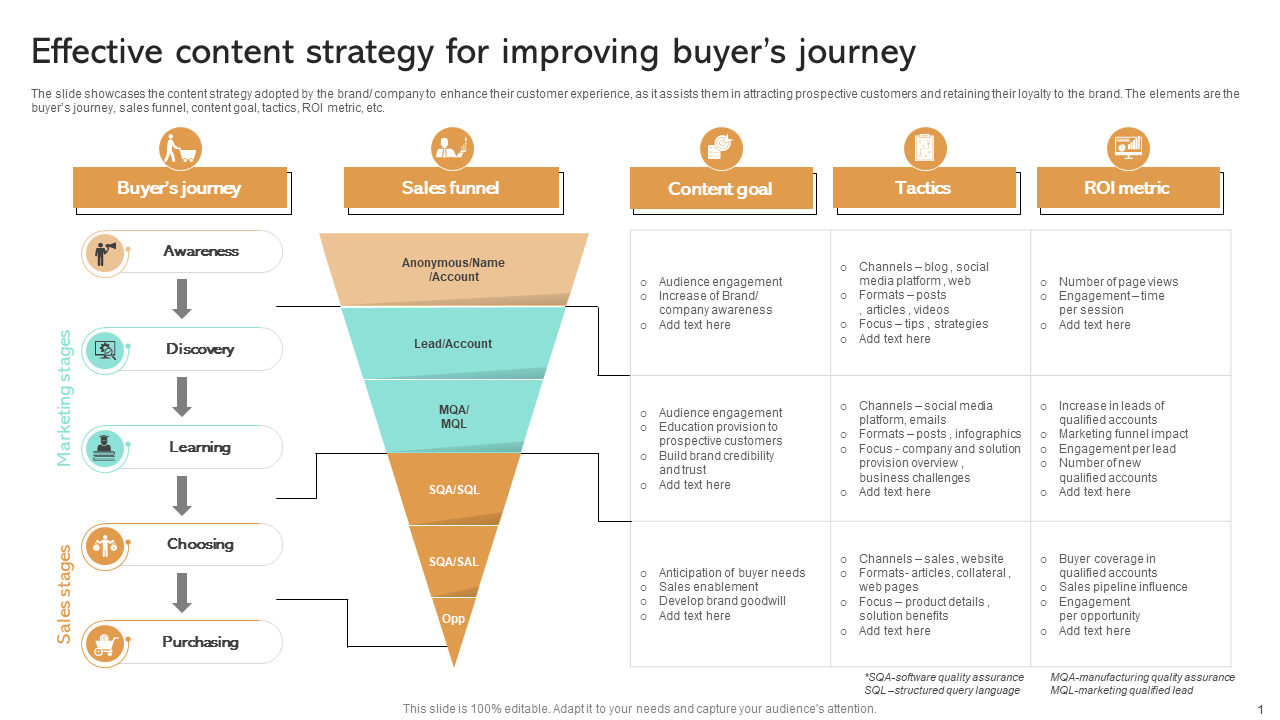
4. A Word of Caution: Practical Considerations
As you begin implementing this measurement framework, keep two common mistakes in mind, as highlighted in the Directive article:
- Measuring Too Early: B2B content marketing is a long game. It can take 3-6 months for content to gain traction and 7+ months to see a significant impact on revenue. Don't abandon a strategy because it isn't delivering massive ROI in the first quarter.
- Ignoring Compound Returns: Unlike paid ads, which stop producing when you stop paying, content provides compounding returns. A blog post published today can generate leads for years. Your measurement model should account for this long-term value.
Finally, remember that measurement is not just about reporting; it's about improving. As Neil Patel discusses in his video, "How to measure the ROI of your content efforts," you should be actively experimenting (e.g., A/B testing calls-to-action) to see what works and then doubling down on the topics and formats that drive the most revenue. The goal is to improve your ROI, not just measure it.
Conclusion
In this lesson, we've built the measurement framework for your content engine. You now have the vocabulary and the structure to track performance in a way that truly matters to the business.
Key Takeaways:
- Move Beyond Vanity: The first step is to shift focus from easy-to-track vanity metrics (page views, shares) to business-focused metrics (leads, pipeline, revenue).
- Funnel-Stage KPIs: A healthy content engine is measured at every stage: TOFU (traffic, reach), MOFU (leads, MQLs), and BOFU (SQLs, opportunities).
- Revenue is the North Star: The most impactful KPIs connect content directly to financial outcomes, such as Pipeline Influenced by Content and Content-Attributed Revenue.
- Measurement is a Long Game: Content marketing ROI is not immediate. It requires patience and a focus on long-term, compounding returns.
Preview of the Next Module:
This lesson concludes our foundational module on the B2B buyer journey. You now understand the stages, the potential gaps, and how to measure performance. However, a perfect funnel map and a detailed dashboard are useless if the two most critical teams—Sales and Marketing—aren't on the same page.
In our next module, "Strategic Sales and Marketing Alignment," we will tackle this challenge head-on. Our first lesson will focus on identifying the common causes of misalignment and why bridging that gap is the first step in building a truly effective content engine.