Introduction
Hello! Welcome to the fifth lesson in our module on the foundations of the B2B buyer journey.
In our last lesson, we built a strategic map, connecting specific content formats to each stage of the funnel (TOFU, MOFU, BOFU) and the buyer's level of awareness. You now have a blueprint for what an ideal, fully-functioning content engine looks like.
Today, we shift from architecture to diagnostics. We're going to explore what happens when that engine sputters or breaks down. Our learning outcome is to identify common funnel gaps where leads disengage or drop off. This is one of the most critical skills for a content strategist, as it’s the first step toward fixing problems that directly impact pipeline and revenue. We'll introduce the concept of "sales leakage"—the revenue that disappears through these cracks—and learn how to spot the warning signs.
1. What is Sales Leakage?
Before we dive into specific stages, it's important to understand the overall problem we're trying to solve. When your marketing efforts generate leads that seem like a perfect fit but fail to become customers, you're experiencing sales leakage.
Sales Leakage and How to Spot Cracks in Your Funnel
To frame our discussion, let's start with a clear definition. This article, 'Sales Leakage and How to Spot Cracks in Your Funnel,' from LoSasso, provides an excellent explanation of what sales leakage is and why it matters.
Please read the introduction and the section titled 'What Is Sales Leakage?'. Focus on the distinction between natural churn and leads that should have converted.
As the article highlights, sales leakage isn't just about losing leads; it's about losing high-potential leads due to breakdowns in your process. This is the gap between the revenue you should be generating from your marketing activities and what you actually close. Our goal today is to become detectives who can find where those breakdowns—or funnel gaps—are happening.
This image provides a stark, quantitative look at how these leaks add up.

2. Diagnosing Funnel Gaps: From TOFU to BOFU
Funnel gaps can occur at any stage, each with its own unique causes and symptoms. A structured approach, looking at the Top, Middle, and Bottom of the funnel, allows you to methodically diagnose where your biggest leaks are.
The following article offers a fantastic, stage-by-stage breakdown of common problems, their symptoms, and potential fixes. We will use it as our guide for this section.
Broken B2B Marketing Funnels | Key Problems & Fixes
The article 'Broken B2B Marketing Funnels' by iBeam Consulting is an excellent diagnostic manual. It clearly outlines the most common issues that cause leads to disengage at each funnel stage.
Read the sections covering Top-of-Funnel (TOFU), Middle-of-Funnel (MOFU), and Bottom-of-Funnel (BOFU) problems. For each stage, pay close attention to the Symptoms listed. These are the practical indicators you'll look for in your own data and team feedback.
Let's synthesize the key gaps from that reading into a diagnostic checklist.
Top-of-Funnel (TOFU) Gaps: The Attraction Problem
At this stage, you're trying to attract the right audience. Leaks here are often about relevance and first impressions.
- Problem: You're attracting the wrong traffic.
- Symptoms: High bounce rates, low time-on-page, and—most importantly—feedback from sales that leads are a poor fit. Your traffic numbers might look good (a classic vanity metric), but they don't translate to quality.
- Problem: Your content isn't capturing attention.
- Symptoms: Low click-through rates (CTR) on social media and ads, and low engagement on your blog posts. The right people might see your headline, but they aren't compelled to click or stay.
Middle-of-Funnel (MOFU) Gaps: The Conversion & Nurturing Problem
Here, you're trying to convert anonymous visitors into known leads and nurture their interest. This is where the first real commitment happens, making it a major leak point.
- Problem: Your content "ask" is misaligned.
- Symptoms: High traffic to landing pages but low form-conversion rates. This indicates a value mismatch: what you're offering (e.g., a simple checklist) isn't valuable enough for the information you're asking for in return.
- Problem: Your leads go cold.
- Symptoms: Your CRM is full of leads who never open follow-up emails or engage further. This happens when there is no timely, relevant follow-up, and the interest you generated withers.
Bottom-of-Funnel (BOFU) Gaps: The Handoff & Closing Problem
This is the most expensive place to have a leak. You've invested time and resources to get a prospect here, and a failure means all that effort was wasted.
- Problem: The sales & marketing "toss-over."
- Symptoms: A low MQL-to-SQL conversion rate. You'll hear sales saying the leads are "junk." This classic misalignment issue means marketing and sales have different definitions of a "qualified lead."
- Problem: Prospects stall before the finish line.
- Symptoms: A high number of proposals sent but a low close rate. Deals get stuck in the pipeline and prospects "ghost" the sales team after showing initial interest. This often means sales lacks the right content to handle final objections.
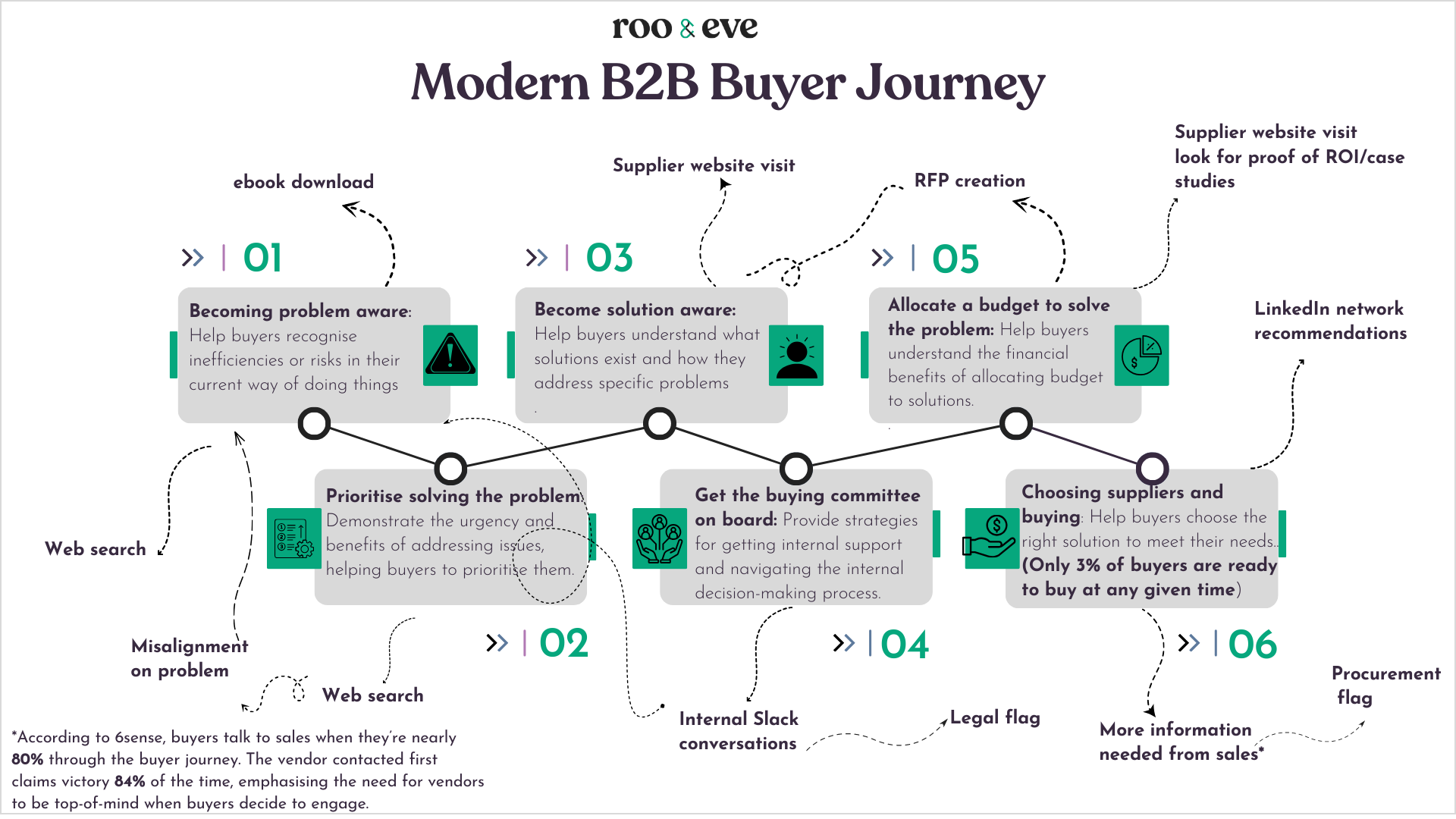
This image of the modern B2B buyer journey illustrates the complexity of this process. The "gaps" aren't always linear drops; they can be internal hurdles like legal flags or misalignment within the buying committee.
3. The Foundational Gap: An Unclear Offer
While the stage-specific gaps are common, there's often a more fundamental problem that can cause the entire funnel to fail: a weak or unclear value proposition. If your audience doesn't immediately understand what you do and what result you deliver, they will disengage before even entering the funnel.
This video makes a powerful case for why a "killer offer" is the most important part of any funnel.
THE most valuable funnel training you'll ever watch (10,000 hours experience)
In 'THE most valuable funnel training you'll ever watch,' Mike from Sell Your Service argues that most funnels fail for one simple reason: the offer is confusing. This clip explains that core concept.
Watch from 13:26 to 16:59. Pay attention to how he contrasts vague, brand-focused messaging with a clear, outcome-oriented offer. This is a crucial mindset shift.
The key takeaway is that your content strategy can't fix a broken product or a confusing offer. Before optimizing content for each funnel stage, always ask: "Can a prospect understand the specific, quantifiable outcome we provide within seconds?" If the answer is no, that's your biggest funnel gap.
4. How to Systematically Find the Gaps
Knowing the types of gaps is one thing; finding them in your own operations requires a specific set of investigative techniques. Let's return to the "Sales Leakage" article, which outlines three practical methods.
Sales Leakage and How to Spot Cracks in Your Funnel
Now that we know what to look for, this final reading will give us a toolkit for how to look. It details three data-driven methods for uncovering hidden cracks in your funnel.
Read the section 'How to Find Sales Leakage.' Focus on the three distinct methods it proposes: Activity-to-Outcome Ratio, Conversion Cliffs, and Win/Loss Root Cause Analysis.
Here are the three diagnostic methods you can start using:
- Analyze Activity-to-Outcome Ratios: Look at the effort versus the results. Are your teams making lots of calls or sending many emails (high activity) but creating very few qualified opportunities (low outcome)? This points to a major efficiency or qualification gap.
- Identify Conversion Cliffs: Map the conversion rate from one stage to the next (e.g., Visitor -> Lead, Lead -> MQL, MQL -> SQL, SQL -> Customer). Look for a "cliff"—a stage where the drop-off is dramatically steeper than others. This is your biggest leak and your top priority for investigation.
- Conduct Win/Loss Root Cause Analysis: Go beyond the data and talk to people. Interview sales reps and, if possible, recent customers (both won and lost). Ask why deals were won or lost. This qualitative insight is pure gold for understanding the real reasons for disengagement, such as a missing feature, a pricing objection, or a competitor's compelling narrative.
These techniques form the foundation of a data-driven approach to content strategy, moving you beyond just creating content to actively managing the health of your funnel.
Conclusion
In this lesson, you've learned to put on your diagnostician's hat. You now understand that a "leaky funnel" is a symptom of specific, identifiable gaps where prospects disengage, and that these leaks represent lost revenue.
Key Takeaways:
- Sales Leakage: This is the loss of high-potential customers due to process breakdowns, not a lack of interest.
- Stage-Specific Gaps: Leaks occur for different reasons at each stage: relevance and attention at the TOFU, value exchange and nurturing at the MOFU, and handoffs and closing at the BOFU.
- The Foundational Gap: The most critical gap is a weak or unclear offer. If your value proposition isn't compelling, no amount of content can fix the funnel.
- Diagnostic Toolkit: You can systematically find gaps by analyzing activity-to-outcome ratios, identifying conversion cliffs in your data, and conducting qualitative win/loss analysis.
Preview of the Next Lesson:
Identifying gaps is the first step. The next is to measure them precisely. In our next lesson, we will define key performance indicators (KPIs) for content marketing at each funnel stage. This will give you the metrics needed to quantify the health of your funnel, measure the impact of your fixes, and ultimately demonstrate the revenue impact of your content engine.