Hello! Welcome to the fourth lesson in our module on the foundations of the B2B buyer journey.
Introduction
In our last lesson, we established the TOFU, MOFU, and BOFU funnel as the core framework for your content engine. We saw how these stages align with the buyer's journey (Awareness, Consideration, Decision) and the lead qualification process (Leads, MQLs, SQLs).
Today, we'll get practical. This lesson is all about turning that strategic framework into an executable plan. Our goal is to map common B2B content formats to the appropriate buyer journey and funnel stage. You'll learn which types of content—from blog posts to case studies and demos—are most effective at each stage and why. This is a crucial skill that transforms you from a content creator into a content strategist who intentionally guides buyers from one stage to the next.
1. A More Granular Framework: The 5 Stages of Awareness
Before we start mapping content formats, let's refine our understanding of the buyer's mindset. The TOFU/MOFU/BOFU model is great for internal planning, but a more customer-centric framework was developed by legendary copywriter Eugene Schwartz: the Five Stages of Awareness.
Understanding these stages gives you a more nuanced view of your prospect's psychology, allowing you to create content that resonates more deeply. This video provides an excellent B2B-focused explanation of this powerful concept.
If I Started SaaS in 2026, Here’s My B2B Content Strategy for $1M ARR
In this video, 'If I Started SaaS in 2026, Here’s My B2B Content Strategy for $1M ARR,' Rob Walling explains how to apply Schwartz's stages to B2B content.
Please watch the section from 04:26 to 07:38. Focus on the definition of each of the five stages: Unaware, Problem Aware, Solution Aware, Product Aware, and Most Aware.
Let's quickly summarize these stages and connect them to the funnel model we already know:
- Unaware: The prospect doesn't know they have a problem. This is the hardest group to reach with content marketing.
- Problem Aware: They know they have a problem but don't know there are solutions.
- This stage corresponds to the Top of the Funnel (TOFU).
- Solution Aware: They know solutions like yours exist but don't know about your specific product.
- This stage marks the transition from TOFU to the Middle of the Funnel (MOFU).
- Product Aware: They know about your product but are comparing it to others and aren't sure it's the best fit.
- This stage is squarely in the Middle of the Funnel (MOFU).
- Most Aware: They know your product and are on the verge of making a decision. They just need final conviction.
- This stage corresponds to the Bottom of the Funnel (BOFU).
This five-stage model gives you a powerful lens. Instead of just thinking "what TOFU content should I create?", you can ask, "what content will make an unaware person problem-aware, or a problem-aware person solution-aware?"
2. Mapping Content Formats to the Funnel
Now for the core of today's lesson: connecting specific content assets to these stages. The key principle is to match the content's depth and focus to the buyer's level of awareness and intent.
Let's return to Rob Walling's talk. The next section provides a wealth of concrete B2B examples for each stage.
If I Started SaaS in 2026, Here’s My B2B Content Strategy for $1M ARR
This section of the video is incredibly practical. It walks through real-world B2B companies and shows what kind of content they use at each of the five awareness stages.
Watch from 14:13 to 28:15. As you watch, try to mentally categorize the examples into the TOFU, MOFU, and BOFU framework. Notice how the content becomes more specific and product-focused as you move down the funnel.
That was a dense section packed with actionable ideas. Let's distill the key principles and organize them into our TOFU/MOFU/BOFU structure.
The following image provides a great visual overview of how different content types fit into the funnel.
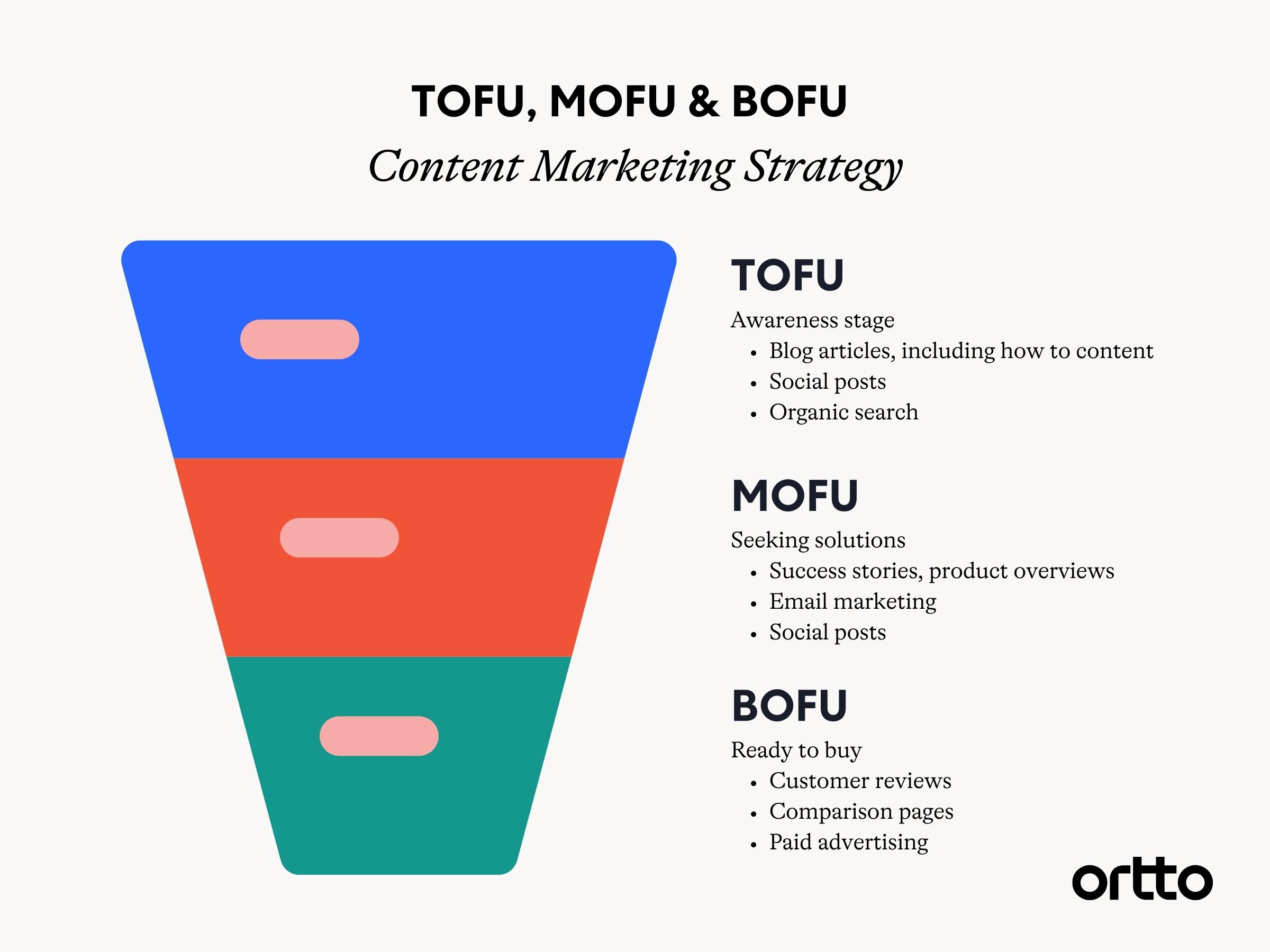
To make this even more concrete, let's use the framework from the article "Content Mapping" by Plezi, which uses the terms Discovery (TOFU), Evaluation (MOFU), and Purchase (BOFU).
Content Mapping: definition, creation stages and tools - Plezi
This article provides a very clear table that associates content types with each stage of the buyer's journey. It's a great summary of the concepts we've just seen.
Read the section 'Step 3: Associate content types with different stages of the journey.' Pay close attention to the table that lists content ideas for the Discovery, Evaluation, and Purchase phases.
Synthesizing from the resources, here is a comprehensive reference map.
Top of Funnel (TOFU) / Awareness Stage
- Buyer Mindset: "I have a problem, but I'm not sure what to call it or what solutions exist." They are looking for education and information, not a sales pitch.
- Your Goal: Attract a broad audience, build trust, and establish your brand as a helpful expert.
- Content Formats:
- Blog Posts ("How to...", "What is...", Listicles)
- Educational Videos & Webinars
- Infographics
- Checklists & Templates
- Ebooks & Guides
- Industry Studies & Reports
Middle of Funnel (MOFU) / Consideration Stage
- Buyer Mindset: "I understand my problem and know there are categories of solutions. Now I need to figure out which approach is best for me and who the key players are."
- Your Goal: Nurture leads, build credibility, and guide them toward your solution category.
- Content Formats:
- Case Studies & Success Stories
- Comparison Guides ("X vs. Y")
- "Alternative to" Pages
- Product Webinars & Recorded Demos
- White Papers with specific solutions
- ROI Calculators
Bottom of Funnel (BOFU) / Decision Stage
- Buyer Mindset: "I've decided on a solution category and have a shortlist of vendors. I need to make a final choice and justify it to my team."
- Your Goal: Convert a highly qualified lead into a customer by removing final barriers and proving your value.
- Content Formats:
- Live, Personalized Demos
- Free Trials or Consultations
- Pricing & Feature Pages
- Customer Testimonials & Reviews
- Detailed Spec Sheets
- Security & Compliance Documentation
This image provides another excellent visual summary of the journey and the content that supports it.
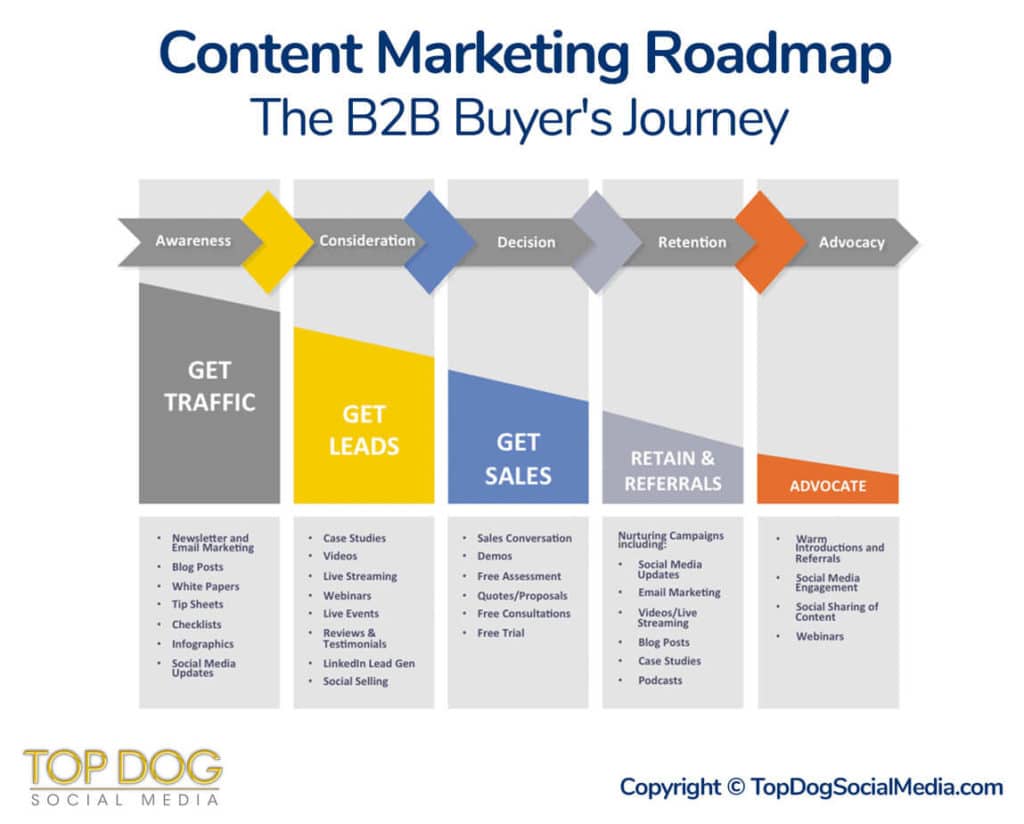
3. Creating Your Content Map
Knowing which formats fit each stage is the first step. The next step is to organize this strategically. This is done using a Content Mapping Matrix. This is a simple but powerful tool for visualizing your content strategy and, as we'll see in the next lesson, for identifying critical gaps.
5 Steps to Map Content to Buyer Journey
This article, '5 Steps to Map Content to Buyer Journey,' explains how to build and use a content mapping matrix to operationalize your strategy.
Please read 'Step 4: Build a Content Mapping Matrix'. Focus on how the matrix is structured (personas vs. journey stages) and how it helps you organize existing content and spot gaps.
As the article explains, a content map is typically a spreadsheet with:
- Rows: Your buyer personas (e.g., "Operations Manager," "CFO").
- Columns: The stages of the buyer journey (Awareness, Consideration, Decision).
In each cell, you list the content assets you have that serve that specific persona at that specific stage. For example, the cell for "Operations Manager" at the "Consideration Stage" might contain a case study about another operations manager who successfully used your product.
This matrix is the blueprint for your content engine. It's a living document that connects your strategy to your execution. In the next module, you will use this exact structure to perform a content audit on your existing library, which is a key step in building a high-performing engine.
Conclusion
Today, you've moved from high-level strategy to on-the-ground tactics. You now have a detailed map of which content formats to deploy at each stage of the buyer's journey to effectively guide them toward a purchase.
Key Takeaways:
- Content must be mapped to the buyer's stage of awareness and the corresponding funnel stage (TOFU, MOFU, BOFU).
- TOFU/Awareness content is broad and educational (blogs, guides).
- MOFU/Consideration content helps buyers evaluate options (case studies, comparisons).
- BOFU/Decision content provides final proof to convert leads (demos, pricing, testimonials).
- A Content Mapping Matrix (organizing content by persona and journey stage) is the essential tool for implementing this strategy and identifying gaps.
Preview of the Next Lesson:
With this mapping framework in hand, you're now equipped to diagnose the health of a content library. In our next lesson, we will focus on identifying common funnel gaps where leads disengage or drop off. You will learn how to use your content map to spot areas that are "content-starved" and understand how those gaps directly impact lead flow and revenue.