Hello! Welcome to the first lesson in your journey to building a powerful B2B content engine.
Your goal is to move beyond simply creating content and start architecting a system that drives measurable business results—aligning marketing and sales, closing funnel gaps, and proving ROI. The foundation of any such system is a deep understanding of the people you're trying to reach: your buyers.
This first module, "Foundations of the B2B Buyer Journey," provides the essential frameworks for this customer-centric approach. In this lesson, we will focus on the very first step: defining the stages of the B2B buyer journey and understanding the specific questions and motivations that drive your audience through it. This will be the lens through which we view all future strategic decisions.
Let's begin.
1. The Strategic Imperative: Why the Buyer Journey Comes First
As a content lead, you're an expert at creating valuable assets. The shift to building a "content engine" involves strategically deploying that content to guide a potential customer from being a complete stranger to a happy client.
A common mistake in B2B marketing is focusing too heavily on the small fraction of the market that is ready to buy right now. A true content engine nurtures the entire market. To understand this concept better, please watch the following segment from a video by TK Kader.
Content Marketing for B2B That Works (Stop Losing Potential Customers)
This video introduces a critical principle for B2B marketing: understanding that only a tiny percentage of your market is actively buying at any given moment. This insight shapes why a full-journey content strategy is essential.
Watch the section from 02:22 to 04:21. Focus on the distinction between the 3% of the market that is actively buying and the 97% that is not.
The key takeaway is that your content strategy must serve two different audiences:
- The 3% actively buying: They are problem-aware and solution-aware.
- The 97% not ready to buy: They may be unaware of the problem, aware but not prioritizing a solution, or just beginning their research.
Your goal is to create content that meets buyers wherever they are and guides them toward a purchase decision. This is how you build a predictable pipeline and move beyond reactive content creation.
2. Defining the B2B Buyer Journey Stages
The path a buyer takes is formally known as the B2B buyer journey. It's crucial to distinguish this from your internal sales funnel. The buyer journey is framed from the customer's perspective—it's their process of discovery, evaluation, and decision-making.
To get a clear definition and understand how the B2B journey differs from a B2C one, please read the following sections from the Sendtrumpet blog.
Understanding the B2B Buyer Journey: Definition, Stages, and ...
This article, 'Understanding the B2B Buyer Journey,' provides clear, concise definitions of the journey and its stages.
Read the sections titled 'What is a B2B Buyer Journey?', 'B2C vs. B2B Buyer Journey: What's the Difference?', and 'Three Stages of the B2B Buyer Journey'. Pay close attention to the non-linear nature of the journey and the key differences in B2B buying (complexity, duration, knowledgeable buyers).
As the article explains, the B2B buyer journey is typically broken down into three core stages:
- Awareness Stage: The buyer realizes they have a problem or an opportunity but hasn't yet clearly defined it. They are looking for information to understand their symptoms.
- Consideration Stage: The buyer has now clearly defined their problem and is researching all available approaches or methods to solve it. They are not yet focused on specific vendors but on solution categories.
- Decision Stage: The buyer has decided on their solution strategy and is now comparing specific vendors to find the best fit.
Let's explore what happens in each stage in more detail. The following resource provides an excellent B2B-focused explanation using a manufacturing example.
5 Steps to Map Content to Buyer Journey
The article '5 Steps to Map Content to Buyer Journey' offers a practical breakdown of buyer behavior within each stage.
Read the section 'Step 2: Map the Buyer Journey Stages,' focusing on the subsection 'What Happens at Each Stage.' Note the example of the facilities manager and how their research evolves.
An important point from this reading is that the journey isn't a straight line. A buyer might jump forward or circle back as they learn more or as new stakeholders get involved. Your content engine must be flexible enough to accommodate this reality.
3. Understanding Buyer Questions, Motivations, and Emotions
To create content that resonates, you need to step into your buyer's shoes and understand their mindset. What are they thinking? What are they feeling? What questions are they asking at each stage?
The following video from HubSpot, while using a B2C example, does a fantastic job of illustrating this empathetic approach.
How To Make An Effective Customer Journey Map In 1 Hour (FREE Templates)
This HubSpot video walks through a customer journey map, clearly articulating the thoughts, feelings, and actions of a buyer at each stage.
Watch from 02:16 to 05:03. Focus on how the buyer's questions and actions change as they move from the Awareness stage to the Decision stage. Try to translate the logic from the 'soccer classes' example to a B2B context.
Now, let's crystallize these ideas with a framework specifically for B2B. The table below, from the "5 Steps to Map Content to Buyer Journey" article, is an invaluable tool for summarizing the buyer's mindset.
5 Steps to Map Content to Buyer Journey
Now, let's study a table that neatly summarizes the focus, questions, emotions, and content types for each stage. This is a great reference to keep handy.
Carefully review the table presented under the heading 'Understanding Buyer Needs at Each Stage.' You may want to bookmark this resource or screenshot the table for future use.
For your convenience, here is the key information from that table:
| Stage | Buyer’s Focus | Key Questions | Emotions |
|---|---|---|---|
| Awareness | Symptoms & Problems | “What is causing this issue?” | Frustration, uncertainty |
| Consideration | Solution Categories | “Which type of solution is best?” | Eagerness, curiosity |
| Decision | Specific Vendors | “Why is this vendor better?” | Need for justification, caution |
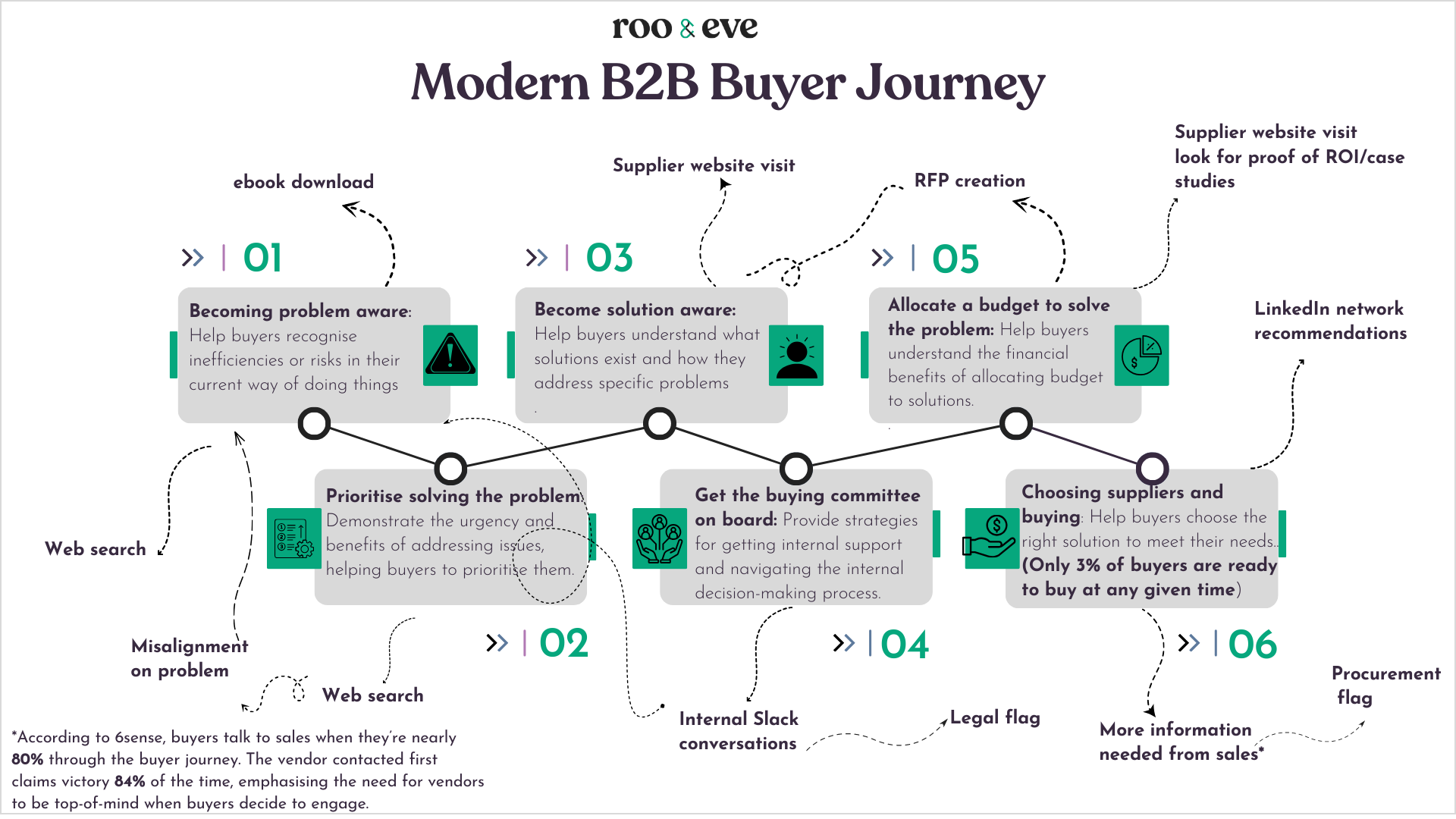
This table provides the "what" and "why" behind the content you will eventually map to each stage. The image below provides another excellent visualization of the modern B2B journey, showing the kinds of activities buyers engage in at each step.
4. Application Exercise: Mapping Your Buyer's Questions
Theory is most useful when applied. Since you have access to your company's buyer personas, let's put this framework into practice.
Your Task:
- Choose one of your primary buyer personas.
- For that single persona, brainstorm and write down 2-3 specific questions they would likely ask during each stage of the buyer journey (Awareness, Consideration, Decision).
- Frame these questions from the buyer's point of view.
Example:
-
Persona: VP of Sales at a 500-person SaaS company.
-
Product: A sales intelligence platform.
- Awareness Questions:
- "Why is my sales team's forecast accuracy so low?"
- "How can I reduce sales rep ramp time?"
- Consideration Questions:
- "What's the difference between lead enrichment tools and a full sales intelligence platform?"
- "What methods are best for improving sales process efficiency?"
- Decision Questions:
- "How does [Your Product] integrate with our existing Salesforce instance?"
- "What is the typical ROI for companies our size using [Your Product]?"
- Awareness Questions:
This exercise will begin building the foundation for the content audit and strategy development we'll tackle in later modules.
Conclusion
In this lesson, you’ve established the foundational concept for building a strategic content engine. You now have a clear framework for understanding your customers' world before you ask them to enter yours.
Key Takeaways:
- A successful content engine serves the entire market—the 97% who aren't ready to buy, not just the 3% who are.
- The B2B buyer journey consists of three core stages from the customer's perspective: Awareness (problem identification), Consideration (solution exploration), and Decision (vendor selection).
- Each stage is defined by the buyer's unique questions, motivations, and emotional state, which must guide your content strategy.
Preview of the Next Lesson:
Now that we've defined the buyer's external journey, our next step is to look inward at your organization's processes. In the next lesson, we will distinguish between Marketing-Qualified Leads (MQLs) and Sales-Qualified Leads (SQLs) and establish clear criteria for qualifying them. This is the first crucial step in aligning your sales and marketing teams around a common goal.