Introduction
Welcome back! In our last lesson, we diagnosed the common causes of sales and marketing misalignment, from strategic and procedural gaps to conflicting metrics and cultural divides. We established that to build a true revenue engine, both teams must work in concert.
Today, we take the first and most crucial step toward building that alignment: establishing a shared vocabulary for lead stages, handoff criteria, and deal stages.
Think of this as learning the essential grammar for a new language—the language of revenue. If marketing's "qualified lead" is sales' "unqualified contact," any conversation about pipeline or performance is bound to fail. By defining terms like MQL, SAL, and SQL, and by understanding the sales cycle from a seller's perspective, you create the bedrock for all future collaboration.
For you as a Content Lead, this shared language is what transforms your work from creating isolated assets into building a strategic system. It allows you to create content that meets a specific need at a specific point in the buyer's journey and to communicate its value in terms both sales and marketing understand.
1. From Contact to Customer: Defining the Lead Lifecycle
The journey from a person showing initial interest to becoming a paying customer is not a single leap but a series of handoffs and qualification steps. Misunderstanding these steps is a primary source of friction. Let's start by defining the core terminology.
To begin, please watch this short video from WebFX. It provides a concise overview of the most critical terms that form the foundation of our shared vocabulary.
26 Sales Terms Every Marketer Should Know | Business Vocabulary 101
This video, '26 Sales Terms Every Marketer Should Know,' will quickly introduce the key concepts of a lead, a Marketing Qualified Lead (MQL), a Sales Accepted Lead (SAL), and a Sales Qualified Lead (SQL).
Please watch the segment from 02:17 to 03:33. Focus on how the video distinguishes between MQL, SAL, and SQL. This distinction is central to a smooth handoff process.
The video gives us the essential definitions. Let's formalize and expand on them:
- Marketing Qualified Lead (MQL): A lead that the marketing team has vetted against a set of criteria and deemed ready for the sales team. This is marketing raising its hand and saying, "Based on who they are and what they've done, this person is worth a sales conversation."
- Sales Accepted Lead (SAL): An MQL that the sales team has reviewed and formally accepted. This is a critical but often skipped step. It represents the "handshake" where sales confirms, "I agree this lead is worth pursuing, and I commit to following up."
- Sales Qualified Lead (SQL): A lead that a salesperson has engaged with and confirmed has a legitimate potential to become a customer. The lead has been vetted against a qualification framework (like BANT, which we'll discuss shortly) and is now considered a real sales opportunity.
To solidify these concepts and understand them in greater detail, let's turn to a more in-depth guide.
MQL, SAL, SQL: A Complete Guide to Lead Qualification Stages
The article 'MQL, SAL, SQL: A Complete Guide to Lead Qualification Stages' from Kubaru provides excellent written definitions and clarifies the sequence of these stages.
Please read the section 'The Lead Qualification Stages' at the beginning of the article, and then jump to the 'Frequently Asked Questions' section at the end to read the answer to 'What comes first, SQL or SAL?'. This will reinforce the proper flow of a lead from marketing to sales.
Understanding this MQL -> SAL -> SQL progression is the first step. The next is to define how a lead moves from one stage to the next.
2. The Handoff: Defining Clear Criteria
A lead doesn't become "qualified" by magic. It happens when they meet specific, pre-agreed criteria. Defining these criteria is where marketing and sales alignment truly begins.
Defining MQL Criteria: From Marketing to Sales
What makes a lead an MQL? The criteria usually fall into two categories:
- Fit (Demographics/Firmographics): Does the lead match your Ideal Customer Profile (ICP)? This is about static attributes like job title, company size, industry, and geographic location.
- Intent (Behavior): Has the lead demonstrated interest through their actions? This includes behaviors like visiting your pricing page, downloading a high-value asset (like a case study), or requesting a demo.
Marketing automation platforms often use a lead scoring model to assign points for these attributes and behaviors. When a lead's score crosses a certain threshold, they are automatically flagged as an MQL and passed to sales.
The following resource explains how these elements come together.
MQL, SAL, SQL: A Complete Guide to Lead Qualification Stages
Let's return to the Kubaru article to see how MQL criteria are practically defined. This section breaks down the process of combining fit and intent signals.
Read the section 'How to Define Marketing Qualified Lead (MQL) Criteria'. Pay close attention to the distinction between fit-based signals (ICP) and behavior-based signals.
Defining SQL Criteria: From Accepted to Qualified
Once sales accepts the lead (making it an SAL), their job is to determine if it's a real opportunity (an SQL). To do this consistently, they often use a qualification framework. A classic example is BANT:
- Budget: Do they have the financial resources to buy?
- Authority: Are they the decision-maker, or can they influence the decision?
- Need: Do they have a clear pain point that your solution solves?
- Timeline: Is there an urgent need to make a purchase?
If a salesperson confirms most or all of these points in a discovery call, they will convert the lead to an SQL. The Kubaru article you just read touches on this in the section "How to Define Sales Qualified Lead (SQL) Criteria."
This entire handoff process, with its stages and criteria, can be visualized with expected timelines. The image below shows how these stages flow together, introducing the concept of a Service Level Agreement (SLA)—a topic we will dive into in our next lesson.

3. From the Seller's View: Understanding Deal Stages
While marketing often thinks in terms of a "funnel," the sales team thinks in terms of a "pipeline" or "sales cycle." These are the concrete stages a salesperson moves a deal through to get it to "closed-won." Understanding these stages is critical for you to create content that helps sellers advance deals.
This image provides a helpful map, connecting the marketing funnel stages you learned about in Module 1 to the sales pipeline stages.
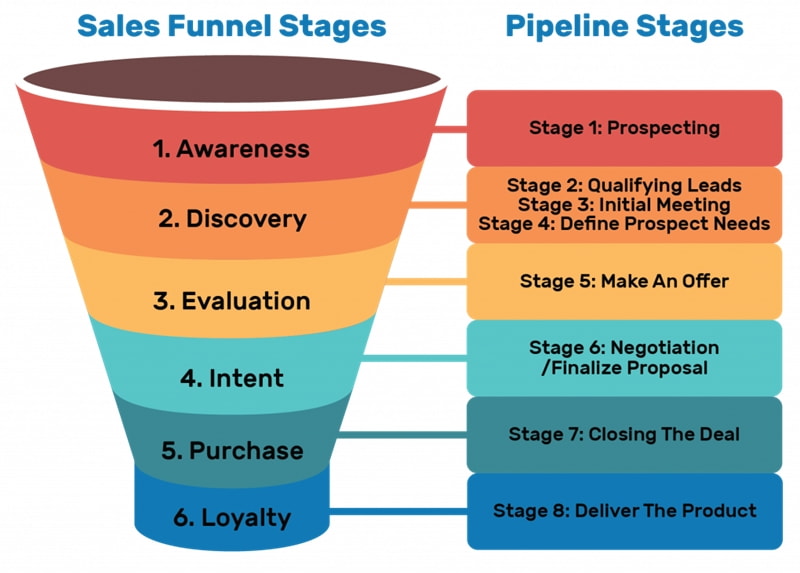
Now, let's explore these pipeline stages from the seller's point of view.
The B2B Sales Cycle Stages, Explained: 2026 Edition - Highspot
The article 'The B2B Sales Cycle Stages, Explained' from Highspot provides an excellent breakdown of the key stages from a sales perspective. This will give you insight into what sales reps are actually doing at each step.
Read the section 'Breaking down the full sales cycle: Key stages involved in modern selling.' As you read through the stages (Prospecting, Qualifying, Engaging, etc.), think about what kind of content would be most helpful for a salesperson at each specific stage.
Let's summarize how your content supports these sales-defined stages:
- Prospecting/Qualifying: Sales is identifying and vetting leads. Your content, like clear ICP definitions and blog posts that attract the right audience, helps generate high-quality raw material for them.
- Engaging/Positioning: Sales is having initial conversations and framing the solution. Your case studies, competitor battle cards, and pitch decks are invaluable here.
- Advancing/Closing: Sales is handling objections, building consensus, and negotiating terms. Your ROI calculators, security documentation, and implementation guides can help get the deal across the finish line.
- Expanding: The deal is won, and the focus shifts to customer success and finding upsell/cross-sell opportunities. Your customer success stories and new feature announcements support this stage.
By understanding the seller's world and their vocabulary, you can ensure your content is not just "created" but actively used to move deals forward.
Conclusion
In this lesson, we established the foundational vocabulary needed for effective sales and marketing alignment. Without these shared definitions, teams operate with different maps, leading to wasted effort and lost revenue.
Key Takeaways:
- Lead stages have precise meanings: The MQL -> SAL -> SQL progression represents a formal, multi-step qualification process, not a casual handoff.
- Handoffs require explicit criteria: A lead becomes an MQL based on a combination of fit (do they match our ICP?) and intent (have they shown interest?). A lead becomes an SQL when they meet a qualification framework like BANT.
- Sales thinks in pipeline stages: To create content that sales will actually use, you must understand their process—from Prospecting and Qualifying to Closing and Expanding.
- Shared vocabulary is the first step to alignment: Agreeing on these terms is the non-negotiable prerequisite for building joint processes, setting shared goals, and measuring success together.
Preview of the Next Lesson:
We’ve defined the terms. Now, we need to codify the rules. In the next lesson, we will build directly on today's concepts to describe the essential components of a sales-marketing service level agreement (SLA). We will formalize the handoff process by defining expectations for lead quality, follow-up time, and what happens to rejected leads.