Introduction
Welcome back. In our previous lesson, we examined GPT-4o as a prime example of a "generalist" native multimodal model, capable of processing and reasoning across text, audio, and vision within a single, unified architecture. We saw how this approach enables incredibly fluid and low-latency interactions.
However, a powerful alternative to the "one model to rule them all" philosophy is the creation of specialist models. These models are intentionally designed to excel in a narrow domain, often outperforming even larger generalist models on specific tasks.
This lesson directly addresses this alternative paradigm. Our learning outcome is to describe how domain-specific pretraining and data filtering create specialist models like Qwen 2.5-Coder and Qwen 2.5-Math. We will dissect the "recipe" that allows a model to develop deep expertise, moving from a general foundation to a specialized master.
The Specialist Advantage: Smaller but Smarter?
It might seem counterintuitive that a smaller model could outperform a larger one. After all, the "scaling laws" suggested that bigger models with more data and compute would always be better. While this is generally true, the composition of that data is paramount.
This is where specialist models come in. By focusing the pre-training data on a specific domain, such as computer code or mathematics, these models can achieve a level of proficiency that is difficult for a generalist to match.
Let's begin with a short video that introduces Qwen's coding model and poses the central question for our lesson: how can a smaller, specialized model achieve state-of-the-art performance?
Qwen 3 Coder explained in 5 minutes
This video from Caleb Writes Code provides an excellent high-level overview of why a model like Qwen's Coder is significant and sets the stage for our deep dive into its training data.
Please watch from the beginning to 01:03 and then from 01:39 to 02:56. Focus on two key points: the shift in industry focus from 'bigger is better' to better architectures and techniques, and the emphasis on the high percentage (70%) of coding data and synthetic data used in pre-training.
The video highlights the two core ingredients for creating a specialist model: a massive amount of domain-specific data and a carefully curated data mixture. Let's now examine the technical details of how this is done, using Qwen2.5-Coder as our first case study.
The Recipe for a Specialist: A Tale of Two Models
The process of creating a specialist model involves taking a strong, general-purpose base model and continuing its pre-training on a new, highly curated dataset. We'll explore this recipe by looking at two models from the same family: Qwen2.5-Coder and Qwen2.5-Math.
Case Study 1: Qwen2.5-Coder
The Qwen team's technical report provides a transparent look into their methodology. The foundation of their specialist model is the Qwen2.5-Coder-Data dataset.
Qwen2.5-Coder Technical Report
The Qwen2.5-Coder Technical Report details the exact process of creating a specialist coding model. We will read the sections describing the data collection and mixing strategy.
Please read Section 3.1, 'Pretraining Data', focusing on the subsections 'Data Composition' and 'Data Mixture'. As you read, note the different types of data used and the experimental results that led to their final 70% Code, 20% Text, 10% Math mixture.
As you read, you uncovered the key components of the recipe:
-
Data Composition: The pre-training dataset isn't just raw code. It's a rich mix of:
- Source Code: Billions of lines of code from public GitHub repositories, including pull requests and commits.
- Text-Code Grounding Data: High-quality text from sources like Common Crawl that discusses code (e.g., tutorials, documentation, blogs). This helps the model ground code in natural language explanations.
- Synthetic Data: New code generated by their previous model (CodeQwen1.5) and validated for correctness. This is a powerful technique to "bootstrap" and expand the dataset with high-quality examples.
-
Data Filtering and Mixture: Simply having a lot of data isn't enough; the quality and balance are critical. The Qwen team used a hierarchical filtering approach with
fastTextclassifiers to sift high-quality data from the noisy Common Crawl. Most importantly, they experimented with the data mixture and found that a 70% Code, 20% Text, and 10% Math ratio yielded the best results—even better than a mix with a higher percentage of code. This suggests that retaining some general language and mathematical reasoning ability helps support the core coding competency.
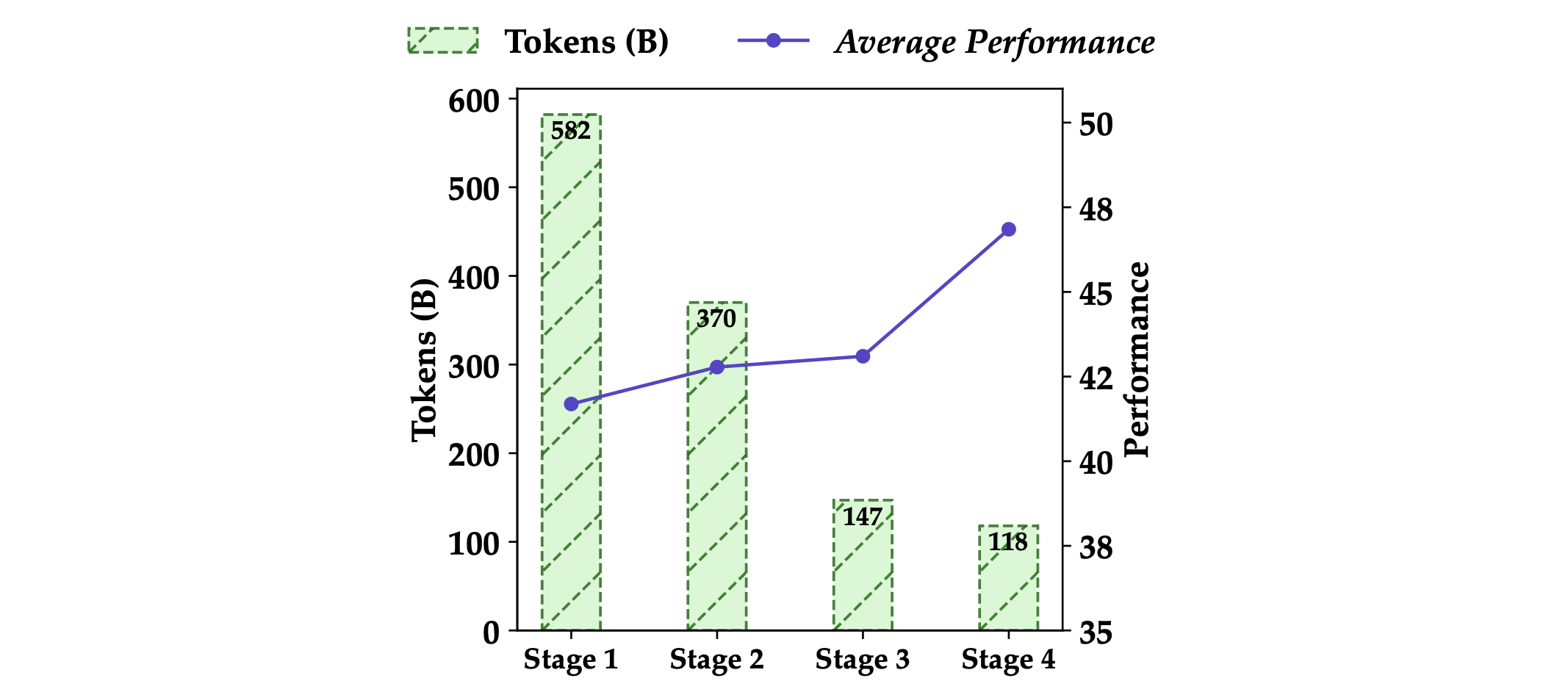
The image below, from the report, illustrates the multi-stage training process where data is applied over several phases to progressively improve performance.
Case Study 2: Qwen2.5-Math
Now, let's see if this recipe holds for a different domain. The process for creating Qwen2.5-Math follows a strikingly similar pattern.
Qwen2.5-Math Technical Report: Toward Mathematical Expert Model via Self-Improvement
The technical report for Qwen2.5-Math describes a similar process of data curation and synthesis, but tailored for mathematical reasoning.
Please read Section 2, 'Qwen2.5-Math Pre-training'. Pay close attention to how they construct their 'Qwen Math Corpus'. Notice the parallels to the Coder model: recalling data from web sources using a FastText classifier, filtering for quality using a small LLM, and generating synthetic data using a powerful parent model (Qwen2-72B-Instruct).
The parallels are clear. To create a math specialist, the Qwen team:
- Recalled math-related data from the web using a
fastTextclassifier trained on math seed data. - Filtered this data for quality using a small instruction-tuned model to score documents.
- Synthesized new, high-quality math problems and solutions using their powerful Qwen2-72B-Instruct model.
- Continued pre-training a strong base model (Qwen2.5) on this new, math-focused corpus.
This "self-improvement" loop—where a strong model is used to generate data to train an even stronger successor—is a common and powerful theme in modern AI development.
The Result: Verifiable Expertise
The outcome of this intensive, domain-focused training is a model that demonstrates exceptional performance in its niche. This radar chart visualizes how Qwen2.5-Coder stacks up against other top-tier models, including generalists like GPT-4o, on a suite of coding benchmarks.

As the chart illustrates, the specialist model is highly competitive, proving the effectiveness of the domain-specific pre-training and data filtering strategy. It can match or even beat larger, more general models on tasks that fall squarely within its area of expertise.
Conclusion
In this lesson, we've moved beyond the concept of the all-powerful generalist model to understand the creation and value of specialists. By dissecting the development of Qwen2.5-Coder and Qwen2.5-Math, we've distilled a clear recipe for building domain expertise in large language models.
Key Takeaways:
- Specialist models can outperform larger generalist models in specific domains like coding or math.
- They are created by performing continual pre-training on a strong base model using a massive, high-quality, domain-specific dataset.
- This dataset curation involves three key steps:
- Recalling relevant data from broad sources (e.g., the web).
- Filtering for quality using rule-based methods or lightweight classifier models.
- Synthesizing new data using a powerful parent model to expand and refine the training corpus.
- The final data mixture is carefully balanced, often retaining a smaller percentage of general text and related domains (like math for a coding model) to support the primary expertise.
Preview of the Next Lesson:
We've just seen how to create an expert coding model. In the context of our course on autonomous systems, this has a profound implication. What if the "plan" for a self-driving car wasn't a sequence of trajectory points, but a piece of executable code? In our next lesson, we will investigate the Code-as-Policy concept, where a planner outputs code rather than raw trajectory points, directly bridging the worlds of specialist language models and robotic control.