Introduction
Welcome back. In our previous lesson, we explored how specialist models like Qwen2.5-Coder are created through intensive, domain-specific training. We saw that by focusing on a massive, high-quality corpus of code, these models can achieve a level of expertise that rivals or even surpasses larger, generalist models.
This raises a fascinating question for our study of autonomous systems: What is the most powerful way to leverage a model that is an expert at writing code?
This lesson answers that question by introducing a paradigm that directly connects code generation to physical action. Our learning outcome is to explain the Code-as-Policy concept where a planner outputs executable code rather than raw trajectory points. We will see why expressing a plan as a program—with logic, loops, and conditions—is often far more powerful and flexible than a simple sequence of waypoints.
Why Code? The Expressiveness of Programs
A traditional motion planner might output a trajectory as a list of coordinates: [(x1, y1), (x2, y2), ...]. This is effective but rigid. It cannot easily adapt to unexpected events or represent complex, conditional logic.
The "Code-as-Policy" paradigm takes a different approach. Instead of generating a fixed path, the planner—powered by an LLM—generates an entire program that accomplishes the goal. Why is this better? Because LLMs trained on billions of lines of code have a deep, implicit understanding of programming constructs.
- Logic and Conditionals (
if/else): The plan can include checks like "if the light is red, stop." - Loops (
for/while): The plan can handle repetitive tasks, like "pick up all the blue blocks." - Abstraction and Reusability: The LLM can generate functions that can be reused for similar tasks in the future.
Let's begin by reading a concise explanation of this concept and its advantages.
LLMs for Robot Task Planning (2025 Guide)
This article from RoboCloud Hub provides a clear and direct explanation of the 'Code as Policies' technique, highlighting why generating code is more powerful than generating simple text commands.
Please read the section titled '2. Code as Policies'. Pay close attention to the example of sorting red and blue blocks and the explanation of why generating a Python function is more expressive and adaptive than generating a linear list of actions.
As the article illustrates, a plan expressed as code is inherently more generalizable. The sort_blocks function can handle any number of blocks, a feat that would be cumbersome for a planner that must specify every single action in a linear sequence.
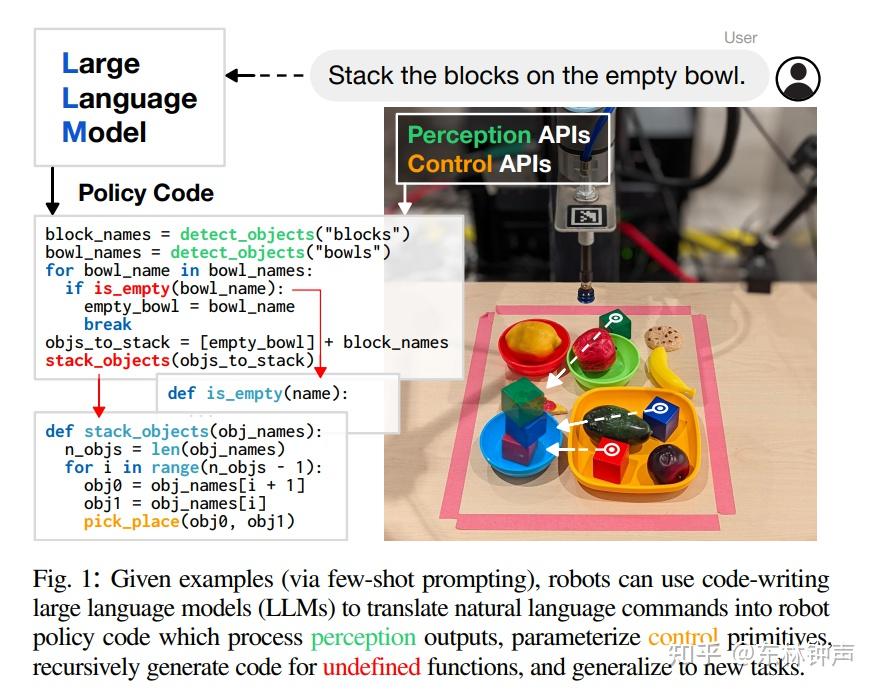
The image below provides another excellent visualization of this process. The LLM receives a high-level command and generates a Python program that uses provided perception and control APIs to execute the task. Notice how it even generates helper functions like is_empty and stack_objects that were not explicitly part of the API, showcasing its powerful reasoning capabilities.
Application to Autonomous Driving: The LaMPilot Framework
This concept is not limited to robot arms in controlled environments. It is being actively applied to the complex domain of autonomous driving. The LaMPilot framework is a prime example of this.
In this framework, the LLM acts as a high-level strategic planner. It doesn't generate low-level steering and throttle commands. Instead, it writes "Language Model Programs" (LMPs)—Python functions—that call upon a library of established driving algorithms, which we call functional primitives.
Let's dive into the research paper that introduced this framework.
LaMPilot: An Open Benchmark Dataset for Autonomous Driving with Language Model Programs
The LaMPilot paper details how Code-as-Policy is applied to autonomous driving. We will focus on the methodology and a concrete example of a generated driving policy.
Please read the following sections: Section 1 ('Introduction') to understand the motivation. Section 3 ('LaMPilot Methodology') to learn about the framework, prompts, and functional primitives. Section 3.3 ('Completions') and Table 1 for a detailed example of a generated policy. Focus on how a high-level instruction ('Go around the car in front...') is translated into a Python function (overtake_using_right_lane) that uses conditional logic and loops.
The overtake_using_right_lane example from the paper is a perfect illustration of Code-as-Policy in action.
- Strategic, Not Tactical: The LLM decides what to do (check for a safe opening, change lanes, monitor distance) but not the micro-level how (the precise steering angle or throttle input).
- Adaptive Logic: The policy uses
while True:loops to wait for conditions to be met (e.g.,if is_safe_enter(...)). This makes the plan robust to dynamic changes in the environment. - Bridging the Gap: The
yield autopilot()command is crucial. It hands control back to a traditional, fast, low-level controller to execute the next step of the high-level plan. This elegantly solves the problem of LLM latency, as the slow, deliberative LLM is only used for high-level strategy, not real-time vehicle control.
This concept can also be extended to coordinate multiple agents, as shown in the SMART-LLM framework below, where different code-based policies are generated and assigned to different robots.

Implementation: Giving Tools to an Agent
So, how do we practically enable an LLM to "call" these functions? The mechanism is known as tool use. We define a set of functions (our "tools" or "APIs") and make the LLM aware of them, typically through the context prompt. The LLM can then decide which tool to use, with what arguments, to accomplish a task.
Frameworks like LangChain make this process straightforward. A Python function can be exposed to an LLM by simply adding a @tool decorator.
This video demonstrates a real robotics project using this exact concept, explaining how an LLM can be given tools to control a simulated robot.
Controlling Robots using a Large Language Model
This video from Mike Likes Robots provides a practical walkthrough of how tool use is implemented in a robotics project using the Rosa library, which is built on LangChain.
Please watch from 15:13 to 20:55. This section shows the underlying Python code. Focus on how standard Python functions are decorated with @tool to expose them to the LLM, and how the LLM's output is a call to one of these functions.
The core idea is simple yet powerful: any Python function, whether it publishes a ROS message to move a robot, calls a web API, or saves a file, can be wrapped as a tool for an LLM agent to use. The agent decomposes a user's high-level request into a sequence of tool calls to achieve the final goal.
Here is a minimal, self-contained Python snippet using LangChain that encapsulates this entire process:
from langchain.tools import tool
from langchain.agents import initialize_agent, AgentType
from langchain.chat_models import ChatOpenAI


# 1. Define Robot Tools (Functional Primitives)
@tool
def move_robot(x: int, y: int) -> str:
    """Moves the robot to the specified (x, y) coordinates."""


    # In a real system, this would call a navigation stack.
    print(f"EXECUTING: Move to ({x}, {y})")
    return f"Robot successfully moved to {x}, {y}"

@tool
def grab_object(object_name: str) -> str:
    """Attempts to grab an object seen by the camera."""


    # In a real system, this would call a grasping controller.
    print(f"EXECUTING: Grab '{object_name}'")
    return f"Successfully grabbed {object_name}"


# 2. Initialize the Planner (LLM) and Tools
llm = ChatOpenAI(model="gpt-4", temperature=0)
tools = [move_robot, grab_object]


# 3. Create the Agent
agent = initialize_agent(
    tools,
    llm,
    agent=AgentType.STRUCTURED_CHAT_ZERO_SHOT_REACT_DESCRIPTION,
    verbose=True # Shows the LLM's thought process
)


# 4. Run a high-level command
# The agent will generate and execute "code" (tool calls) to solve this.
agent.run("Go to the kitchen at location (10, 20) and grab the apple.")
When you run this code, the agent's verbose=True output would show the LLM's "thoughts" as it decides which tool to call next, demonstrating the "Code-as-Policy" reasoning loop in action.
Conclusion
In this lesson, we have defined the Code-as-Policy paradigm, a powerful method for integrating LLM reasoning into control systems. By having the planner generate executable code instead of low-level control signals, we can create plans that are more expressive, adaptive, and generalizable.
Key Takeaways:
- Code-as-Policy: An approach where an AI planner, typically an LLM, outputs a program (e.g., Python code) as its policy.
- Expressiveness: Code can naturally represent complex logic, including loops and conditional statements (
if/else), which are difficult to encode in traditional trajectory-based plans. - Mechanism: The LLM is provided with a set of APIs or functional primitives (tools) that it can call. It accomplishes high-level tasks by composing these primitives into a coherent program.
- Strategic Planning: In robotics and autonomous driving, this paradigm is used for high-level strategic planning (the what and when), while fast, traditional controllers handle the low-level, real-time execution (the how).
Preview of the Next Lesson:
Code-as-Policy represents one type of "generative planning." In our next lesson, which kicks off the "Generative Planning for Autonomous Driving" module, we will broaden our perspective. We will formally compare the traditional modular AD pipeline (perception, prediction, planning) with the emerging paradigm of unified generative planning, situating approaches like Code-as-Policy within this larger context and setting the stage for our deep dive into end-to-end models like DAP.