Introduction
Welcome to the first lesson in our module on Generative Planning for Autonomous Driving. In the previous lesson, we explored "Code-as-Policy," where an LLM generates a Python program to guide a robot. This is a powerful example of generative planning, where the plan itself is a generated artifact.
In this lesson, we will step back and build the foundational context for this entire module. Our learning goal is to compare the traditional modular AD pipeline (perception, prediction, planning) with the unified generative planning paradigm. Understanding this shift is crucial, as it represents one of the most significant architectural debates in the field of autonomous systems today. We will examine the classical approach, analyze its limitations, and then explore how modern end-to-end systems aim to overcome them by reframing driving as a unified generation task.
The Traditional Paradigm: The Modular Pipeline (AV 1.0)
The classical approach to building an autonomous vehicle (AV) system is rooted in a "divide and conquer" strategy. The complex problem of driving is broken down into a series of smaller, more manageable sub-problems, each handled by a specialized software module. This is often referred to as the "modular pipeline" or "AV 1.0."
To understand the components of this pipeline, please read the following article, which provides a clear breakdown.
Autonomous driving: Modular pipeline Vs. End-to-end and LLMs
This article from Medium contributor Samer Attrah clearly defines the traditional modular pipeline and its core components.
Please read the section titled 'Modular pipeline.' Focus on understanding the distinct roles of the four main modules: Perception, Prediction, Planning, and Control.
As the article describes, the data flows sequentially through this pipeline:
- Perception: Senses the world using cameras, LiDAR, etc., to answer the question, "What is around me?" This involves tasks like 3D object detection (e.g., using VoxelNet) and segmentation.
- Prediction: Takes the output of the perception module to forecast the future behavior of other agents (vehicles, pedestrians). It answers, "What will those other agents do next?"
- Planning: Uses the outputs from perception and prediction to chart a safe and efficient path for the ego-vehicle. It answers, "What should I do?"
- Control: Executes the plan by sending low-level commands (e.g., acceleration, steering angle) to the vehicle's hardware.
This modular design is intuitive and allows specialized teams to work on individual components. However, it has a critical weakness. Watch this short clip from a talk by the creators of UniAD, a modern AV system, who start by describing the limitations of this traditional approach.
CVPR23 Plenary Talk | [Best Paper] UniAD: Planning-oriented Autonomous Driving
The following clip from an OpenDriveLab presentation at the CVPR conference introduces the traditional modules and highlights their main drawback.
Watch from 00:22 to 01:20. Pay close attention to the concept of 'accumulated errors' that the speaker mentions.
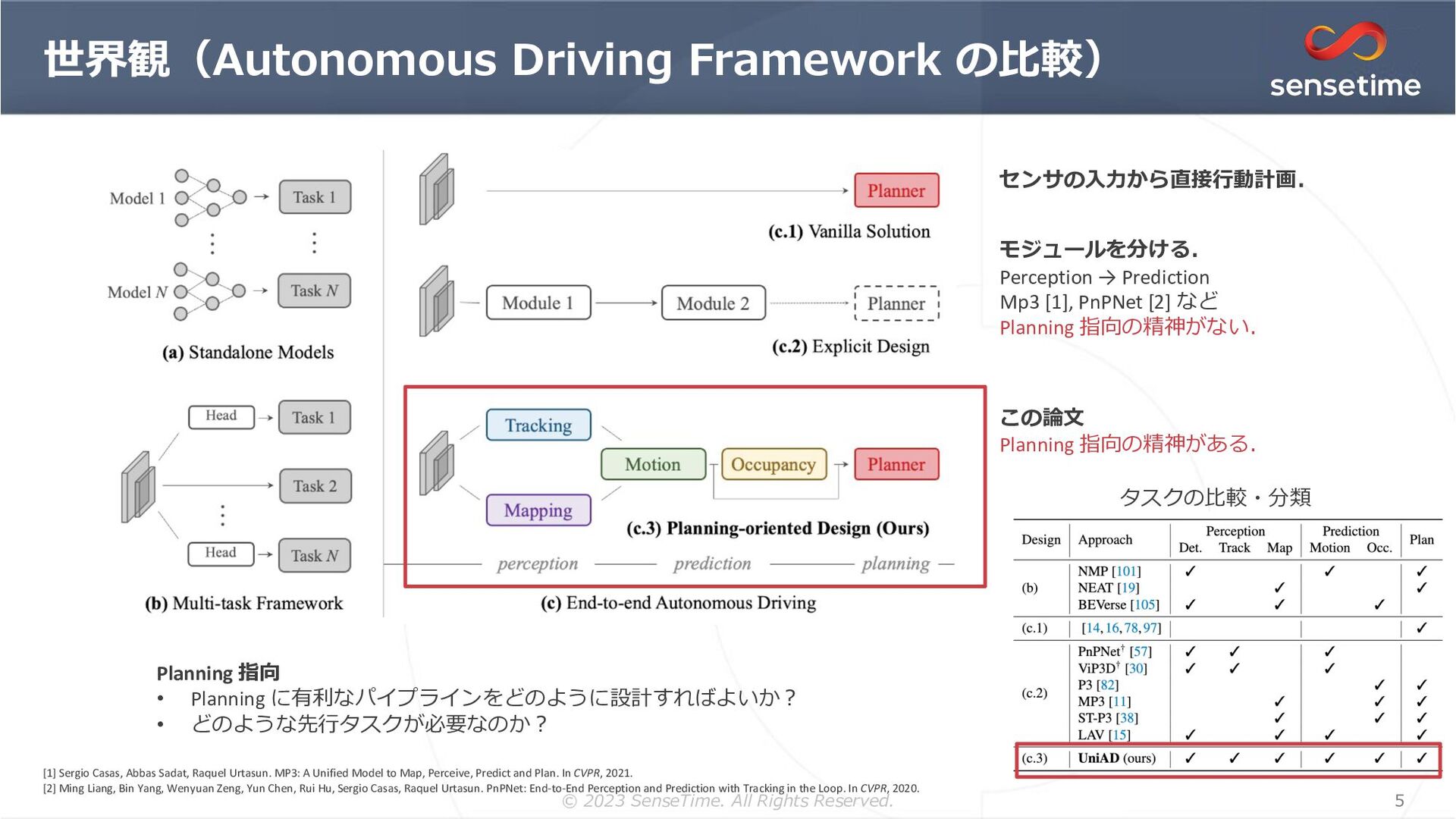
The key issue with the modular pipeline is error propagation. Each module is optimized independently, and an error made in an early stage (e.g., the perception module fails to detect a distant car) is passed down the chain. The prediction module cannot forecast the behavior of a car it doesn't know exists, and the planning module cannot plan to avoid it. There is no feedback mechanism for the planner to signal to the perception system that something might be wrong.
The image below visually contrasts this "Standalone Models" approach with more integrated designs.
The New Paradigm: Unified Generative Planning (AV 2.0)
The limitations of the modular pipeline led researchers to explore a new paradigm: unified end-to-end planning. This approach, often called "AV 2.0," abandons the series of hand-engineered modules in favor of a single, holistic system that learns to drive by mapping sensor inputs directly to driving decisions.
Let's hear from Alex Kendall, CEO of Wayve, a leading company in this space, as he defines the shift from AV 1.0 to AV 2.0.
How End-to-End Learning Created Autonomous Driving 2.0: Wayve CEO Alex Kendall
In this clip, Alex Kendall provides a clear, high-level industry perspective on the shift from the classical modular approach (AV 1.0) to an end-to-end intelligence (AV 2.0).
Watch from 01:48 to 04:00. Focus on how he characterizes the difference between the two approaches, especially regarding hand-engineered interfaces versus a general-purpose intelligence.
Instead of optimizing for intermediate tasks like object detection accuracy, the entire system is optimized for the final planning objective. This allows the model to learn a more robust and nuanced understanding of the driving task.
The core idea is to treat driving not as a pipeline of classification and regression problems, but as a generative modeling problem. The model's goal is to generate a future trajectory that is safe, comfortable, and makes progress toward the destination.
The research paper for GenAD (Generative End-to-End Autonomous Driving) provides an excellent, technically deep comparison of these two paradigms.
[PDF] GenAD: Generative End-to-End Autonomous Driving
The GenAD paper offers a rigorous, graduate-level critique of the conventional pipeline and formally proposes a generative alternative. This is a key reading for understanding the state-of-the-art.
Please read the following parts of the introduction: The paragraph starting 'Most existing end-to-end models...'. The paragraph starting 'In this paper, we propose...'. Carefully study Figure 1 and its caption, as it perfectly visualizes the architectural shift. Focus on the limitations the authors identify in the conventional pipeline, such as failing to model high-order interactions and structural trajectory priors.
Advantages of the Unified Approach
The GenAD paper highlights the key advantages of unified generative planning over the traditional modular pipeline:
-
Modeling High-Order Interactions: A modular pipeline predicts how other cars will move, then plans the ego-vehicle's path. It cannot easily model how the ego-vehicle's own tentative plan might influence other cars, which in turn influences the ego-plan. A unified generative model, by generating the entire future scene simultaneously, can capture this complex, interactive dynamic.
-
Learning Structural Priors: Real-world trajectories are not random; they are smooth and follow physical laws. A generative model can learn this "structural prior" of what a realistic future looks like, leading to more plausible and safer plans.
-
End-to-End Optimization: By training the system with a final planning loss, all intermediate representations are automatically optimized to serve the ultimate goal of driving well. This avoids issues where a component excels at its intermediate metric (e.g., perception achieves 99% detection accuracy) but still fails in a way that is critical for the downstream planner.
The diagram below from another paper illustrates this well. The more modular approaches (a, b) suffer from "Information Loss" between perception and planning, whereas the unified approach (c) integrates simulation and multi-target learning directly into the planning process.

Conclusion
Today we've drawn a clear line between the two dominant architectural philosophies in autonomous driving. The traditional modular pipeline offers interpretability and engineering simplicity but suffers from error propagation. The unified generative paradigm offers a more holistic, robust, and scalable solution by framing driving as a single end-to-end learning problem.
Key Takeaways:
| Feature | Traditional Modular Pipeline (AV 1.0) | Unified Generative Planning (AV 2.0) |
|---|---|---|
| Architecture | Separate, hand-interfaced modules (Perception, Prediction, Planning) | Single, end-to-end model. |
| Optimization | Each module optimized for a different, intermediate objective. | The entire system is globally optimized for the final planning objective. |
| Error Handling | Error Propagation: Errors from early modules accumulate downstream. | Potential for Recovery: End-to-end optimization can make the model robust to some upstream noise or failures. |
| Core Limitation | Complexity of interfaces; cannot model high-order interactions. | Can be a "black box," often requires massive amounts of data. |
| Examples | Classical robotics systems. | GenAD, Plan-R1, DAP, Wayve. |
This fundamental shift from a modular pipeline to a unified generative model is what enables the advanced systems we will be studying, like DAP and Plan-R1, which literally treat "planning as language modeling."
Preview of the Next Lesson:
Now that we understand why the field is moving toward unified generative planners, our next lesson will explore how these systems work. We will begin by dissecting a critical component mentioned in your syllabus: the Vector-Quantized Variational Autoencoder (VQ-VAE). We will explain its architecture and see how it provides the essential bridge for turning the continuous, high-dimensional visual world into the discrete tokens that a transformer-based planner can understand and process.