Hey there! Welcome back.
Last time, we took a deep dive into the difference between the "perfect" world of reversible processes and the real world of irreversible ones. We saw that every real process, from a car braking to coffee cooling, has built-in one-way streets called irreversibilities—things like friction, heat transfer across a temperature gap, and sudden expansion. We ended with a big question: if reversible processes are just impossible ideals, why do we care so much about them?
Today, we answer that question head-on. This lesson is all about the why. You'll learn why these theoretical ideals are the single most important benchmark in thermodynamics. Our goal is to explain exactly why reversible processes deliver the maximum possible work when they expand, and require the minimum possible work to be compressed.
Understanding this principle is the key that unlocks the concept of maximum efficiency. It's how engineers know the "ultimate speed limit" for any engine or refrigerator they design. Once we nail this down, we'll be ready to build the most famous theoretical engine of all time: the Carnot engine.
Let's get started.
The Big Idea: Getting the Most "Bang for Your Buck"
At its heart, work from an expanding gas is about a high-pressure system pushing on its surroundings. Think of it like a crowd of people pushing to get out of a packed room.
- The Goal (Work Output): To get the most work out of an expanding gas, you want it to push with the maximum possible force over the entire distance of its expansion.
- The Goal (Work Input): To compress a gas with the least effort, you want to push against the minimum possible opposing force at every step.
A reversible process is the ideal, perfect way to achieve these goals. An irreversible process is what happens in reality, and it always involves some "waste" or "lost opportunity."
Let's build the intuition for this with a brilliant video analogy.
Reversibility & Irreversibility: Crash Course Engineering #8
This video from Crash Course Engineering uses the analogy of moving a piston with bricks and sand to give a fantastic intuitive feel for why slow, careful processes are better at extracting work.
Please watch from 3:23 to 7:47. As you watch, focus on the difference between these two scenarios: The Irreversible Case: Removing the whole brick at once. The Reversible Case: Removing tiny grains of sand one by one. Pay close attention to the narrator's explanation of the work needed to reverse the process in each case. This is the key insight!
The video makes the core point beautifully.
-
For Expansion (getting work out): When you remove the whole brick (irreversible), the gas expands rapidly against very little opposing force. It's like throwing a punch into thin air—lots of motion, but not much useful work is done. By removing sand grains (reversible), the gas is always pushing against an almost-equal opposing force. It's fighting a battle at every step and transferring the maximum possible energy to the outside world as work.
-
For Compression (putting work in): To reverse the single-brick process, you had to lift the entire brick all the way back to the top. To reverse the sand-grain process, you only had to lift each tiny grain back to the level where you removed it. The total effort (work input) was far, far less.
This is the essence of it: Irreversibilities force you to "waste" potential. An irreversible expansion doesn't harness the full pressure of the gas, and an irreversible compression makes you fight against unnecessary extra pressure created by turbulence and rapid changes.
Another powerful way to think about this is with a waterfall.
Why are quasi-static processes reversible?
This answer on the Physics Stack Exchange site offers a fantastic mechanical analogy.
Please read the short answer provided by the user 'Themis', which starts with the paragraph 'Relaxation to equilibrium...'.
As the analogy explains, the potential energy of the falling water can either be wasted as heat and sound when it splashes at the bottom (an irreversible process) or it can be captured as useful rotational energy by a perfectly placed water wheel (an ideal, reversible process).
Visualizing Work on a P-V Diagram
Your calculus background will make this next part crystal clear. Remember that the work done during an expansion is the area under the curve on a P-V diagram (). Let's see what this looks like for our two cases.
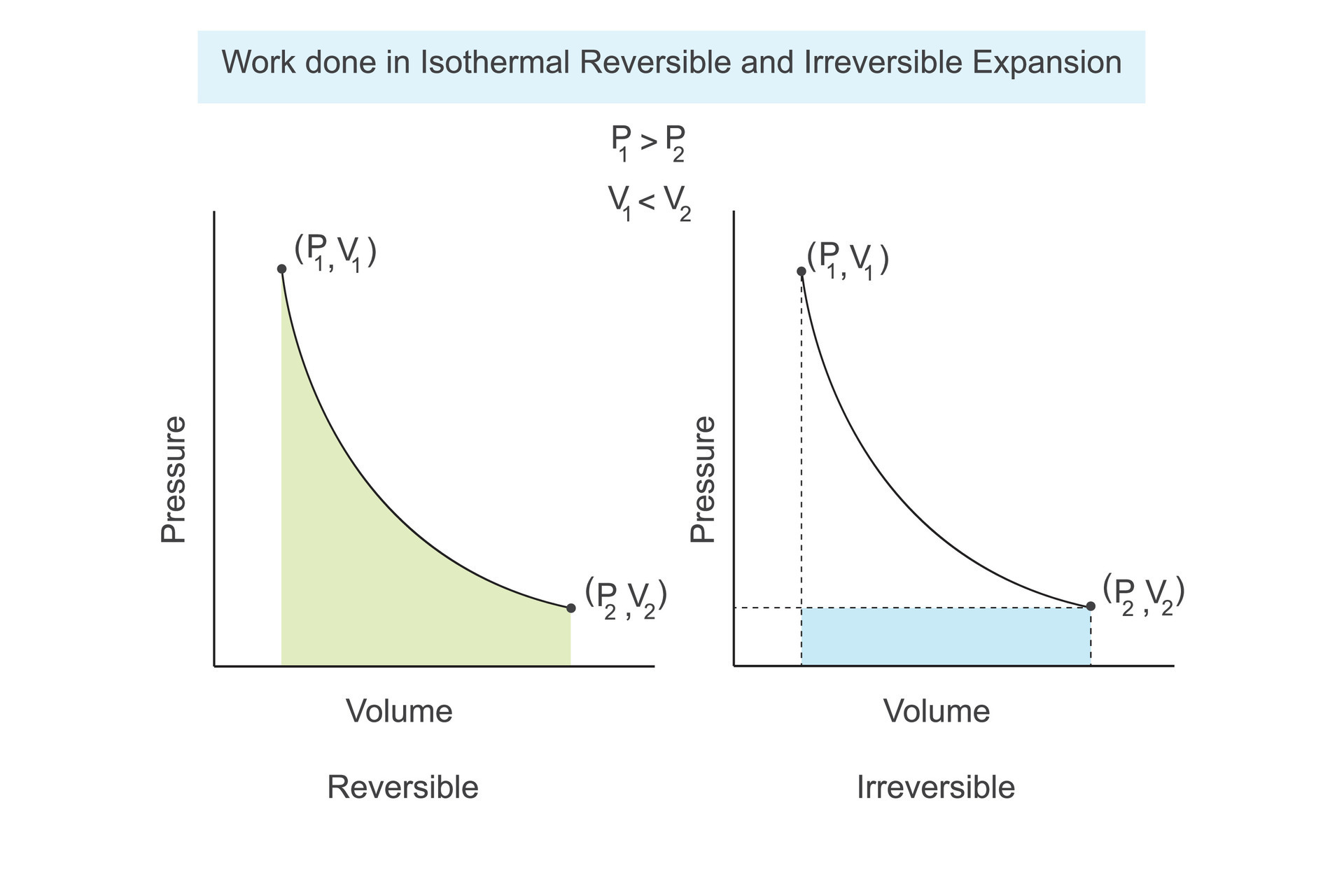
Look closely at the two diagrams:
-
Reversible Expansion (Left Diagram): The process moves slowly from state 1 to state 2, following the smooth curve. Because the external pressure is always just infinitesimally below the internal gas pressure, the work done is the entire area under that curve. This is the maximum possible area you can get between V1 and V2.
-
Irreversible Expansion (Right Diagram): Here, we imagine just suddenly dropping the external pressure to its final value, , and letting the gas expand against that constant low pressure. The piston shoots from V1 to V2. The work done is simply the constant external pressure times the change in volume: . This corresponds to the much smaller rectangular shaded area.
The difference in area between the two graphs is the "lost work". It’s the potential to do work that was wasted because of the irreversible nature of the rapid expansion.
The Same Logic for Compression
Now let's think about going backward, from state 2 to state 1. We need to put work in to compress the gas. Our goal is to use the least amount of work possible.
-
Reversible Compression: We would slowly add sand grains, tracing the exact same curve from right to left. The work we have to do is, again, the area under the curve. We are always pushing with just enough force to overcome the gas pressure, and no more. This is the minimum required work.
-
Irreversible Compression: To do it quickly, we'd have to slam a big weight on the piston, instantly raising the external pressure to the high final pressure, . We would then be pushing with that high pressure all the way from V2 to V1. The work input would be a large rectangle with height and width . This is significantly more work than the area under the curve.
This next video does a great job of walking through the pressure arguments for both expansion and compression.
Comparison of work done between reversible and irreversible expansion & compression of a gas.
This video, while a bit more technical, clearly explains why the external pressure determines the work done and how it differs between reversible and irreversible cases.
Please watch these three segments: Reversible Expansion (1:56 - 4:09): Notice how P_external is always high. Reversible Compression (8:07 - 10:20): Notice how P_external is kept as low as possible. Conclusion (12:11 - 14:12): This summarizes the key results perfectly.
Test your understanding!
Imagine you have two identical springs.
- Case 1 (Reversible): You slowly, gently compress the first spring by turning a crank.
- Case 2 (Irreversible): You compress the second spring by hitting it with a hammer.
Which process requires more work input from you and why? How does this relate to gas compression?
Show answer
Hitting the spring with a hammer (Case 2) requires more work. When you hit it, not only do you have to do the work to compress the spring, but a lot of your energy is wasted creating vibrations, sound, and heat in the spring material. This wasted energy is due to the irreversibility of the rapid impact.
The slow crank (Case 1) is like a reversible process. All your energy goes directly into the potential energy of the spring, with minimal energy wasted. This is the minimum work required.
This is a perfect analogy for gas compression. Compressing a gas quickly with a large force (like the hammer) creates turbulence and internal friction, wasting energy as heat. Compressing it slowly and reversibly avoids these dissipative effects, requiring the minimum possible work input.
Let's See It with Numbers
Let's solidify this with a concrete example.
Problem:
One mole of an ideal gas is kept at a constant temperature of 400 K. It expands from an initial volume of 10 liters to a final volume of 20 liters. Calculate the work done in two different ways:
a) The expansion is done reversibly.
b) The expansion is done irreversibly against a constant external pressure of 166.2 kPa (this is the final pressure the gas will have after its reversible expansion).
Given:
- mole
- K (Isothermal)
- L = 0.01 m³
- L = 0.02 m³
- Gas constant, J/(mol·K)
Solution:
Part a) Reversible Isothermal Expansion
- Concept: For a reversible isothermal process, we use the formula we derived in a previous module. The pressure is changing continuously, so we have to integrate.
- Formula:
- Calculation:
- This is the maximum work we can possibly get from this expansion.
Part b) Irreversible Expansion against Constant Pressure
- Concept: The gas is expanding against a constant external pressure. The work done is simply this opposing pressure times the volume change.
- Formula:
- Given:
- Calculation:
Comparison:
The reversible process yielded 2304 J of work, while the irreversible one only gave 1662 J. The "lost work" due to irreversibility is J. This energy wasn't destroyed; it was simply not converted into useful work and remained within the gas (or was dissipated as heat), resulting in a different final state than a comparable adiabatic expansion.
Key Takeaways
Excellent work today. This concept is subtle but incredibly powerful. It forms the foundation for understanding the limits of all real-world energy conversion devices.
- Maximum Work Output: A process that produces work (like an expanding gas) delivers the maximum possible work when it is done reversibly. This is because the system is always pushing against the maximum possible opposing force.
- Minimum Work Input: A process that requires work (like compressing a gas) needs the minimum possible work when it is done reversibly. This is because you only need to apply the bare-minimum force required at each step.
- Irreversibility = Lost Opportunity: Irreversibilities like friction and turbulence are the culprits. They dissipate energy that could have been used for work, or they force you to do extra work to overcome them.
Preview of the Next Lesson
We've done it! We've established what a perfect process is (reversible) and why it's the benchmark for performance (max work out / min work in).
Now, we can finally assemble these perfect building blocks to create the perfect engine. In the next lesson, we will introduce the Carnot Cycle, an engine cycle composed entirely of four special reversible processes. By analyzing this ideal engine, we will derive a simple and profound formula for the absolute maximum efficiency any heat engine can ever achieve.