Hello again! I hope you're ready for our next step.
Last time, we figured out how to measure the performance of engines and refrigerators using efficiency and the Coefficient of Performance (COP). We saw that real-world engines can't be 100% efficient, and refrigerators can have COPs greater than one. This naturally leads to a huge question for any engineer: If we can't be perfect, what's the best we can possibly do? What is the theoretical limit—the ultimate speed limit for performance—set by the laws of physics?
To answer that, we first need to imagine a perfect, idealized world. This is the world of reversible processes. All real-world processes, from making coffee to driving a car, are what we call irreversible.
In this lesson, our entire focus is on understanding this fundamental split between the ideal and the real. We will:
- Define what makes a process "reversible" versus "irreversible."
- Identify the specific culprits in the real world—like friction and sudden expansion—that cause irreversibility.
Understanding this distinction is the key to unlocking the secrets of maximum efficiency, which we'll tackle in our next lesson.
The Two Worlds: Reversible vs. Irreversible
Let's start with the core idea. Imagine you watch a movie of a process. If you can run the movie backward and everything looks physically plausible, the process is likely reversible. If the backward movie looks absurd, it's irreversible.
- A movie of a perfect, frictionless pendulum swinging back and forth looks normal whether played forward or backward. This is the essence of a reversible process.
- A movie of a glass falling off a table and shattering looks normal. But if you play it backward, you see a pile of shards magically leap up and assemble themselves into a glass on the table. This is absurd. The process is irreversible.
A more formal definition, as explained in the resources we'll look at, is:
A reversible process is one that can be reversed without leaving any trace on the surroundings. After the process is reversed, both the system and the surroundings are returned to their initial states.
An irreversible process is any process that is not reversible. If you restore the system to its original state, you will have left some permanent change in the surroundings (like heat that was generated and lost).
All real processes that happen in the universe are irreversible. Reversible processes are theoretical ideals that we use as a perfect benchmark to measure real processes against.
How to Imagine a Perfect Process: The Quasi-Static Idea
So, if reversible processes don't really exist, how do we even think about them? We use a clever thought experiment called a quasi-static process. The name sounds fancy, but it just means "almost static." It’s a process that happens so incredibly slowly that the system is always in equilibrium.
Let's return to our familiar friend: the gas in a piston-cylinder device.
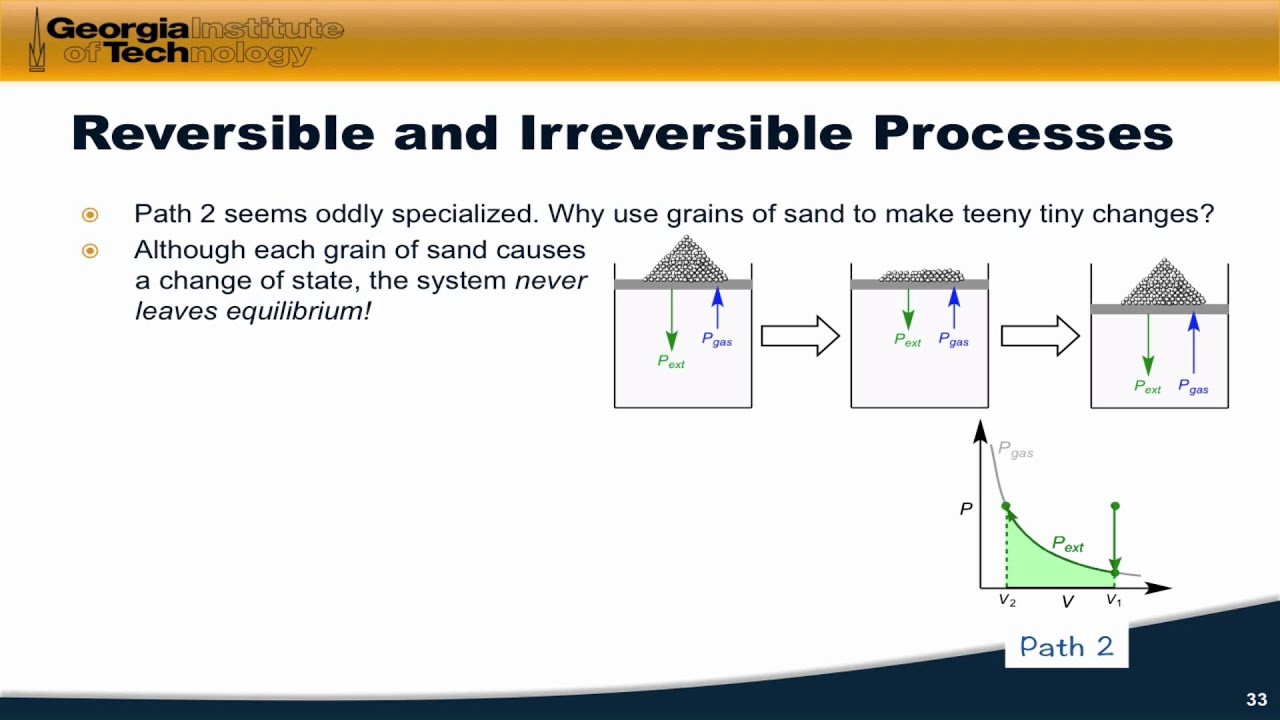
Imagine we have a piston held down by a pile of fine sand, as shown in the diagram above.
- Irreversible (Sudden) Change: If we scoop off half the sand all at once, the pressure outside suddenly drops. The gas inside explodes upward, creating turbulence, pressure waves, and temperature differences. The system is in chaos (non-equilibrium). We know its state at the beginning and the end, but we can't describe what's happening in between.
- Reversible (Quasi-Static) Change: Now, what if we remove just one single grain of sand? The piston will move up an infinitesimally small amount and then settle. The system is barely disturbed. It's always infinitesimally close to equilibrium. If we keep removing one grain at a time, the gas expands slowly and smoothly. We can perfectly define the pressure and volume at every single point along the way, tracing a clear path on a P-V diagram.
This slow, gentle, equilibrium-hugging process is quasi-static. To make it truly reversible, we just have to add one more condition: there must be no friction. If the process is quasi-static AND frictionless, we could reverse it by adding the sand grains back one by one, and both the gas (the system) and the pile of sand (the surroundings) would return to their exact starting states.
To really get the intuition for this, the following video from Khan Academy is one of the best explanations out there.
Quasistatic and reversible processes | Thermodynamics | Physics | Khan Academy
This video, 'Quasistatic and reversible processes,' gives a fantastic intuitive feel for why we need the idea of a quasi-static process and how it relates to reversibility.
Please watch from the beginning to 13:11. Focus on these key points: Why a sudden process (blowing a rock off the piston) leaves you with an undefined path. How the sand grain analogy creates a 'quasi-static' process where the path is defined. The crucial difference between a 'quasi-static' process and a truly 'reversible' one (hint: it involves friction!).
Test your understanding!
You brew a hot cup of tea (the system) and leave it on your desk. It slowly cools down to room temperature.
- Is this process reversible or irreversible?
- To prove your answer, imagine trying to reverse it. What would have to happen to restore the system (the tea) and the surroundings (the air in the room) to their original states? Why is this impossible?
Show answer
- The process is irreversible.
- To reverse the process, the slightly warmer air in the room would have to spontaneously give its heat back to the now-cool tea, making the tea hot again and the air slightly cooler. This would require heat to flow from a cooler object (the room air) to a hotter object (the tea), which, as the Clausius statement tells us, never happens spontaneously. You could reheat the tea on a stove, but that would involve work and change the surroundings in a different way. You can't restore both the tea and the air to their exact starting conditions.
The Culprits: What Causes Irreversibility?
So, if all real processes are irreversible, what are the specific things that make them that way? These "sources of irreversibility" fall into two main categories, as explained in the excellent article "External and Internal Irreversibility" from the journal Resonance.
External and Internal Irreversibility
This article provides a clear, concise breakdown of what causes irreversibility. We'll focus on the section that lists the main culprits.
Please read the short section titled 'Causes of Irreversibilities' on the second page. It's just two paragraphs but it gives us a perfect framework for classifying these effects.
As the article explains, the causes are:
- Lack of Equilibrium: The process is driven by a finite "push" or "gradient."
- Dissipative Effects: Energy that could have been used for work gets "wasted" or dissipated as heat.
Let's break down the most common examples you'll encounter in engineering.
1. Heat Transfer Across a Finite Temperature Difference
This is the most fundamental irreversibility. Heat naturally flows from hot to cold. Your hot coffee cools down, an ice cube in your drink melts. This process always happens in one direction because of the temperature difference (). As we saw in the "Test your understanding" question, you'll never see the room air spontaneously make your coffee hot again. Any time heat moves between two things at different temperatures, an irreversibility occurs. A truly reversible heat transfer would require the temperature difference to be infinitesimally small (), which would make the process take forever.
2. Friction
This is the classic example of a dissipative effect.
- When a car's brake pads rub against the rotor, the car's kinetic energy is converted into thermal energy, heating up the brakes and the air. You can't use that heat to make the car move backward up the hill again.
- When a piston slides in a cylinder, there's always some friction, which generates heat. This is energy that can't be used for work and is lost to the system.
The energy isn't destroyed (First Law!), but it's dissipated into a low-grade, disorganized form (heat) that can't be fully recovered to undo the process.
3. Unrestrained Expansion (Free Expansion)
This is a critical example. Imagine a perfectly insulated container divided in two by a thin wall. One side has a gas, and the other side is a perfect vacuum.
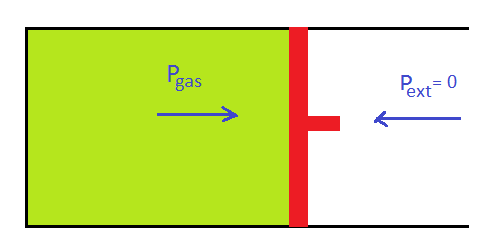
What happens when we remove the barrier? The gas instantly expands to fill the entire container. This is called a free expansion. It is highly irreversible. Why?
- It's a spontaneous, one-way event. The gas molecules will never, on their own, all decide to huddle back in the original half.
- The expansion happens against zero external pressure (), so the gas does no work on its surroundings ().
- Because the container is insulated, no heat is transferred ().
To reverse this, you would need a piston to push the gas back into its original half. This would require you to do work on the gas, compressing it and changing its state (and the state of the surroundings). You can't get back to the start without leaving a trace.
Other Irreversibilities
There are many other examples that follow the same logic:
- Mixing: If you mix milk (or sugar) into coffee, they will never spontaneously un-mix.
- Chemical Reactions: The combustion of gasoline in your car engine is a one-way street. You won't see exhaust fumes and heat turn back into gasoline and oxygen.
- Electrical Resistance: Current flowing through a wire heats it up (I²R heating). That heat won't spontaneously generate a current.
The following resource gives a great summary of these ideas.
This chapter excerpt from an OpenStax textbook reinforces our discussion with more examples of irreversible processes.
Please read the two short sections: 'Reversible Processes' (one paragraph) and the part of 'Introduction to the Second Law...' that discusses irreversibility (starting with 'The second law of thermodynamics deals with the direction...' and ending just before Figure 15.16). This will reinforce the key definitions and provide more everyday examples.
Why Do We Care About an Impossible Ideal?
This is a fair question. If all real processes are irreversible, why do we spend so much time talking about the impossible "reversible" ideal?
The reason is simple: Reversible processes set the upper limit on performance.
Because irreversibilities like friction and heat loss always degrade performance, a real engine will always be less efficient than an ideal, reversible engine operating between the same temperatures.
By studying the performance of a perfect, reversible engine (which we'll do in the next lesson), we establish a "gold standard." We calculate the best-case-scenario efficiency that the laws of nature permit. Then, we can compare the efficiency of our real, irreversible engine to that ideal benchmark to see how much room for improvement there is.
Conclusion
Great job today. This was a purely conceptual lesson, but it's one of the most important in all of thermodynamics. It's the philosophical heart of the Second Law.
Here are our main takeaways:
- Irreversible Processes are all real-world processes. They are spontaneous, one-way events. You can't run the movie backward.
- Reversible Processes are theoretical ideals that happen infinitely slowly (quasi-statically) and without any dissipative effects like friction. They can be reversed without leaving any change in the system or the surroundings.
- The main causes of irreversibility are friction, unrestrained expansion, mixing, and heat transfer across a finite temperature difference.
- We study ideal reversible processes because they act as benchmarks for the maximum possible performance of real engines and refrigerators.
Preview of the Next Lesson
We now have the tool we need to answer our big question. We know that a perfect engine must be built from reversible processes. In our next lesson, we will introduce the most famous theoretical engine in history: the Carnot Cycle. It is an engine built entirely from four special reversible processes, and it will allow us to finally calculate the absolute maximum efficiency for any heat engine.