Hello! It's great to connect again.
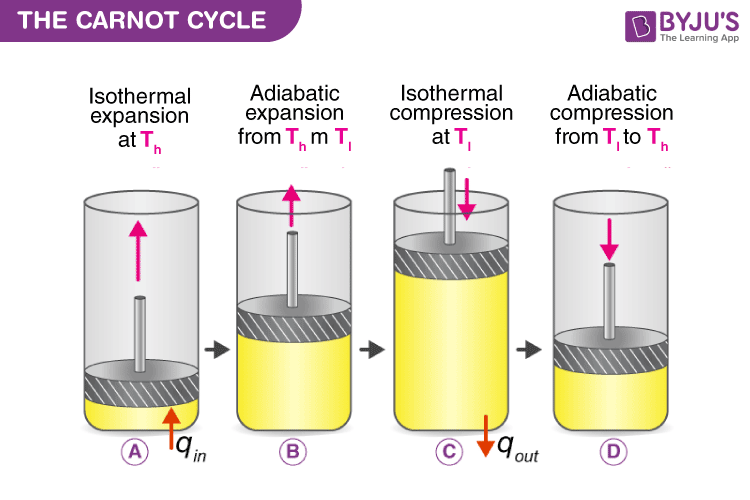
In our last session, we drew the blueprint for the "perfect" engine—the Carnot cycle. We saw how it's built from four carefully chosen reversible processes: two isothermal (constant temperature) and two adiabatic (no heat transfer). We also saw how this cycle looks on a P-V diagram, with the area inside the loop representing the net work we get out.
You might be thinking, "Okay, it's a neat theoretical idea, but what's the big deal?" Today, we're going to answer that question. This lesson is all about the why. Our goal is to explain why the Carnot cycle is the most efficient cycle possible operating between two thermal reservoirs.
This isn't just a small detail; it's a cornerstone of thermodynamics known as Carnot's Principle. Understanding this will show you why there's a fundamental, unbreakable speed limit on how efficiently we can turn heat into work.
The Key to Maximum Efficiency: A Water Wheel for Heat
Before we dive into the formal logic, let's build some intuition. Sadi Carnot himself used a brilliant analogy: a water wheel.
Heat Engines: the Carnot Cycle
This article from the University of Virginia uses a great analogy to explain Carnot's original thinking. It compares a heat engine to a water wheel, which makes the idea of efficiency much more intuitive.
Read the section titled 'Carnot’s Idea: a “Water Wheel” for Heat'. Focus on how the 'fall' of water is analogous to the 'drop' in temperature and what it means for a water wheel to be 'efficient'.
As you just read, think about it this way:
- A water wheel gets work from water falling from a high elevation to a low one. The potential energy of the water is converted into work.
- A heat engine gets work from heat "falling" from a high temperature () to a low temperature ().
What makes a water wheel inefficient? If water splashes over the side, or if it hits the paddles violently and creates a lot of turbulence instead of a smooth push. The most efficient water wheel would have water entering smoothly at the top and leaving gently at the bottom, with no wasted motion or splashing.
Carnot realized the same must be true for a heat engine. To be perfectly efficient:
- Heat must enter "gently" from the hot source, meaning the gas should be at the same temperature as the source (). This is the isothermal expansion.
- Heat must be rejected "gently" to the cold sink, meaning the gas should be at the same temperature as the sink (). This is the isothermal compression.
- The process of the gas temperature dropping and rising between and must happen without any "splashing" of heat to the outside. This means it must be insulated—the adiabatic expansion and compression.
Any friction, or any heat transfer across a large temperature difference (like putting a room-temperature object on a hot stove), is like "splashing" heat. It's an irreversibility that wastes the potential to do work. The Carnot cycle is the only cycle built entirely of non-splashing, perfectly smooth, reversible processes. That's the intuitive reason it's the most efficient.
The Proof: A Thought Experiment
Now, let's prove this logically. We're going to use a classic method called "proof by contradiction." It's like playing detective. We'll assume something impossible is true, follow the consequences logically, and show that it leads to an absurd result that breaks a fundamental law of nature.
The Setup:
Imagine we have our two reservoirs, one hot at and one cold at .
- We have a Carnot Engine (C), which is reversible. Run it as a normal engine. It takes in heat from the hot reservoir, produces work , and rejects heat to the cold reservoir.
- Now, let's imagine an inventor brings us a new engine, the "Impossible" Engine (I). They claim it's more efficient than our Carnot engine, even though it operates between the same two temperatures, and .
The Assumption: The efficiency of engine I is greater than the efficiency of engine C.
The Experiment:
Let's hook these two engines together in a clever way. We will run the "Impossible" Engine I forward to produce work. We'll then use that exact amount of work to run the Carnot engine C in reverse. Remember, since the Carnot engine is reversible, running it backward turns it into a refrigerator or heat pump.
Let's say Engine I produces work . We use this work to power the Carnot refrigerator. So, .
Now let's analyze the heat flows.
From the definition of efficiency, . Our assumption means:
For this to be true, the denominator on the left must be smaller than the denominator on the right.
This is a crucial step! It means our "Impossible" engine needs to draw less heat from the hot reservoir to produce the same amount of work as the Carnot engine.
The Combined Machine:
Now, let's look at the two engines coupled together as one single device.
- Work: The net work is zero. Engine I produces , and the Carnot Refrigerator consumes . No work enters or leaves our combined machine.
- Heat at : Engine I takes from the hot reservoir. The Carnot Refrigerator dumps into the hot reservoir. The net heat transfer at the hot reservoir is . Since we found that , this is a positive number. So, our combined machine delivers a net amount of heat to the hot reservoir.
- Heat at : By the first law (), the net heat taken from the cold reservoir is . This is the same positive number. So, our combined machine takes a net amount of heat from the cold reservoir.
The Verdict (The Contradiction):
Let's recap what our combined machine does. It operates in a cycle, and its only effect on the surroundings is to take a certain amount of heat from the cold reservoir at and transfer that exact amount of heat to the hot reservoir at . It does this with zero work input.
This violates the Clausius statement of the Second Law of Thermodynamics, which you'll recall says:
It is impossible for any process to have as its sole result the transfer of heat from a cooler to a hotter body.
Our "Impossible" engine led us to create a device that does exactly this impossible thing! Therefore, our initial assumption must be false. No engine can be more efficient than a Carnot engine.
This leads us to a powerful statement known as Carnot's Theorem.
Carnot Cycle: The Most Efficient Heat Engine Explained
This article provides a very clear statement of Carnot's theorem and its consequences.
Read the sections 'Carnot’s Theorem: The Fundamental Limit' and 'Connection to the Second Law of Thermodynamics'. Pay close attention to why reversibility is key and the statement about all reversible engines.
The Profound Consequences of Carnot's Principle
This proof reveals two incredible facts:
- No heat engine operating between two heat reservoirs can be more efficient than a reversible Carnot engine operating between the same two reservoirs. This establishes the Carnot cycle as the absolute, unbeatable benchmark.
- All reversible heat engines operating between the same two reservoirs have the same efficiency. This is amazing! It doesn't matter if you use an ideal gas, steam, or some exotic fluid. It doesn't matter if the engine is a piston-cylinder or a turbine. If it's reversible and operates between and , its efficiency is exactly the same—it's the Carnot efficiency. This tells us that the maximum possible efficiency depends only on the temperatures you're working with, not on the substance or machine design.
Test your understanding!
An inventor comes to you with a proposal. She says, "I've designed a revolutionary new car engine that operates between a combustion temperature of 1200°C and an exhaust temperature of 400°C. My engine is 65% efficient!"
A standard Carnot engine operating between these temperatures has an efficiency of about 54%. Without questioning her engineering skills, why can you be certain her claim is impossible based on the principles we've just discussed?
Show answer
Her claim violates the Second Law of Thermodynamics. Carnot's principle proves that no engine can be more efficient than a reversible Carnot engine operating between the same two temperatures.
Her claimed efficiency of 65% is higher than the maximum possible theoretical efficiency of 54% for those temperatures. Therefore, her engine is impossible. It would be like claiming to have built a car that can go faster than the speed of light—it violates a fundamental law of the universe.
Key Takeaways
This was a big conceptual step, so let's pause and summarize.
- The Carnot cycle is the most efficient possible heat engine because it is constructed entirely from reversible processes.
- Any source of irreversibility (like friction or heat transfer across a finite temperature difference) acts like "splashing" heat, reducing an engine's efficiency below the Carnot ideal.
- We proved this using a thought experiment: an engine more efficient than a Carnot engine could be used to create a machine that violates the Clausius statement of the Second Law.
- A major consequence is Carnot's Theorem: No engine can be more efficient than a reversible one, and all reversible engines operating between the same two temperatures have the same maximum efficiency.
Preview of the Next Lesson
We have now established that the Carnot cycle is the most efficient and why. We also know this maximum efficiency depends only on the temperatures and .
But what is the actual formula? In our next lesson, we will get our hands dirty with the math. We will analyze the heat and work transfers for each of the four steps in the Carnot cycle and derive the famous Carnot efficiency formula: . This will give us the exact tool to calculate the ultimate speed limit for any heat engine.