Hey there! Welcome back.
In our last chat, we made a huge conceptual leap. We established, through a neat thought experiment, that the Carnot cycle is the "undisputed champion" of heat engines. We proved Carnot's Principle: no engine operating between two temperatures, a hot one () and a cold one (), can be more efficient than a reversible Carnot engine.
We also discovered something amazing: all reversible engines working between the same and have the exact same efficiency, regardless of what's inside them (air, steam, etc.). This told us that this maximum possible efficiency must be a function only of those two temperatures.
Today, our goal is to find that function. We're moving from the "why" to the "how much." We will derive the famous Carnot efficiency formula, . This formula is like the universe's speed limit for turning heat into work. Let's get to it.
The Missing Link: Tying Heat to Temperature
So, how do we connect the efficiency, which we know involves heat (), to temperatures? The key is a brilliant idea from Lord Kelvin that led to the creation of the thermodynamic temperature scale.
Let's start with what we know. For any reversible engine operating between and , the efficiency is the same.
Since only depends on the temperatures, it must be that the ratio for a reversible cycle also depends only on the temperatures. We can write this as:
Our mission is to figure out what this function, , looks like. To do this, let's use another clever thought experiment involving three heat reservoirs and three reversible engines.
Take a look at this diagram. It's the key to the whole puzzle.

Let's break down what's happening in the diagram:
- Engine A operates between and . Based on our rule, the heat ratio is: .
- Engine B operates between and . Its heat ratio is: .
- Engine C is equivalent to A and B combined. It operates between and . Its heat ratio is: .
Now for a little bit of simple algebra. Notice that:
If we substitute our temperature functions into this equation, we get a purely mathematical relationship:
This is a huge clue! We need to find a function that behaves this way. The simplest function that fits this pattern is a ratio. Lord Kelvin proposed that the function could be written as the ratio of some new property, let's call it , that depends only on temperature:
Let's check if this works: . Yes, it works perfectly!
Kelvin then made the most elegant and simple choice for this function . He just defined it as the temperature itself, . This new scale, where the ratio of heat transfers equals the ratio of temperatures, is the absolute thermodynamic temperature scale, which we now call the Kelvin scale.
So, by definition, for any reversible cycle:
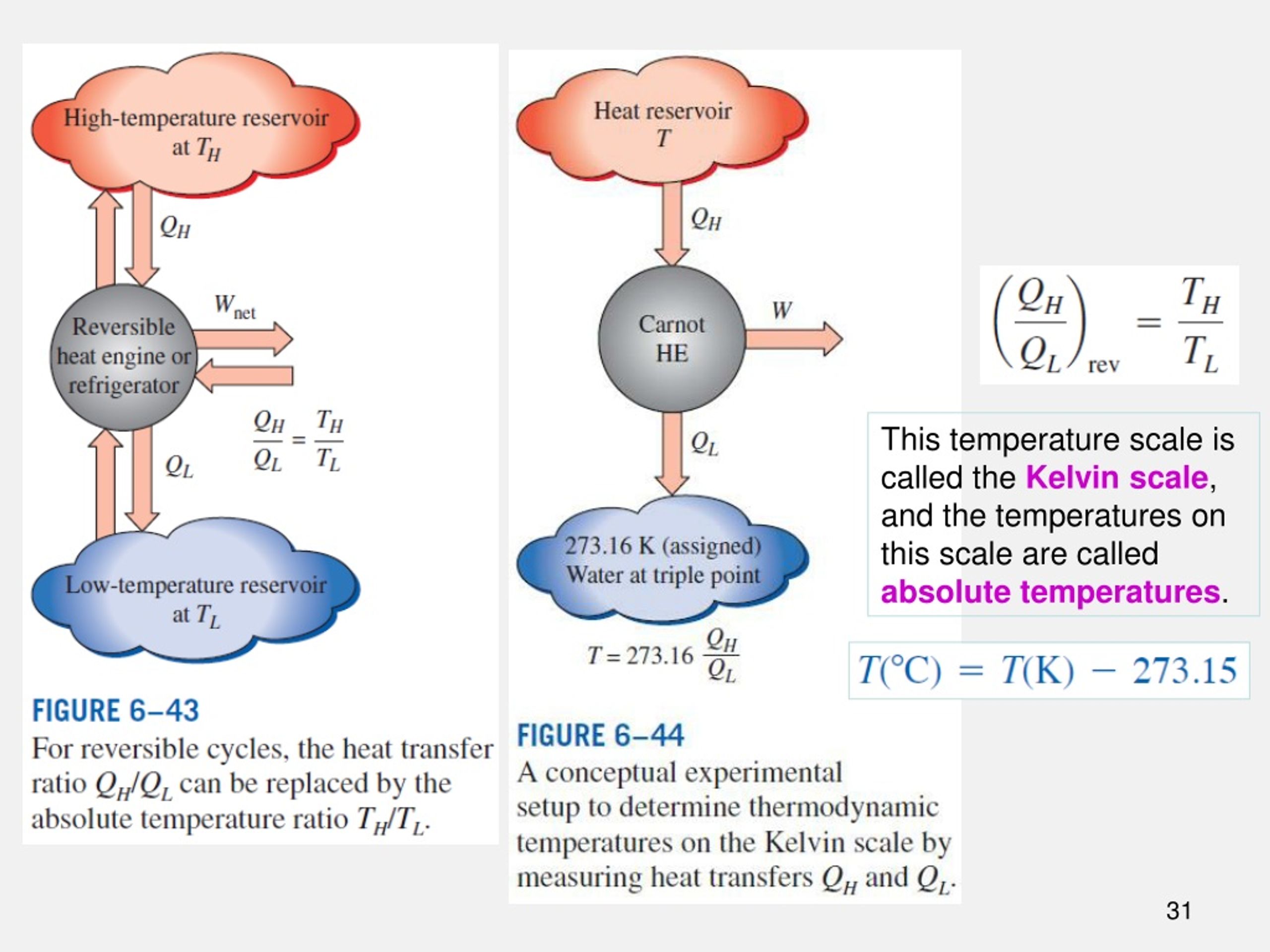
This is an incredibly powerful result. It creates a direct, fundamental link between the abstract idea of heat transfer in an ideal engine and the temperatures we can measure.
The Final Step: Deriving the Efficiency Formula
With that brilliant insight from Kelvin, the rest is straightforward. We're at the finish line.
-
Let's start with the general definition of thermal efficiency for any heat engine:
-
We know that for a reversible engine (like a Carnot engine), this efficiency is the maximum possible. So we'll call it :
-
And we just established the definition of the thermodynamic temperature scale, which gives us the value of that ratio:
-
Now, we simply substitute the temperature ratio into the efficiency equation:
And there you have it! This is the celebrated Carnot efficiency formula.
Why This Formula is So Important
Let's pause and appreciate what this equation tells us.
- Use Absolute Temperatures! This is non-negotiable. The entire derivation is based on the Kelvin scale, which starts at absolute zero. If you plug in Celsius or Fahrenheit, your answer will be completely wrong. Always convert your temperatures to Kelvin (or Rankine, the English absolute scale) first.
- How to Get More Efficient: The formula clearly shows two paths to higher efficiency:
- Increase the high temperature, . (Make the "waterfall" taller).
- Decrease the low temperature, . (Lower the point where the "water" lands).
- The 100% Efficiency Myth: The only way for to equal 1 (100%) is if K (absolute zero). Since reaching absolute zero is physically impossible, this formula confirms that no heat engine can ever be 100% efficient. This is another powerful statement of the Second Law of Thermodynamics.
Putting the Formula to Work
Let's solidify this with some practical examples.
Worked Problem 1
A steam power plant, like the ones that generate most of our electricity, operates with a high-temperature boiler producing steam at 400°C. It uses a nearby river at 25°C to cool the condenser. What is the absolute maximum theoretical efficiency of this power plant?
-
Step 1: Convert temperatures to Kelvin. Remember, .
- K
- K
-
Step 2: Apply the Carnot efficiency formula.
-
Step 3: Calculate the result.
So, the maximum possible efficiency is 55.7%. -
Discussion: In reality, due to friction, heat loss, and other irreversibilities, a real power plant with these temperatures would be lucky to achieve an efficiency of 40-45%. The Carnot efficiency simply tells us the theoretical ceiling they can never surpass.
Worked Problem 2
An engineer is designing a futuristic engine that operates between a ceramic combustion chamber at 1600 K () and an exhaust temperature of 400 K (). The engine needs to produce 500 kW of useful power. What is the minimum rate of heat energy () that must be supplied to the engine from the combustion?
-
Step 1: Find the maximum possible efficiency.
The theoretical maximum efficiency is 75%. -
Step 2: Use the definition of efficiency to find .
To find the minimum required heat input, we assume the engine is perfect and achieves the maximum possible efficiency. -
Step 3: Calculate the result.
-
Discussion: This means that to get 500 kW of work, we must supply at least 666.7 kW of heat. The remaining 166.7 kW is unavoidably dumped as waste heat () to the environment, even for a "perfect" engine. A real engine would be less efficient and require even more than 666.7 kW of heat.
Test your understanding!
Conceptual Question 1: An inventor claims to have built an engine that takes in heat from boiling water (100°C) and rejects waste heat to a bucket of ice water (0°C). He claims his engine is 30% efficient. Is this claim credible? Why or why not?
Show answer
Let's check the maximum possible efficiency.
First, convert temperatures to Kelvin:
K
K
Now, calculate the Carnot efficiency:
or 26.8%.
The inventor's claim of 30% efficiency is higher than the maximum theoretical limit of 26.8%. Therefore, his claim is not credible. It violates the Second Law of Thermodynamics.
Test your understanding!
Conceptual Question 2: Consider a power plant with K and K. Which of the following two changes would improve the plant's maximum theoretical efficiency more?
(a) Increasing by 50 K (to 650 K).
(b) Decreasing by 50 K (to 250 K).
Show answer
Let's calculate it.
The original efficiency is (or 50%).
(a) Increase : (or 53.8%). An improvement of 3.8%.
(b) Decrease : (or 58.3%). An improvement of 8.3%.
Decreasing the cold reservoir temperature by 50 K has a much larger impact on efficiency than increasing the hot reservoir temperature by the same amount. This is a very practical result! It highlights why power plants are often located near cold bodies of water and why they are more efficient on cold winter days than hot summer days. The "cold side" of the equation is just as important, if not more so, than the "hot side."
Key Takeaways for Today
Fantastic work today! This was a big one. Let's recap the main points:
- We connected heat transfer and temperature by defining the thermodynamic temperature scale (Kelvin scale), where for a reversible cycle, the ratio of heat rejected to heat absorbed is equal to the ratio of their absolute temperatures: .
- Using this key relationship, we derived the Carnot efficiency formula: .
- This formula gives the unbreakable "speed limit" for the efficiency of any heat engine operating between two temperature reservoirs.
- The formula underscores the importance of a large temperature difference () and confirms that 100% efficiency is impossible.
- Crucially, you must always use absolute temperatures (Kelvin or Rankine) in this formula.
Preview of the Next Lesson
We now have a complete picture of the ideal heat engine. But what about the devices that do the opposite? Refrigerators and heat pumps use work to move heat from a cold place to a hot place. How do we measure their performance?
In our next session, we'll turn the Carnot cycle on its head. We will define a new performance metric called the Coefficient of Performance (COP) and derive the maximum possible COP for ideal refrigerators and heat pumps. This will round out our understanding of ideal thermodynamic cycles. See you then