Welcome to our next lesson. In our previous session, we established the language of performance by defining core marketing metrics like CTR, CAC, and ROAS. These numbers are essential for measuring the effectiveness of your campaigns. But how do these isolated metrics fit into a cohesive strategy that turns strangers into loyal customers?
This lesson introduces the framework that connects all your marketing activities and metrics: the marketing funnel. We will explore its purpose as a strategic model for the customer journey. You will learn to identify the key stages of the funnel, from initial awareness to post-purchase loyalty, and, crucially, how to map different digital marketing channels to each of these stages. Understanding this concept is fundamental to building strategic, goal-oriented marketing plans for your future freelance clients.
What is a Marketing Funnel?
At its core, a marketing funnel is a model that visualizes the path a potential customer takes from first learning about your brand to making a purchase and beyond. Imagine a physical funnel: it's wide at the top, capturing a large volume, and narrows towards the bottom, guiding a smaller, more focused stream. In marketing, many people may become aware of a brand at the top, but only a fraction will move through the entire process to become customers.
The purpose of the funnel is to provide a structured strategy, allowing you to deliver the right message through the right channel at the right time.
The Customer Journey & the Marketing Funnel | Google Digital Marketing & E-commerce Certificate
To start, let's watch this short video from the Google Career Certificates channel. It provides an excellent introduction to the marketing funnel concept.
Watch from the beginning to the end of the section comparing funnels and journey maps. Pay close attention to how it defines the four basic stages—Awareness, Consideration, Conversion, and Loyalty—and clarifies the difference between a business-centric funnel and a customer-centric journey map.
As the video explained, while a customer's journey can be complex and non-linear, the funnel gives us, as marketers, a simplified, linear model to plan and measure our efforts.

The Stages of the Funnel and Their Channels
While simple four-stage models are a great starting point, a more detailed funnel can provide greater strategic clarity. A comprehensive model not only includes the path to purchase but also what happens after the sale—crucial stages for building a sustainable business with high Customer Lifetime Value (LTV), a metric we discussed in our last lesson.
Let's explore a more granular, six-stage funnel.
Digital Marketing Funnel: A Complete Guide & How-To
This article from Aksel Digital provides a detailed breakdown of a modern marketing funnel, complete with goals and tactics for each stage. It's a great reference for understanding the "what" and "how" of each phase.
Please read the section titled "Marketing Funnel Stages Explained." For each of the six stages (Awareness, Interest, Consideration, Action, Retention, Advocacy), focus on understanding its primary Goal and the Key Tactics (which are your marketing channels and content types).
Let's synthesize what you've just read and connect it back to our metrics from the previous lesson.
1. Top of Funnel (TOFU): Awareness & Interest
- Goal: Attract a broad audience and make them aware of a problem and your brand as a potential solution. Then, capture their interest with engaging content.
- Customer Mindset: "I have a problem, and I'm looking for information." or "This looks interesting, I'll learn more."
- Channels & Tactics:
- SEO & Content Marketing: Blog posts, articles, and infographics that answer common questions.
- Social Media: Engaging posts, short-form videos (Reels, TikToks), and sharing content to reach new audiences.
- Paid Ads (Search & Social): Ads targeted at broad interests or keywords to maximize reach.
- Relevant Metrics: Impressions, Reach, Website Traffic, Click-Through Rate (CTR).
2. Middle of Funnel (MOFU): Consideration
- Goal: Nurture the leads you've captured. Build trust and help them evaluate your offer as the best solution among competitors.
- Customer Mindset: "I'm comparing different options to solve my problem. Which one is the best fit for me?"
- Channels & Tactics:
- Email Marketing: Nurture sequences with educational content and case studies.
- Webinars & Demos: In-depth presentations that showcase your expertise and product.
- Case Studies & Testimonials: Social proof that demonstrates your value.
- Retargeting Ads: Reminding people who visited your site about your products.
- Relevant Metrics: Email Open/Click Rate, Lead Magnet Downloads, Time on Page.
3. Bottom of Funnel (BOFU): Action (or Conversion)
- Goal: Persuade the qualified lead to take the final step and make a purchase or sign up.
- Customer Mindset: "I'm ready to buy. Is this a good deal? Is it easy to do?"
- Channels & Tactics:
- High-Intent Landing Pages: Pages designed specifically for conversion.
- Limited-Time Offers & Discounts: Creating a sense of urgency.
- Free Trials: Allowing users to experience the product before buying.
- Strong Calls-to-Action (CTAs): Clear, direct buttons like "Buy Now" or "Sign Up."
- Relevant Metrics: Conversion Rate, Customer Acquisition Cost (CAC), Return on Ad Spend (ROAS).
4. Post-Funnel: Retention & Advocacy
- Goal: Turn one-time customers into repeat buyers and loyal fans who promote your brand for you.
- Customer Mindset: "I'm happy with my purchase. What else do they have?" or "My friends should know about this!"
- Channels & Tactics:
- Personalized Email Marketing: Post-purchase follow-ups, product recommendations.
- Loyalty Programs: Rewarding customers for repeat business.
- Referral Programs: Incentivizing customers to spread the word.
- Excellent Customer Support: Building trust and goodwill.
- Relevant Metrics: Customer Lifetime Value (LTV), Customer Retention Rate, Referral Rate.
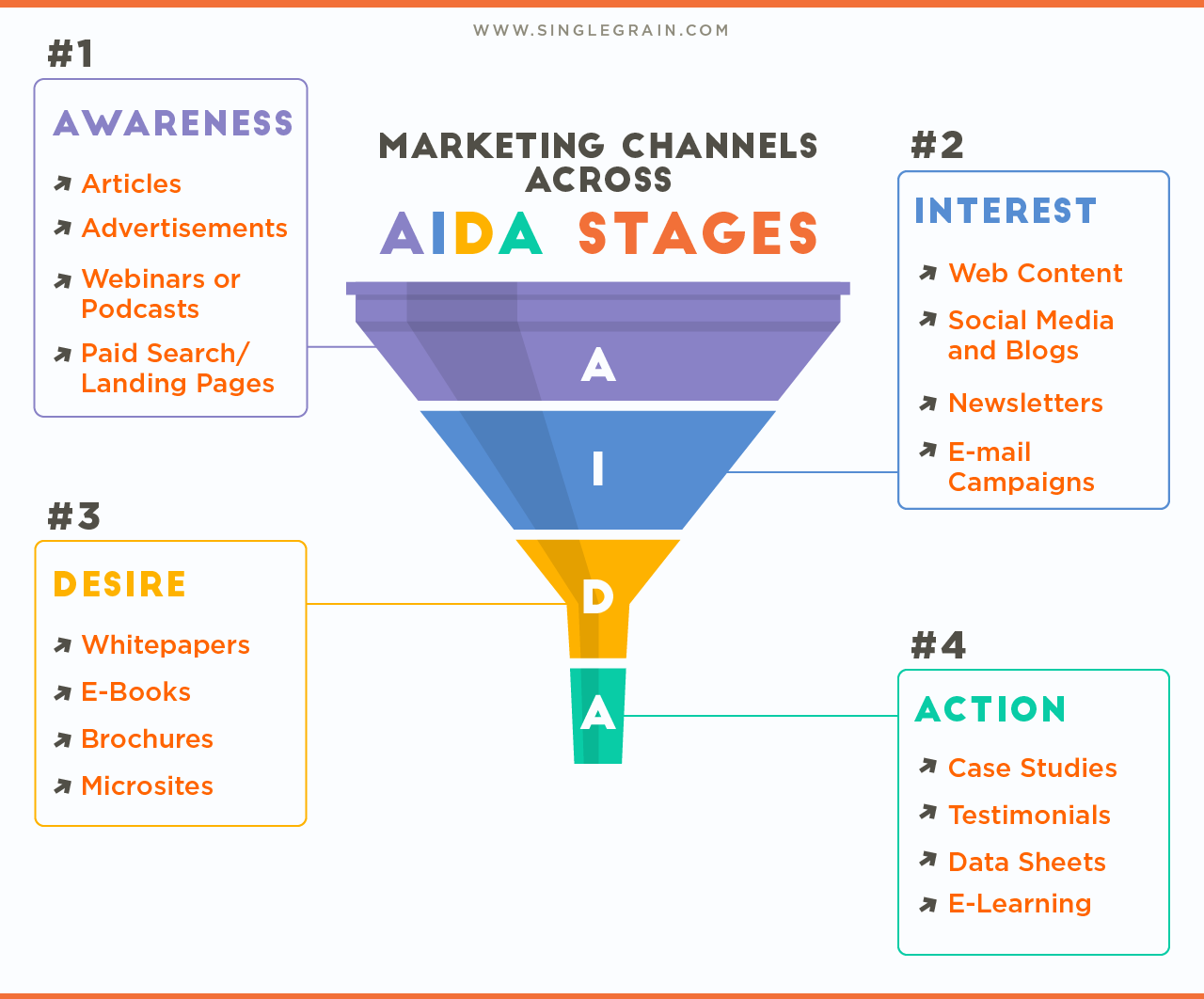
This infographic shows a slightly different but very common model called AIDA (Awareness, Interest, Desire, Action) and maps various content types to each stage, reinforcing the same core principle.
A Real-World Example: The Funnel in Action
Theory is great, but seeing how a successful brand applies these principles is even better. Warby Parker, the eyewear company, is a master of creating content for every stage of their marketing funnel.
How to Build a Marketing Funnel that Actually Works for your Business
This video from HubSpot uses Warby Parker as a case study to demonstrate a perfectly executed marketing funnel.
Watch the section from the start of the Warby Parker example. Notice how they use different types of content and features—from blog posts to a virtual try-on tool—to move customers from one stage to the next.
As you saw, Warby Parker doesn't just create random content. Their blog posts create Awareness, their home try-on kits facilitate Consideration, and their easy checkout process with a first-time buyer discount drives Action. It's a deliberate, strategic system.
Your Turn: Mapping a Funnel
Now it's time to apply what you've learned. As a freelancer, you will often be asked to create a marketing plan from scratch. A funnel map is the perfect starting point for this task.
[PDF] Funnel Mapping Worksheet - Digital Marketing Success Plan
This worksheet from TheDMSP.com is a simple yet powerful tool for planning a marketing funnel. It provides a clear structure for brainstorming tactics, content, and metrics for each stage.
Take a moment to review the entire worksheet (pages 2-5). You don't need to fill it out yet, just familiarize yourself with the sections for Awareness, Consideration, Decision, and Retention & Advocacy.
Let's walk through a thought exercise using the local fitness studio example mentioned in one of our resources. How would we fill out this worksheet?
-
1. Awareness (Top of Funnel)
- Goal: How will you generate interest in your brand?
- Answer: Make locals aware that a friendly, accessible fitness studio is nearby.
- Primary Tactics: Paid Digital Ads (Google & Facebook), SEO & Blog Content.
- Key Content Pieces: A Facebook ad targeting people interested in "fitness" within a 5-mile radius. A blog post titled "5 Beginner-Friendly Workouts You Can Do Today."
- Key Metrics: Ad Impressions, CTR to the website, Website Traffic from organic search.
- Goal: How will you generate interest in your brand?
-
2. Consideration (Middle of Funnel)
- Goal: How will you nurture leads and provide value?
- Answer: Show them that our classes are effective and our community is welcoming.
- Primary Tactics: Email Marketing, Retargeting Ads.
- Key Content Pieces: An email sequence sharing client testimonials. A retargeting ad on Instagram showing happy members with the caption "Your fitness journey is one click away."
- Key Metrics: Email Open Rate, Landing Page Conversions (for a lead magnet like a "Free Workout Plan PDF").
- Goal: How will you nurture leads and provide value?
-
3. Decision (Bottom of Funnel)
- Goal: What actions will convert leads into customers?
- Answer: Make it irresistible and easy for them to sign up for their first class or a trial membership.
- Primary Tactics: Limited-Time Offers, Customer Testimonials.
- Key Content Pieces: A landing page with a "Get Your First Week Free!" offer. Testimonial videos on the sign-up page.
- Key Metrics: Conversion Rate (trial sign-ups), Customer Acquisition Cost (CAC).
- Goal: What actions will convert leads into customers?
-
4. Retention & Advocacy (Post-Sale)
- Goal: How will you keep customers engaged and encourage referrals?
- Answer: Make them feel part of a community and reward them for staying and for spreading the word.
- Primary Tactics: Loyalty Programs, Referral Programs.
- Key Content Pieces: A monthly members-only newsletter with health tips. An in-studio sign promoting a "Bring a Friend, Get a Free Class" program.
- Key Metrics: Customer Retention Rate, Customer Lifetime Value (LTV), Net Promoter Score (NPS).
- Goal: How will you keep customers engaged and encourage referrals?
This simple exercise transforms a set of disconnected tactics into a coherent, measurable strategy that guides a customer from "Who are you?" to "I love this place!"
Conclusion
In this lesson, we demystified the marketing funnel and established it as a foundational strategic tool. You now understand that a funnel is not just a theoretical concept, but a practical roadmap for guiding customers through their journey with a business.
Here are the key takeaways:
- Purpose: The marketing funnel provides a structured framework to plan, execute, and measure your marketing efforts, turning strangers into customers and advocates.
- Stages: A comprehensive funnel includes stages for Awareness, Interest, Consideration, Action, Retention, and Advocacy. Each stage has a unique goal and requires a different approach.
- Channel Mapping: Different digital marketing channels and content types are suited for different funnel stages. SEO and social media are great for awareness, while email marketing and retargeting are powerful for consideration and conversion.
- Metrics: The metrics we discussed previously (CTR, CVR, CAC, LTV) are used to measure the performance and health of your funnel at each specific stage.
Now that you have this strategic framework in place, you can begin to think creatively about what to put inside the funnel. In our next lesson, we will do just that, exploring how to use AI tools to brainstorm marketing ideas for each stage, helping you generate effective campaigns for any business.