Hello! In our last lesson, we built a solid strategic foundation by understanding the marketing funnel and how to map different channels to its stages. We saw how a business can guide a person from being a stranger to a loyal advocate. Now, we're going to infuse that strategic framework with creativity, powered by one of the most transformative tools in a modern marketer's toolkit: Artificial Intelligence.
This lesson addresses your goal of weaving AI throughout your marketing education. We'll move from the 'what' and 'why' of the funnel to the 'how' of generating compelling marketing ideas for each stage. You will learn how to use AI tools like ChatGPT not as a replacement for your thinking, but as a tireless brainstorming partner that can help you overcome creative blocks, save time, and explore ideas you might not have considered. This is a crucial skill that will make you more efficient and valuable as a future freelancer.
The Foundation: Giving AI the Right Context
The most common mistake people make when using AI is giving it vague instructions and getting generic results. The key to unlocking powerful, relevant ideas is to provide the AI with high-quality, specific context about the business. Think of it as briefing a new team member.
Before you can ask for marketing ideas, you need to compile a "Marketing Knowledge Base" that the AI can draw from. This is simply a collection of essential information about the business.
Let's continue with the local fitness studio example from our last lesson. Here is a sample "Knowledge Base" we could give to an AI:
Business Profile: "Urban Strength Fitness"
- Business Name: Urban Strength Fitness
- Business Description: A boutique fitness studio located in a dense urban neighborhood. We offer small group classes (HIIT, Yoga, Strength) and personal training. We are not a big-box gym; we focus on community and personalized attention.
- Target Audience: Young professionals (ages 25-40) living within a 2-mile radius. They are busy, health-conscious, and looking for an effective workout and a sense of community. They are often intimidated by large, impersonal gyms.
- Unique Selling Propositions (USPs):
- Small class sizes (max 10 people) for personalized coaching.
- Strong community focus with social events.
- Beginner-friendly environment.
- Marketing Goals:
- Primary: Generate sign-ups for a "First Week Free" trial.
- Secondary: Build brand awareness in the local neighborhood.
- Marketing Budget: Small. We need low-cost, high-impact ideas.
- Brand Voice: Encouraging, energetic, friendly, and inclusive. Not aggressive or intimidating.
With this profile, the AI now has a clear picture of the business and its goals, enabling it to generate much more relevant and strategic ideas.
The Art of the Prompt: How to Ask for What You Want
A good prompt is like a good brief. The better your instruction, the better the result. A simple and effective framework for writing prompts is to include four key elements:
- Role: Tell the AI who it should be (e.g., "Act as an expert digital marketer...").
- Context: Provide the business profile you just created.
- Task: Tell the AI exactly what you want it to do (e.g., "...brainstorm 10 marketing ideas...").
- Constraints: Define the output format and any limitations (e.g., "...focus on low-budget tactics," "...present the ideas in a table.").
Step 1: AI-Assisted Research and Strategy
Before brainstorming specific tactics, you can use AI to understand the competitive landscape and refine your target audience. This ensures your ideas are not just creative, but also strategically sound.
How to Do Market Research with AI (Loop Marketing Express Stage)
This video from HubSpot demonstrates exactly how to use AI prompts for this initial research phase. It shows how to turn raw information into strategic insights.
First, watch the section on analyzing the competition. Notice how the prompt asks the AI to find a gap or an opportunity for differentiation. Next, watch how they use the AI as an ideal customer profiler. This is a powerful way to go from basic demographics to a rich persona with real motivations.
Using AI for this initial research helps you ground your brainstorming in data, which is exactly what a good freelancer does to build effective strategies for their clients.
Step 2: Brainstorming Through the Marketing Funnel
Now, let's combine our marketing funnel knowledge with our AI prompting skills. We'll ask the AI for ideas specific to each stage of the funnel for "Urban Strength Fitness."
We will be referencing prompt structures from a helpful article on LivePlan. It provides excellent templates for various marketing tasks.
17 ChatGPT Prompts for Starting a Business in 2025
This article from LivePlan is a fantastic resource filled with practical, well-structured prompts for marketing. We'll be adapting several of them for our fitness studio example.
Please read the following sections to familiarize yourself with the prompt formats. Focus on the structure of the "Main Prompt" and its "Variations" in each section. The section on how to brainstorm marketing ideas. The section on how to draft blog posts. The section on how to create social media ads.
Now, let's put these prompt structures into practice for each stage of the funnel.
Top of Funnel (TOFU): Building Awareness
Goal: Make local professionals aware that Urban Strength Fitness exists and is a great alternative to big gyms.
Here is a sample prompt you could use:
Act as an expert digital marketer specializing in local businesses.
Here is the context: I run "Urban Strength Fitness," a boutique fitness studio. [Paste the full Business Profile here].
Your task is to brainstorm 5 content marketing ideas to build awareness in my local neighborhood. The ideas should be suitable for a blog and social media.
For your output, please provide a headline for each idea and a brief description of what the content would cover. Focus on topics that would appeal to beginners and address their potential concerns.
Expected AI Output:
- Headline: "5 Myths About HIIT Workouts Debunked (And Why You'll Love It)"
- Description: A blog post that tackles common fears about high-intensity training, making it seem accessible and fun.
- Headline: "A Day in the Life: What It's Really Like at Urban Strength Fitness"
- Description: A short video for social media featuring real members (with permission) sharing their positive experiences.
- Headline: "Meet the Trainers: Our Philosophy on Fitness (and Life!)"
- Description: A series of Instagram posts or a blog article introducing the friendly faces behind the studio, building a personal connection.
- Headline: "Your Ultimate Guide to Finding the Right Gym in [Your City]"
- Description: An SEO-optimized blog post that helps people in the consideration phase, subtly positioning Urban Strength as the ideal choice for those seeking community.
- Headline: "Fuel Your Workout: Top 5 Healthy Lunch Spots Near Our Studio"
- Description: A collaborative post tagging local healthy restaurants, engaging the local business community and providing value to followers.
Middle of Funnel (MOFU): Nurturing Consideration
Goal: Convince people who are aware of the studio to take the next step and see Urban Strength as the right choice for them. We need to build trust and demonstrate value.
Here's a prompt for this stage:
Act as a content strategist.
Context: [Paste Business Profile here].
Your task is to brainstorm 3 ideas for "lead magnets" that would convince my target audience to provide their email address. A lead magnet is a free resource given in exchange for contact info.
For your output, describe each lead magnet and suggest a compelling title for it. The ideas should be easy to create with a small budget.
Expected AI Output:
- Lead Magnet: "Printable 1-Week Workout Planner"
- Title: "Your Free 7-Day Fitness Kickstart Plan"
- Lead Magnet: "At-Home Workout Video"
- Title: "Get the 15-Minute Bodyweight Burn You Can Do Anywhere"
- Lead Magnet: "Healthy Recipe E-book"
- Title: "5 Simple, High-Protein Recipes to Power Your Workouts"
These ideas directly nurture interest and capture leads for your email list, moving people down the funnel.
Bottom of Funnel (BOFU): Driving Action
Goal: Convert interested leads into paying members by encouraging them to sign up for the "First Week Free" trial.
Let's ask the AI to write some ad copy.
Act as a direct-response copywriter.
Context: [Paste Business Profile here].
Your task is to create 3 different ad copy variations for a Facebook ad. The goal of the ad is to get people to sign up for our "First Week Free" trial.
For your output, write a headline and a short body text for each variation. Each variation should test a different angle: one focusing on community, one on convenience, and one on overcoming fear.
Expected AI Output:
- Angle: Community
- Headline: Find Your Fitness Family.
- Body: Tired of working out alone? Join a community that sweats together and celebrates every win. Try your first week at Urban Strength Fitness for FREE!
- Angle: Convenience
- Headline: The Best Workout is the One You Don't Skip.
- Body: Located right in your neighborhood, our quick and effective classes fit into your busy life. Your first week is on us. Claim your free trial today!
- Angle: Overcoming Fear
- Headline: Think You're Not a "Gym Person"? Think Again.
- Body: Our friendly trainers and small classes are designed for YOU, not for elite athletes. Let us show you how fun fitness can be. Start your journey with a free week.
These AI-generated ideas can be used directly for A/B testing to see which message resonates most with your audience.
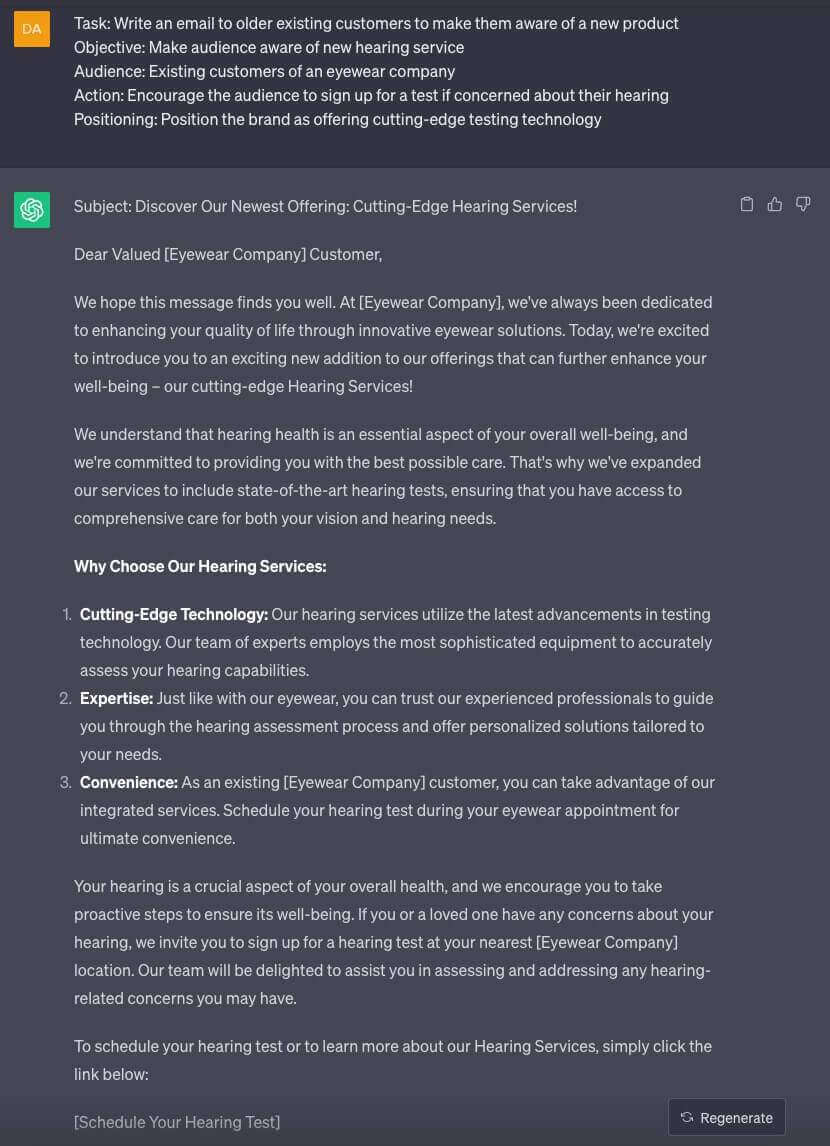
From Idea to First Draft
Brainstorming is just the beginning. The real power of AI is in accelerating the entire content creation process. Once you have an idea you like, you can ask the AI to create a first draft.
Your Turn: Practice Prompting
Now, let's put your skills to the test. Imagine you're a freelancer hired by a new local coffee shop. Here is their business profile:
- Business Name: The Daily Grind
- Business Description: A new coffee shop in a suburban town center. We focus on ethically sourced, high-quality coffee beans and homemade pastries.
- Target Audience: Commuters grabbing coffee on their way to the train station, and local residents/remote workers looking for a cozy place to work or meet friends.
- Unique Selling Propositions (USPs):
- We are the only shop in town offering single-origin pour-over coffee.
- All our pastries are baked fresh in-house daily.
- Our space is designed to be a "third place"—comfortable for both quick stops and long stays, with free, fast Wi-Fi.
- Marketing Goals: Drive foot traffic and build a base of regular customers.
- Brand Voice: Warm, artisanal, knowledgeable, and community-oriented.
Your Task:
Open a free AI tool like ChatGPT, Claude, or Google Gemini. Using the prompt framework we discussed (Role, Context, Task, Constraints), write one prompt for each stage of the marketing funnel for "The Daily Grind":
- TOFU Prompt: Ask for ideas to make the local community aware of the new coffee shop.
- MOFU Prompt: Ask for ideas to build a relationship with people who have visited once or are following on social media.
- BOFU Prompt: Ask for an idea for a special offer to turn a first-time visitor into a regular.
Take 10-15 minutes to experiment. Don't worry about getting it perfect; the goal is to practice interacting with the AI as a creative partner.
Conclusion
Today, you've added a powerful, practical skill to your digital marketing toolkit. You've learned that effective AI-driven brainstorming isn't magic; it's a process of providing clear context and asking smart questions.
Here are your key takeaways:
- Context is King: Always start by giving the AI a detailed business profile or "Marketing Knowledge Base."
- Structure Your Prompts: Use a framework like Role, Context, Task, and Constraints to get specific, high-quality results.
- Brainstorm Through the Funnel: Use AI to generate targeted ideas for every stage of the customer journey, from Awareness to Action.
- AI is a Partner, Not a Replacement: Use AI to generate a volume of ideas and first drafts, but it's your strategic oversight and human touch that will ultimately make a campaign successful.
You have now completed the "Digital Marketing Foundations" module. You've defined digital marketing, identified its core channels and metrics, and learned how to structure campaigns using the marketing funnel.
In our next module, "Audience Research & Strategy," we'll take the concepts from today's lesson even further. We will begin by diving deep into how to conduct professional market and audience research, ensuring the creative ideas you generate are aimed at the right people with the right message.