Hello! In our last lesson, we categorized the digital marketing landscape into paid, owned, and earned media. You learned that paid media, like Google or Facebook ads, is a powerful tool for getting your message out quickly. This raises a critical question for any aspiring freelancer: how do you prove to a client that their money is being well-spent?
This lesson moves from the what to the how much and how well. We will define the essential language of performance marketing by exploring six core metrics: Click-Through Rate (CTR), Cost Per Click (CPC), Conversion Rate, Customer Acquisition Cost (CAC), Customer Lifetime Value (LTV), and Return on Ad Spend (ROAS). Mastering these metrics is the first step toward making data-driven decisions, optimizing campaigns, and demonstrating your value to future clients.
The Language of Performance: Why Metrics Matter
In digital marketing, you can measure almost everything. This is both a blessing and a curse. While data gives us incredible power, it's easy to get lost in a sea of numbers. Our goal is to focus on the metrics that truly indicate business health.
Imagine you're running an ad campaign. You see that it was shown to 100,000 people. That sounds impressive, but what if it didn't lead to a single sale? This is the difference between a "vanity metric" (impressions) and an "actionable metric" (sales). As a freelancer, your clients will hire you to influence the latter.
Marketing metrics explained: how to track performance in 2026
This article from monday.com does an excellent job of distinguishing between metrics that look good on paper and those that actually drive business decisions.
Please read the introduction and the section The difference between metrics and vanity metrics. Pay close attention to the table that contrasts vanity metrics with their actionable alternatives.
The actionable metrics we'll focus on in this lesson are the building blocks for measuring the success of nearly any digital marketing campaign.
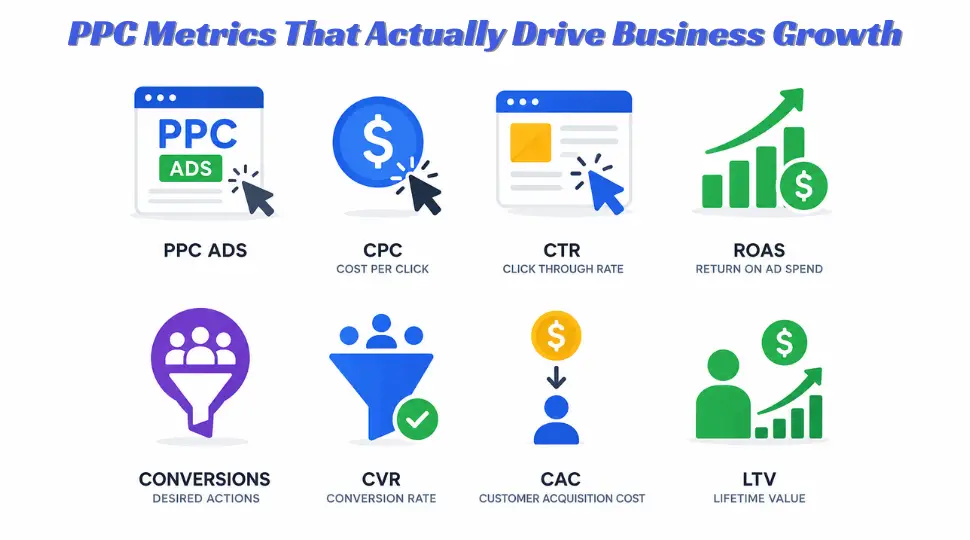
Phase 1: Measuring Engagement and Cost
The first step in any campaign is to get your audience to interact with your content. The following metrics tell us how effective our ads and content are at capturing initial interest and how much that interest is costing us.
Click-Through Rate (CTR)
CTR is the percentage of people who click on your ad, link, or call-to-action after seeing it. It's a primary measure of relevance. A high CTR suggests that your ad copy and targeting are well-aligned with your audience's interests.
Formula:
For example, if your ad is shown 1,000 times (impressions) and receives 50 clicks, your CTR is 5%.
Key Digital Marketing Metrics to Improve Your Results
This video from SiteGround provides a clear, concise explanation of CTR and its importance.
Watch the section from the beginning of the explanation of Click-Through Rate to understand its calculation and why it's a fundamental metric for gauging audience engagement.
Cost Per Click (CPC)
CPC is the price you pay for each click on your ad in a pay-per-click (PPC) marketing campaign. Platforms like Google Ads and Meta Ads operate on an auction system, so your CPC can vary based on competition, ad quality, and targeting. Managing CPC is crucial for controlling your advertising budget.
Formula:
If you spent $100 on ads and got 50 clicks, your CPC is $2.00.
These metrics are not abstract concepts; they are the numbers you will live and breathe when managing paid ad campaigns. Here is an example of what a typical performance marketing dashboard looks like.

Phase 2: Measuring Desired Actions
A click is a great first step, but it's rarely the ultimate goal. You want visitors to take a specific, valuable action on your website. This is where conversion rate comes in.
Conversion Rate (CVR)
A "conversion" is any desired action a user takes. This could be making a purchase, signing up for a newsletter, downloading an ebook, or filling out a contact form. The Conversion Rate is the percentage of visitors who complete that action. It is one of the most important indicators of your website's and marketing message's effectiveness.
Formula:
If 500 people clicked your ad to visit your landing page, and 15 of them filled out your contact form, your conversion rate for that form is 3%.
Digital Marketing Metrics & KPI's Explained (With Examples)
This article from Elevate Digital gives a straightforward definition of conversion rate and provides several examples of what a "conversion" can be.
Read the section titled "Conversion rate." Note the variety of actions that can be considered conversions, which is a key concept to grasp.
A low conversion rate, even with a high CTR, often indicates a disconnect between your ad's promise and your landing page's experience.
Phase 3: Measuring Business Profitability
This final set of metrics connects all your marketing efforts directly to the bottom line: money. For your future clients, these are often the only numbers that truly matter.
Customer Acquisition Cost (CAC)
CAC is the total cost of sales and marketing efforts required to acquire a single new customer. This goes beyond just ad spend and can include salaries, software costs, and more. For simplicity in campaign analysis, it's often calculated based on the marketing spend for that specific campaign.
Formula: \text{CAC} = \frac{\text{Total Marketing & Sales Cost}}{\text{Number of New Customers Acquired}}
If you spent $1,000 on a campaign that brought in 10 new customers, your CAC is $100.
Marketing Analytics 101 (A Beginner’s Guide To Marketing Metrics)
In this excerpt, marketing expert Adam Erhart calculates the cost per acquisition in a practical, step-by-step example. He uses the term CPA (Cost Per Action), which is often used interchangeably with CAC when the action is a customer purchase.
Watch this segment from his calculation to see how total ad spend is divided by the number of sales to determine the cost of acquiring one customer.
Customer Lifetime Value (LTV)
LTV is the total amount of revenue a business can reasonably expect from a single customer throughout their entire relationship. It's a predictive metric that helps you understand the long-term value of acquiring a customer, not just the value of their first purchase.
A high LTV means customers are loyal and continue to buy from you, which is the hallmark of a healthy business.
A critical concept for any marketer is the relationship between LTV and CAC. A sustainable business model requires that the value of a customer is greater than the cost to acquire them. A common rule of thumb is to aim for an LTV:CAC ratio of 3:1 or higher. This means that for every dollar you spend to get a customer, you should expect to get three dollars back over their lifetime.
Return on Ad Spend (ROAS)
ROAS is the metric that directly measures the profitability of your advertising. It tells you how much revenue you generated for every dollar you spent on ads.
Formula:
If you generated $5,000 in sales from a campaign that cost $1,000 in ad spend, your ROAS is 5. This is often expressed as 5:1 or 500%.
Marketing metrics explained: how to track performance in 2026
Let's return to the monday.com article for a crisp definition of ROAS.
Read the short definition for Return on ad spend (ROAS). This is the ultimate measure of an ad campaign's financial success.
Conclusion
In this lesson, we've defined the six foundational metrics that allow you to measure and understand the performance of your digital marketing efforts.
- CTR (Click-Through Rate) and CPC (Cost Per Click) measure audience engagement and the immediate cost of attracting attention.
- Conversion Rate measures the effectiveness of your website in turning visitors into leads or customers.
- CAC (Customer Acquisition Cost), LTV (Customer Lifetime Value), and ROAS (Return on Ad Spend) are the ultimate measures of business profitability and sustainability.
It's vital to remember that these metrics tell a story together. A high CTR is meaningless without conversions, and a good conversion rate is irrelevant if your CAC is higher than your LTV. By analyzing them holistically, you can diagnose problems and identify opportunities for growth.
In our next lesson, we will introduce the concept of the marketing funnel. You'll see how these metrics map to different stages of the funnel and help us measure a customer's progress on their journey from awareness to purchase.