Hello! Welcome back to our course on geopolitics.
In our previous lesson, we analyzed the China-Pakistan Economic Corridor (CPEC) as a powerful tool of economic statecraft. We saw how a massive infrastructure project can reshape regional alliances, create economic dependencies, and serve as a flashpoint for geopolitical rivalry. This demonstrated how economic means can be used to project influence.
Today, we shift our focus to a more direct form of economic statecraft: economic coercion. This lesson will explain the primary mechanisms of economic sanctions and assess their effectiveness. As required by your course, we will use two of the most significant modern examples as our case studies: Iran and Russia. This topic is central to understanding how states compete in the 21st century, often using financial and commercial levers as alternatives to military force.
1. What Are Economic Sanctions?
At its core, an economic sanction is a penalty levied by one or more countries against another country, group, or individual to compel a change in behavior. This is distinct from a tariff, which is typically a protectionist measure to shield domestic industry. The motivation behind a sanction is primarily political, not economic.
To start, let's get a clear, concise overview of what sanctions are and the different forms they can take.
Do Sanctions Work? | Economics Explained
The video 'Do Sanctions Work?' from Economics Explained provides an excellent introduction to the topic. This first segment defines sanctions and explains how they differ from other trade restrictions.
Please watch from the beginning to 06:34. Focus on: The definition of sanctions and their different categories (military, diplomatic, economic). The key distinction between sanctions and trade restrictions, based on motivation. The main types of economic sanctions discussed.
2. The Mechanisms of Coercion
Sanctions have evolved significantly. The blunt, country-wide embargoes of the Cold War era have often been replaced by more sophisticated, targeted measures designed to maximize pressure on a regime's leadership while minimizing harm to the general population—though this is rarely fully achieved.
Let's explore the primary mechanisms of modern sanctions with the help of a detailed podcast discussion.
How Effective are Economic Sanctions? - The Red Line Podcast
The Red Line podcast episode 'How Effective are Economic Sanctions?' features multiple experts who break down the mechanics of sanctions. This segment explains the evolution from broad embargoes to 'smart' sanctions and details the main types.
Please watch the following two clips: 04:27 - 08:03: This section explains the shift to more surgical, targeted sanctions and distinguishes between country-wide and individual/entity sanctions. 10:12 - 14:03: This part introduces the powerful concept of secondary sanctions and the foreign direct product rule, using semiconductors as a key example. This is particularly relevant given your background in technology and our future lessons on the 'chip war'.
To summarize the key mechanisms:
- Trade Sanctions: Restricting the import or export of specific goods. This can range from a full embargo (banning all trade) to targeted restrictions on strategic goods like weapons, dual-use technologies, or key commodities like oil.
- Financial Sanctions: These are arguably the most powerful tools today. They include:
- Asset Freezes: Seizing the property and financial assets of targeted individuals, companies, or even the central bank of a country.
- Financial Market Access Restrictions: Prohibiting sanctioned entities from raising capital or obtaining loans from the sanctioning country's financial markets.
- Banking System Cutoffs: Disconnecting a country's banks from global financial messaging systems like SWIFT, making international transactions nearly impossible.
- Targeted ('Smart') Sanctions: Focusing on specific individuals (like political leaders or oligarchs), companies, or sectors (e.g., defense, energy) to apply direct pressure on decision-makers.
- Secondary Sanctions: Extending sanctions to third-party countries or companies that continue to do business with the primary target. This is a way to enforce the sanctions regime globally, leveraging the sanctioning power's economic weight.
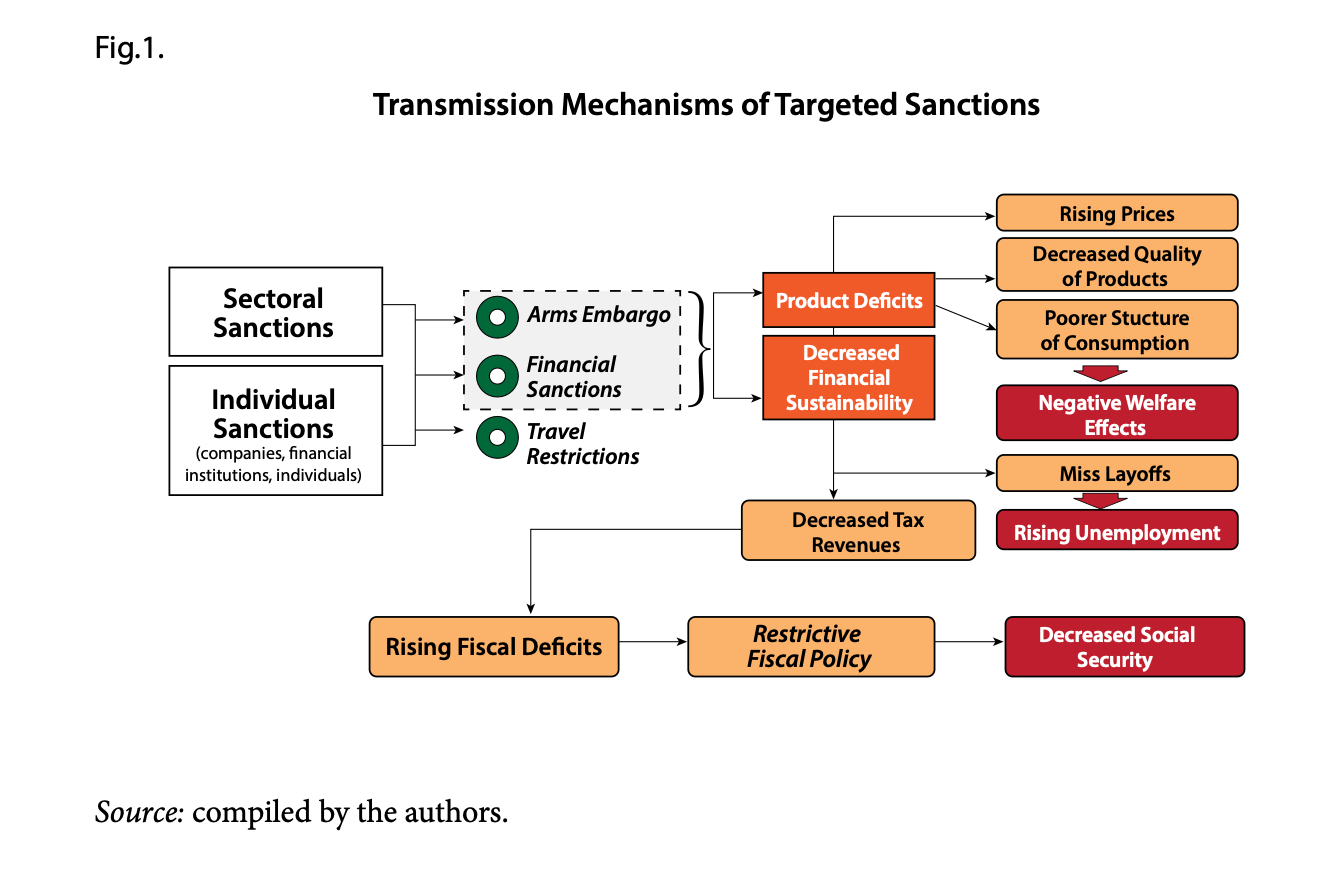
The following flowchart visualizes how these mechanisms translate into concrete economic and social consequences. Think of this as a systems diagram illustrating the chain reaction that sanctions are designed to trigger.
3. A Framework for Assessing Effectiveness
Do sanctions work? The answer is complex. Their success is not guaranteed and depends on a range of factors. To analyze their effectiveness systematically, we can use an analytical framework that considers two critical variables:
- International Cooperation: The degree to which the sanctions are supported and enforced by a broad coalition of countries. High cooperation closes off loopholes and prevents the target from finding alternative partners.
- Domestic Regime Cohesion: The internal unity and stability of the targeted government. A fragmented regime with internal rivalries is more vulnerable to pressure than a highly consolidated, repressive one.
Let's explore this framework, which will be our primary tool for analyzing the case studies.
[PDF] A Comparative Analysis of Sanction Cases Through the Interplay of ...
The master's thesis 'The Effectiveness of Sanctions' provides a powerful analytical matrix for our lesson. The author argues that the interplay of external and internal factors is key to understanding sanctions outcomes.
Please read the following sections: Chapter 2: Theoretical Framework and Methodology (pages 12-16): Focus on the definitions of 'International Cooperation' and 'Domestic Regime Cohesion'. Table 1: Sanctions Outcomes (page 17): Study the 2x2 matrix carefully. This table is the core of our analytical framework. Notice where Iran and Russia are placed and the predicted outcome for each quadrant.
This matrix gives us four possible scenarios. For our lesson, we will focus on the two highlighted in the paper:
- Iran: High International Cooperation + Low Domestic Cohesion → High Likelihood of Success
- Russia: High International Cooperation + High Domestic Cohesion → High Likelihood of Failure
4. Case Studies: Iran and Russia
Now, let's apply this framework to our two case studies to understand why similarly strong sanctions produced vastly different results.
Case Study 1: Iran (Success)
The goal of the sanctions against Iran was to force it to negotiate limitations on its nuclear program.
- International Cooperation (High): The sanctions were backed by multiple UN Security Council resolutions, giving them strong international legitimacy. The coalition included not just the US and EU but also, crucially, received cooperation from Russia and China. Key mechanisms included a global oil embargo and cutting Iranian banks off from SWIFT.
- Domestic Cohesion (Low): As explained in the thesis you just read, Iran's political system, while authoritarian, is fragmented. It features a rivalry between hardliners and more pragmatic reformists. The severe economic pain caused by sanctions exacerbated these internal divisions and fueled public discontent, most famously in the "Green Movement."
The economic impact was severe, as this chart demonstrates.
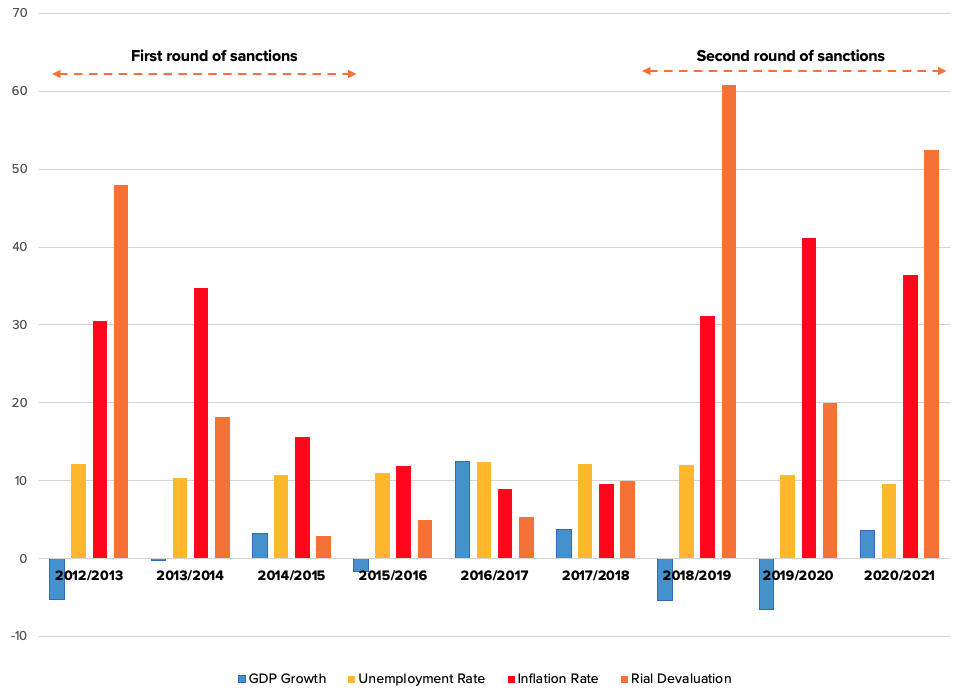
The combination of overwhelming international pressure and internal fragmentation created an environment where the Iranian leadership, under the newly elected moderate President Rouhani, saw negotiation as a preferable alternative to economic collapse. This led to the 2015 Joint Comprehensive Plan of Action (JCPOA), where Iran agreed to curb its nuclear activities in exchange for sanctions relief. This is widely considered a success story for sanctions achieving a specific policy goal.
Case Study 2: Russia (Failure)
The primary goal of the post-2022 sanctions against Russia was to compel it to end its invasion of Ukraine.
- International Cooperation (High): The sanctions were unprecedented in their speed and scope, imposed by a powerful Western-led coalition (US, EU, G7, etc.). They included freezing hundreds of billions of the Russian Central Bank's assets, sanctioning major banks, and imposing wide-ranging technology export controls.
- Domestic Cohesion (High): Unlike Iran, Vladimir Putin's Russia is a highly consolidated, cohesive regime. Power is centralized, the security elite (siloviki) are loyal, and the opposition has been systematically eliminated. The regime used the sanctions to fuel a "rally 'round the flag" narrative, blaming the West for Russia's economic problems while violently repressing any dissent. Sanctioned oligarchs, dependent on Putin for their wealth, had no choice but to remain loyal.
The experts in our main video resource provide an excellent analysis of the Russian case.
How Effective are Economic Sanctions? - The Red Line Podcast
Let's return to The Red Line podcast. These segments focus specifically on the sanctions against Russia and why they failed to change the Kremlin's calculus.
Please watch these three clips: 43:17 - 45:35: Note the scale of the sanctions compared to previous rounds and the initial assessment of their impact. 48:19 - 50:54: This explains how Russia attempted to become more self-reliant but faced immense challenges due to its integration into global supply chains, especially for technology. 58:20 - 59:19: This clearly states the primary goal of the sanctions—to constrict Russia's economic and technological resources for the war.
Despite causing significant economic damage, the sanctions failed to achieve their primary political objective. The highly cohesive Russian regime was able to absorb the pressure, redirect trade to non-Western partners, and maintain its war effort. This case highlights the limitations of sanctions when faced with a resilient and repressive authoritarian state.
Conclusion
In this lesson, we have dissected the mechanics of economic sanctions and developed a framework to assess their effectiveness.
Key Takeaways:
- Sanctions are a tool of economic coercion that work through various mechanisms, including trade restrictions, financial blockades (asset freezes, SWIFT cutoffs), and secondary sanctions.
- The effectiveness of sanctions is not guaranteed. It is highly dependent on the interplay between the level of international cooperation and the target regime's domestic cohesion.
- Iran serves as a case study where high international cooperation successfully exploited domestic political fragmentation to force a policy change (the JCPOA).
- Russia demonstrates the limits of sanctions. Despite facing unprecedented international pressure, its highly cohesive and repressive regime was able to withstand the economic impact and continue its war in Ukraine, leading to a failure to achieve the primary political goal.
Preview of the Next Lesson:
The sanctions on Russia and Iran are deeply connected to their status as major energy producers. We saw how "carve-outs" for energy were a key part of the Russia sanctions debate. This perfectly sets the stage for our next topic. We will analyze another critical aspect of economic statecraft: how control over global energy markets shapes power dynamics. Our next learning outcome is to: Analyze how control over oil markets and the actions of cartels like OPEC shape global power dynamics.