Welcome to the next step in our journey into the foundations of neuroscience. In our previous lesson, we discovered that proteins act as the cell's specialized machinery. We focused on how channel and transporter proteins form gates and passages through the otherwise impermeable cell membrane. This left us with a question: what makes substances move through these gates?
Today, we will explore the fundamental physical principle that answers this question: diffusion. We will define what diffusion is and explain how it is driven by a concentration gradient. Understanding this process is absolutely essential, as it is the primary force that moves the ions responsible for all electrical activity in the nervous system. By the end of this lesson, you will be able to explain how and why substances naturally spread out, setting the stage for understanding how neurons build and use electrical energy.
The Tendency to Spread Out: Diffusion
At its heart, diffusion is a simple and intuitive process. Imagine dropping a bit of food coloring into a glass of water. At first, the color is intense in one spot, but over time, it spreads out until the entire glass of water is faintly and uniformly colored. This spreading out is diffusion.
Diffusion is the net movement of particles from an area of high concentration to an area of low concentration.
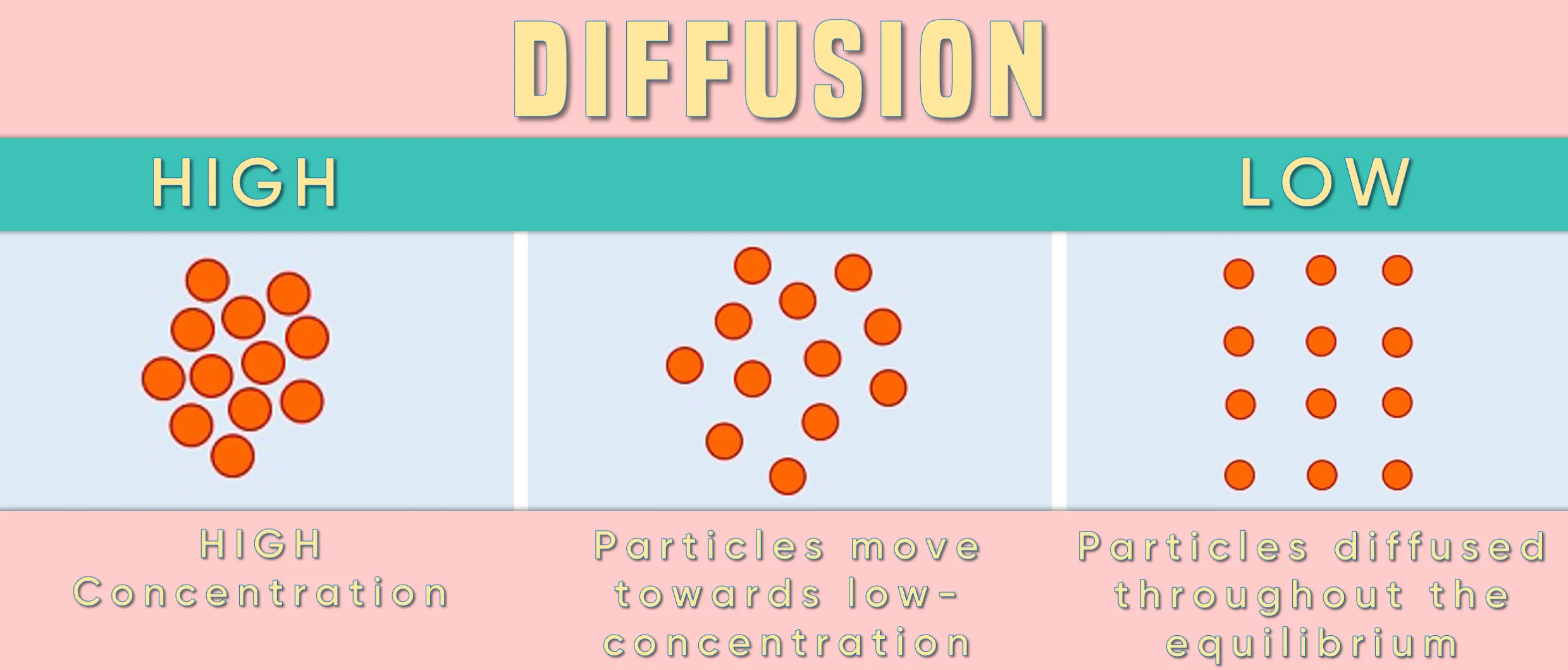
But why does this happen? It’s not because the particles "want" to spread out. It's a direct result of their constant, random motion. Particles in liquids and gases are always moving and bumping into each other. Where there are more particles (high concentration), there are more random movements sending particles away from that area than there are movements sending them back in. The result is a net, or overall, movement from the crowded area to the less crowded area.
The following video provides an excellent visual introduction to this concept using relatable examples.
Watch the beginning of this video from the Amoeba Sisters. It introduces diffusion using the example of treating a fish tank and spraying an air freshener.
Pay close attention to the definition of diffusion as a net movement down a concentration gradient. The video also shows how the molecules spread out from high to low concentration until they are evenly dispersed.
The video mentions an important term: net movement. Individual particles can and do move in all directions, even from low to high concentration. However, the overall trend—the net movement—is always from high to low concentration until the particles are distributed evenly. At that point, a state of equilibrium is reached. The particles are still moving randomly, but there is no longer any net change in their distribution.
The Driving Force: Concentration Gradients
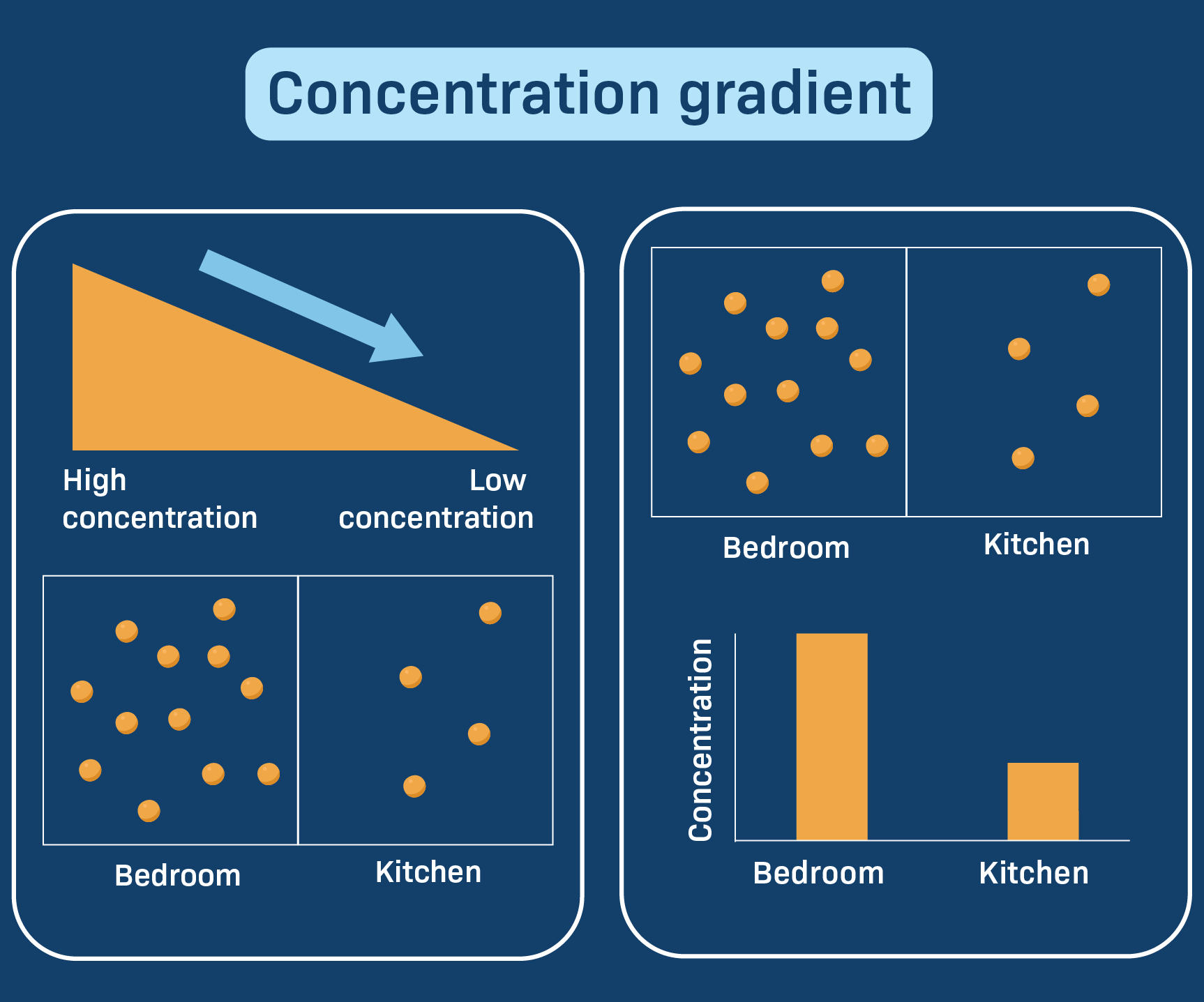
The engine driving diffusion is the concentration gradient. This term simply describes the difference in the concentration of a substance across a space. If one area has a high concentration and another has a low concentration, a gradient exists between them. You can think of it like a slope or a ramp.
Let's solidify this concept with a short reading.
Simplified: What is a Concentration Gradient? | Out-Class
This article from Out-Class provides a straightforward definition and examples of a concentration gradient and its relationship to diffusion.
Please read the sections that define the concept using the food coloring example. Then, focus on the section "Does Diffusion Require a Concentration Gradient?", which explains that particles flow down the gradient. Finally, note how the steepness of the gradient affects the speed of diffusion, as mentioned under the heading "How does the concentration gradient affect diffusion?".
As the reading highlights, the steeper the concentration gradient (i.e., the larger the difference in concentration), the faster the rate of diffusion. It's like rolling a ball down a hill: a steeper hill results in a faster roll.
Diffusion is also a form of passive transport, a concept introduced in the Amoeba Sisters video. This means the cell does not need to expend any metabolic energy (like ATP, which we'll discuss later) to make it happen. The energy that drives the movement is stored within the concentration gradient itself—it's a form of potential energy.
Factors That Affect the Rate of Diffusion
Besides the steepness of the gradient, several other factors influence how quickly diffusion occurs.
Let's return to the Amoeba Sisters video, "Diffusion".
Watch the segment explaining that diffusion is a form of passive transport. Then, continue to the next part, which discusses several factors affecting the rate of diffusion, such as temperature, distance, and the mass of the diffusing substance.
To summarize the key factors from the video and general principles:
- Temperature: Higher temperatures mean particles have more kinetic energy and move faster, increasing the diffusion rate.
- Mass of the substance: Lighter particles move more quickly than heavier ones, so they diffuse faster.
- Solvent properties: Diffusion is slower in a denser medium. For example, diffusion happens much faster in air (a gas) than in water (a liquid).
- Distance: The greater the distance the particles need to travel, the longer it will take. This is why diffusion is very effective over microscopic distances, like across a cell membrane, but slow over macroscopic distances.
Diffusion in the Body: Each to Its Own Gradient
Now, let's bring this back to the neuron. The environment inside a cell is different from the environment outside. There are many different types of particles (ions, mostly) dissolved in the water on both sides of the cell membrane. Crucially, each type of particle moves according to its own concentration gradient, largely independent of the others.
For example, a neuron at rest has a high concentration of potassium ions (K⁺) inside and a high concentration of sodium ions (Na⁺) outside.
- The concentration gradient for K⁺ will drive K⁺ to move out of the cell.
- The concentration gradient for Na⁺ will drive Na⁺ to move in to the cell.
This principle is fundamental to all of neural signaling. The Khan Academy video below illustrates this point perfectly.
Concentration gradients | Membranes and transport | Biology | Khan Academy
This video clearly explains how different substances move according to their own unique concentration gradients.
Watch the entire short video. Notice how the purple particles move from left to right down their gradient, while the yellow particles simultaneously move from right to left down their gradient. The key takeaway, explained at the end, is that there is no magic; it's all based on the random motion and probability for each particle type.
This independent movement is possible because, as we learned in the last lesson, the cell membrane has specific protein channels. There are channels just for sodium, channels just for potassium, and so on. Each ion passes through its designated channel, moving down its personal concentration gradient.
Conclusion
In this lesson, we have explored the physical force that powers much of the molecular traffic in and out of cells. This passive, yet powerful, process is the starting point for understanding all bioelectricity.
Here are the key takeaways:
- Diffusion is the net movement of particles from a region of high concentration to one of low concentration, caused by random molecular motion.
- This movement is driven by a concentration gradient, which is the difference in concentration of a substance across a space.
- Diffusion is a form of passive transport; it does not require the cell to expend energy.
- The rate of diffusion is affected by the steepness of the gradient, temperature, and the size of the particles.
- In a biological system, each type of substance (e.g., Na⁺, K⁺) diffuses down its own unique concentration gradient, independently of others.
We've now seen how particles move "downhill" along their concentration gradients. But what if a cell needs to move something "uphill," against its gradient? This requires energy and a special kind of protein machine. In our next lesson, we will introduce the concept of electrical potential (voltage) and then examine the difference between passive channels and active ion pumps, focusing on the single most important pump in the nervous system: the sodium-potassium pump.